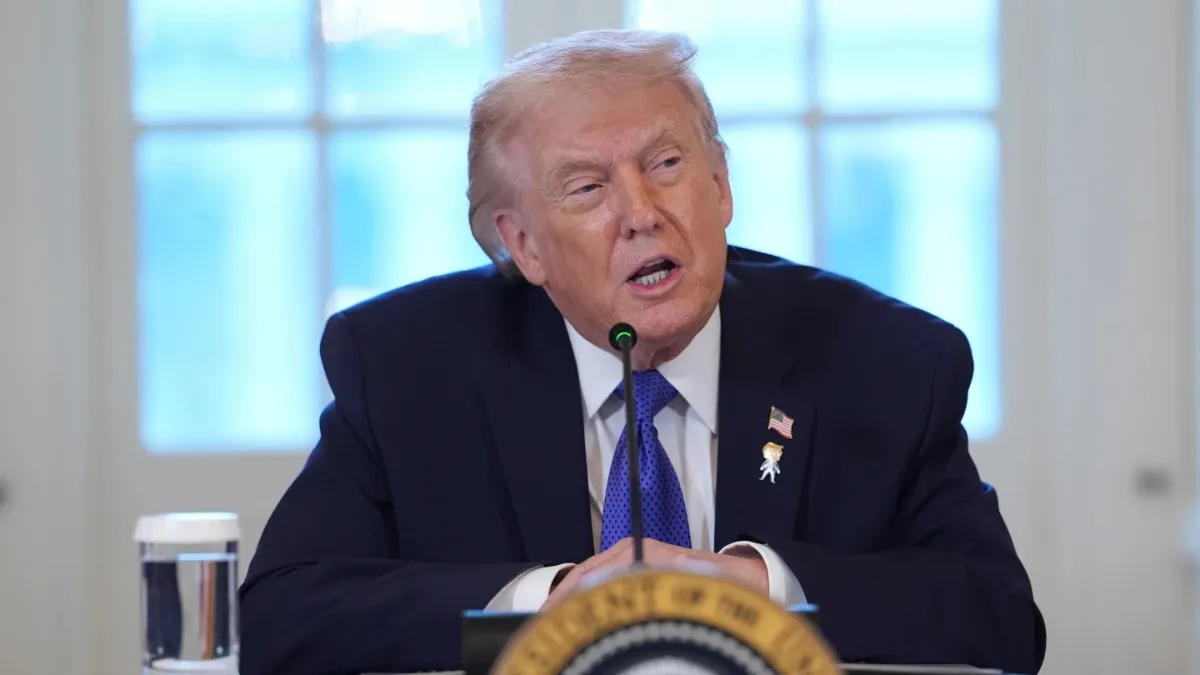
In an extraordinary escalation of his campaign to acquire Greenland, President Donald Trump announced on Friday that the United States will impose significant tariffs on eight European nations beginning February 1, declaring the measures will remain in place until Denmark agrees to sell the semi-autonomous Danish territory.
The policy marks an unprecedented use of trade pressure to pursue territorial expansion, intertwining economic coercion with geopolitical ambition in a manner that has alarmed European capitals and ignited protests on both sides of the Atlantic.
Under the directive, the United States will levy 10 percent tariffs on “any goods” imported from Denmark, Norway, Sweden, France, Germany, the United Kingdom, the Netherlands, and Finland. Trump warned that these duties would surge to 25 percent on June 1 if no agreement on Greenland’s “complete and total purchase” is reached.
The president framed the tariffs as overdue compensation for what he characterized as decades of American largesse. “We have subsidized Denmark and all of the countries of the European Union, and others, for many years by not charging them tariffs or any other forms of remuneration,” Trump wrote on Truth Social, his preferred social media platform. “Now, after centuries, it is time for Denmark to give back. World peace is at stake!”
Trump’s statement leaned heavily on security concerns, portraying Greenland as vulnerable to foreign adversaries and questioning Denmark’s military capabilities. He claimed that China and Russia pose imminent threats to the Arctic island, which sits strategically between North America and Europe and hosts a critical U.S. military installation at Thule Air Base.
In characteristic hyperbole, Trump mocked Denmark’s defense posture: “They currently have two dog sleds as protection, one added recently.” He insisted that “Only the United States of America, under PRESIDENT DONALD J. TRUMP, can play in this game, and very successfully, at that.”
The remarks echo Trump’s longstanding fixation on Greenland, which first surfaced publicly during his previous presidency when reports emerged in 2019 that he had inquired about purchasing the island. Danish officials flatly rejected the notion then, with Prime Minister Mette Frederiksen calling the idea “absurd.”
The tariff announcement has sent shockwaves through European diplomatic circles, where officials are scrambling to formulate a coordinated response. Denmark, home to approximately 5.9 million people with deep economic ties to the United States, faces particular pressure as the primary target of Trump’s demands.
Protests have erupted in Copenhagen and in Nuuk, Greenland’s capital, where citizens have made clear their opposition to any discussion of sovereignty transfer. Greenland, an autonomous territory within the Kingdom of Denmark with its own parliament and significant self-governance, has a population of roughly 57,000, predominantly Indigenous Greenlandic Inuit.
The broader European Union, which counts several of the targeted nations among its members, now confronts a delicate challenge: how to respond to what many view as economic blackmail without escalating tensions with Washington or triggering a broader trade war.
Trump’s focus on Greenland reflects genuine strategic concerns shared across the American national security establishment. The island’s geographic position, vast mineral resources—including rare earth elements crucial for modern technology—and melting ice caps that are opening new shipping routes have made the Arctic an arena of intensifying great power competition.
Russia has been expanding its military presence in its Arctic territories, while China has declared itself a “near-Arctic state” and invested heavily in regional infrastructure and research. American military planners view Greenland as essential to monitoring transatlantic air and sea routes and maintaining early warning systems for missile defense.
However, Trump’s transactional approach—attempting to purchase territory through tariff pressure—represents a sharp departure from traditional diplomatic norms and post-World War II international conventions regarding territorial sovereignty.
The tariffs threaten billions of dollars in trans-Atlantic trade. The eight targeted nations collectively represent major U.S. trading partners, exporting everything from pharmaceuticals and machinery to automobiles and luxury goods to American consumers and businesses.
Economic analysts warn that the levies could disrupt supply chains, increase costs for American consumers, and invite retaliatory measures that would harm U.S. exporters—particularly in agriculture and manufacturing sectors already vulnerable to global trade tensions.
European officials have yet to announce specific countermeasures, but several governments have indicated they will not negotiate under duress and view any discussion of Greenland’s status as a non-starter.
With the February 1 implementation date looming, diplomatic channels are expected to intensify in the coming days. However, Danish and Greenlandic leaders have shown no indication they will entertain Trump’s proposal, setting the stage for a protracted standoff.
The situation represents an early test of Trump’s second-term foreign policy approach and European unity in the face of American pressure. Whether the president will follow through on his tariff threats—or whether this represents an opening negotiating position in some broader trade discussion—remains unclear.
What is certain is that Trump’s gambit has injected unprecedented volatility into transatlantic relations and raised fundamental questions about sovereignty, security, and the limits of economic coercion in the 21st century.
As one European diplomat, speaking on condition of anonymity, put it succinctly: “You cannot buy a people. This is not the 19th century.”
WHAT YOU SHOULD KNOW
President Trump has weaponized trade policy in an unprecedented bid to acquire Greenland, threatening eight European nations with escalating tariffs—starting at 10 percent in February and rising to 25 percent by June—unless Denmark agrees to sell the semi-autonomous territory. This marks a dramatic departure from diplomatic norms, attempting to purchase sovereign territory through economic coercion rather than negotiation.
Economically, it threatens billions in transatlantic trade and risks retaliatory measures; geopolitically, it exploits legitimate Arctic security concerns but through unconventional means; and diplomatically, it has united European opposition while igniting protests in Denmark and Greenland, where citizens emphatically reject any discussion of sale.
The fundamental issue is whether 21st-century territorial ambitions can be achieved through tariff pressure—a question that will define U.S.-European relations and set precedents for how great powers pursue strategic interests in the modern era. Denmark and Greenland have made their position clear: sovereignty is not for sale.