The head of Nigeria’s state oil corporation has moved to reassure consumers that the dramatic price fluctuations currently roiling the nation’s petroleum sector represent growing pains in a historic transition that will ultimately work in their favor.
Bayo Ojulari, Group Chief Executive Officer of the Nigerian National Petroleum Company Limited, struck an optimistic tone Sunday following a briefing with President Bola Tinubu, describing the current market turbulence as an inevitable but temporary phase as Africa’s largest oil producer shifts from decades of import dependency to domestic refining capacity.
“Where there is healthy competition, the buyers are the ultimate beneficiaries,” Ojulari told reporters in Lagos, adding that while tensions were expected during this “major transition,” market forces would eventually stabilize to consumers’ advantage.
His comments come as Nigerian motorists have witnessed a remarkable reversal of fortune at the pumps. After enduring petrol prices exceeding N1,200 per liter just last month, some retail outlets now sell the product for as low as N739 per liter—a dramatic correction driven by an unprecedented price war among major players in the newly liberalized market.
A Market Transformed
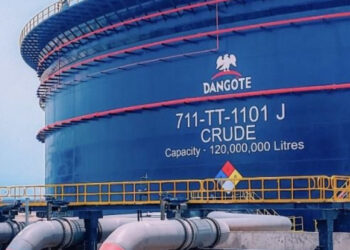
The seismic shift in Nigeria’s downstream petroleum landscape can be traced directly to September 2024, when Dangote Refinery—the continent’s largest single-train facility with a massive 650,000 barrels-per-day capacity—began producing petrol domestically. That milestone shattered NNPCL’s long-held monopoly on petroleum imports and distribution, introducing genuine competition into a market that had functioned for decades under heavy government subsidies and state control.
The impact has been swift and severe. National Bureau of Statistics data shows the average retail price of Premium Motor Spirit declined by N153 per liter between November 2024 and November 2025, dropping from N1,214.17 to N1,061.35. But those figures only hint at the intensity of the battle that erupted in December.
That month, Dangote Refinery fired what industry observers describe as the opening salvo in a full-scale price war, slashing its ex-depot price from N970 to N699 per litre. The move forced competitors into an uncomfortable choice: match the aggressive pricing or watch their market share evaporate.
MRS filling stations, serving as Dangote’s retail partner, quickly rolled out nationwide pricing at N739 per liter. NNPC retail outlets responded by cutting their own prices from N875 to between N825 and N840 per liter, depending on location. Independent marketers, squeezed between industry giants, have offered rates as low as N865 per liter just to remain competitive.
According to the industry tracking platform Petroleumprice.ng, Dangote Refinery adjusted its prices more than 20 times throughout 2025 alone—a frenetic pace that underscores the volatility gripping the sector.
Casualties of Competition
While consumers celebrate lower prices at the pump, the rapid devaluation has created devastating consequences for petroleum marketers who purchased inventory at higher rates and now face the prospect of selling at a loss or losing customers entirely.
“Price competition now determines customer loyalty,” confirmed Chinedu Ukadike, spokesperson for the Marketers Association of Nigeria. “Any marketer unwilling to adjust prices risks losing patronage and facing mounting bank interest costs.”
The comment highlights a harsh reality: in this new environment, business survival depends on the ability to absorb losses in the short term while hoping for market stabilization down the road.
A Fundamental Restructuring
Ojulari was careful to emphasize that NNPCL’s role has fundamentally changed under the Petroleum Industry Act, which became operational in 2022. The landmark legislation stripped the state oil company of its regulatory powers and repositioned it as a purely commercial entity required to compete profitably without government safety nets.
“The first thing you have to know is that the PIA did something fundamental,” Ojulari explained. “Before the PIA in 2021, which rolled in 2022, everything was under NNPC, including some regulations. The PIA divided the roles of regulation from what I will call the business.”
He noted that regulatory oversight now falls to the Nigerian Midstream and Downstream Petroleum Regulatory Authority for downstream and midstream operations, while the Nigerian Upstream Petroleum Regulatory Commission handles upstream regulation.
“Nigerians must understand that post-PIA, we as NNPC are not regulators,” Ojulari stressed. The company no longer receives federation allocations and must raise financing independently, “like any other business.”
Still, NNPCL maintains what Ojulari described as a “supplier of last resort” function, working closely with all major downstream players—including Dangote Refinery, in which the state company holds an equity stake—to ensure product availability across the country.
Historical Context
The current market dynamics represent a dramatic departure from the status quo that defined Nigeria’s petroleum sector for generations. Despite being Africa’s largest oil producer, Nigeria relied almost entirely on imported refined products, with NNPC functioning as the dominant importer and distributor under a heavily subsidized regime that cost the government billions of naira annually.
When President Tinubu removed fuel subsidies in May 2023—a move long advocated by international financial institutions and economists—pump prices skyrocketed from approximately N195 per liter to over N1,030 per liter by October 2024. The sudden increase compounded economic hardships for ordinary Nigerians already grappling with inflation rates exceeding 30 percent.
The federal government attempted to provide relief by restarting the long-dormant Port Harcourt refinery in November 2024, but imports remained essential until Dangote’s production capacity ramped up significantly in late 2024 and early 2025.
Production Gains
Beyond the downstream turbulence, Ojulari shared encouraging news about NNPCL’s upstream performance. He revealed that oil production has climbed from 1.5 million barrels per day in 2024 to over 1.7 million barrels per day currently, with the company targeting at least 1.8 million barrels per day in 2026.
These gains move Nigeria closer to President Tinubu’s stated goal of reaching 2 million barrels per day by 2027 and attracting over $30 billion in additional investment by 2030.
Gas production has also seen significant improvement, increasing from 6.5 billion standard cubic feet to over 7 billion standard cubic feet daily—critical for domestic power generation and industrial development.
Infrastructure Milestone
In a development with potentially transformative implications for northern Nigeria, Ojulari announced that NNPCL has completed welding of the main line of the Ajaokuta-Kaduna-Kano gas pipeline, including the technically challenging River Niger crossing that had stymied previous efforts.
“You remember sometimes in summer, we were able to cross the River Niger, which has been a struggle for many years,” Ojulari said. “By completing this main line, what that means now is that we can begin to connect and make all the connections to the main line, which we will do in the earlier parts of next year.”
The 614-kilometer AKK pipeline is designed to deliver gas to northern Nigeria for industrialization, fertilizer production, and power generation when it becomes operational in early 2026.
The Road Ahead
Ojulari acknowledged that the simultaneous operation of major refineries like Dangote’s facility and NNPC’s rehabilitated plants has disrupted market equilibrium in ways that will take time to resolve.
“To be honest with you, by the time you have a refinery like Dangote in-country, which has not been there before, with the NNPC refinery now under a major relook, such a huge refinery in the country, you can expect the market will be impacted right now,” he said. “All we need to do together is to walk through that reality.”
He framed the challenge ahead as finding the balance that allows market forces to stabilize while ensuring all players remain viable: “The question now is, how do we then ensure that the market forces stabilize so that everyone can be okay?”
For now, the NNPCL chief said his company would defer to the regulatory authority to manage competitive dynamics, acknowledging that “competitiveness is not easy, and I think in these early stages, we are seeing a lot of tension with a willing buyer and a willing market.”
As Nigerians navigate this period of unprecedented change in their petroleum sector, the hope is that short-term disruption will give way to a more efficient, competitive market that delivers lower prices and more reliable supply—the promised benefits of economic liberalization that have long remained elusive in Africa’s most populous nation.
WHAT YOU SHOULD KNOW
Nigeria’s fuel prices have crashed from over N1,200 to as low as N739 per liter due to fierce competition between Dangote Refinery, NNPCL, and independent marketers—marking a historic shift from total import dependence to domestic refining. While the price war is causing short-term market disruption and losses for some petroleum marketers, NNPCL’s chief assures consumers that they are the ultimate winners of this competition.
The transition, driven by the deregulation under the Petroleum Industry Act and Dangote Refinery’s entry in September 2024, represents a fundamental restructuring of Nigeria’s petroleum sector that promises long-term benefits despite current growing pains.