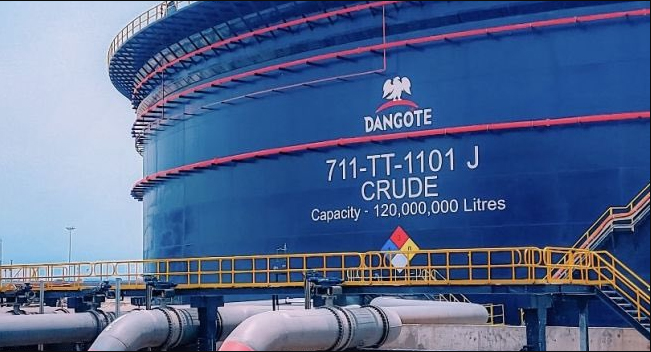
In an ambitious expansion that could reshape global refining dynamics, the Dangote Refinery has announced plans to more than double its production capacity to 1.4 million barrels per day, positioning the Nigerian facility to overtake India’s Jamnagar Refinery as the world’s largest oil refining complex.
The announcement, made by Aliko Dangote, President of the Dangote Group, at a press conference in Lagos on Sunday, marks a significant vote of confidence in Nigeria’s energy sector and broader economic trajectory at a time when the country continues to grapple with fuel supply challenges and foreign exchange pressures.
A Giant Among Giants
The proposed expansion would see the refinery’s capacity surge from its current 650,000 barrels per day—already substantial by global standards—to 1.4 million bpd. To put this in perspective, the facility would process roughly 115% more crude than it does currently, eclipsing the Jamnagar Refinery complex in Gujarat, India, which has long held the distinction as the world’s largest refining operation.
“This expansion is about confidence in Nigeria, in Africa, and in our capacity to shape our own energy future,” Dangote declared, framing the project not merely as a business venture but as a statement of African industrial ambition.
The billionaire industrialist was effusive in his praise for the Federal Government’s support, specifically highlighting three policy initiatives he credited with creating a more favorable investment climate: the Nigeria First Policy, which prioritizes domestic supply; the Naira-for-Crude Policy, aimed at reducing foreign exchange pressure; and the One-Stop Shop Initiative, designed to streamline regulatory processes.
Economic Ripple Effects
Beyond the headline-grabbing production figures, the expansion carries significant implications for Nigeria’s employment landscape and industrial ecosystem. Dangote revealed that the construction phase alone would generate approximately 65,000 jobs—a substantial injection into Nigeria’s labor market, where unemployment and underemployment remain persistent challenges.
The facility’s enhanced petrochemical capabilities are equally noteworthy. Polypropylene production, crucial for plastics manufacturing, would nearly triple from 900,000 metric tons to 2.4 million metric tons annually. The refinery will also produce base oils for lubricants and linear alkylbenzene, a critical component in detergent manufacturing—suggesting potential downstream benefits for Nigeria’s consumer goods sector.
Overcoming Obstacles
Dangote’s remarks also touched on recent operational challenges, including what he characterized as “union activities and sabotage attempts” that had disrupted refinery operations. He commended government intervention in resolving these issues, describing the authorities’ response as “decisive and confidence-restoring”—language that suggests the disruptions were more than minor inconveniences.
The reference to sabotage, though not elaborated upon, raises questions about security at the strategically important facility and the nature of opposition the project may have encountered from various quarters.
Addressing Immediate Concerns
With Nigeria’s perennial fuel scarcity issues historically reaching their peak during the December holiday season, Dangote sought to reassure consumers that this year would be different. Despite what he acknowledged as “recent fluctuations in global oil prices,” he pledged an uninterrupted petrol supply and stable pricing throughout the festive period.
“For the first time in many years, Nigerians can look forward to a festive season free of fuel anxiety,” he stated—a promise that, if fulfilled, would mark a departure from the queues and price spikes that have become an unwelcome December tradition for many Nigerians.
Looking Ahead
The expansion plan, while bold, raises several questions that remain unanswered: What is the timeline for completion? What will be the total investment required? And perhaps most critically for Nigeria’s energy independence ambitions—how will the facility secure sufficient crude oil feedstock to operate at such a massive scale?
The success of this expansion could have far-reaching implications not just for Nigeria, but for Africa’s position in global energy markets. If realized, it would represent a significant shift from a continent long characterized primarily as a crude exporter toward one with substantial refining capacity—potentially altering regional fuel trade patterns and reducing dependence on imported refined products.
For now, the announcement stands as a testament to the scale of private sector investment Nigeria can still attract and a bet by one of Africa’s wealthiest individuals that the country’s economic fundamentals remain sound enough to justify a project of this magnitude.
WHAT YOU SHOULD KNOW
The Dangote Refinery’s expansion to 1.4 million barrels per day would make it the world’s largest refinery, representing a watershed moment for African industrialization.
Beyond the production milestone, the project’s real significance lies in its potential to end Nigeria’s paradox of being a major oil producer that imports refined fuel—a chronic problem that has plagued the nation for decades.
With 65,000 jobs during construction, expanded petrochemical production, and promises of a stable fuel supply, this expansion could fundamentally reshape Nigeria’s energy independence and economic trajectory.