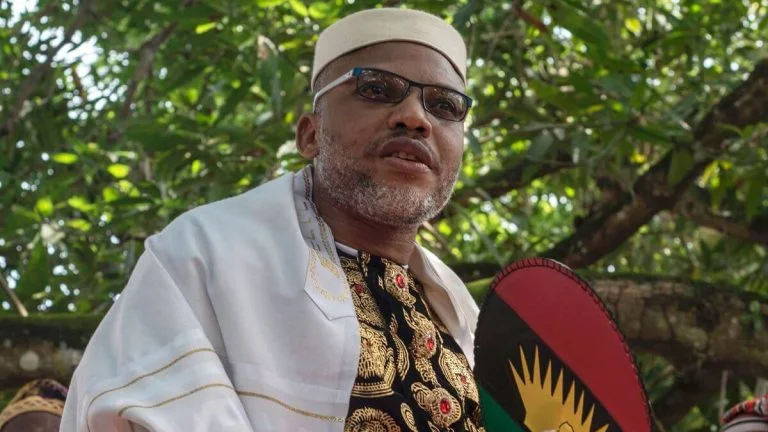
In a surprising development, the detained leader of the proscribed Indigenous Peoples of Biafra (IPOB), Nnamdi Kanu, has decided to personally take up his defence in his ongoing trial.
This decision, announced on Tuesday, came just hours after Omoyele Sowore, the 2023 presidential candidate of the African Action Congress (AAC), led demonstrations across parts of Abuja demanding Kanu’s release.
Kanu’s move follows his earlier filing of a preliminary objection challenging the jurisdiction of the court to continue hearing his case. The objection was submitted on the same day a medical panel, constituted by the court to assess his health, reported that he was medically fit to stand trial.
In a new motion he personally submitted on October 21, 2025, Kanu told the court he was ready to begin his defence “pursuant to the order of this honourable court made on the 16th day of October 2015, directing the defendant to commence his defence on the 24th day of October 2025.”
Appearing before Justice James Omotosho, Kanu revealed plans to call a total of 23 witnesses, divided into two categories. The first set, he said, would be “ordinary but material witnesses,” while the second would consist of “vital and compellable” witnesses who would be “summoned under Section 232 of the Evidence Act, 2011.”
In the document he signed personally, which hinted at the possible dismissal of his legal team led by Chief Kanu Agabi, SAN, Kanu asked the court to grant him a 90-day period to conclude his defence due to the number of witnesses he intends to call.
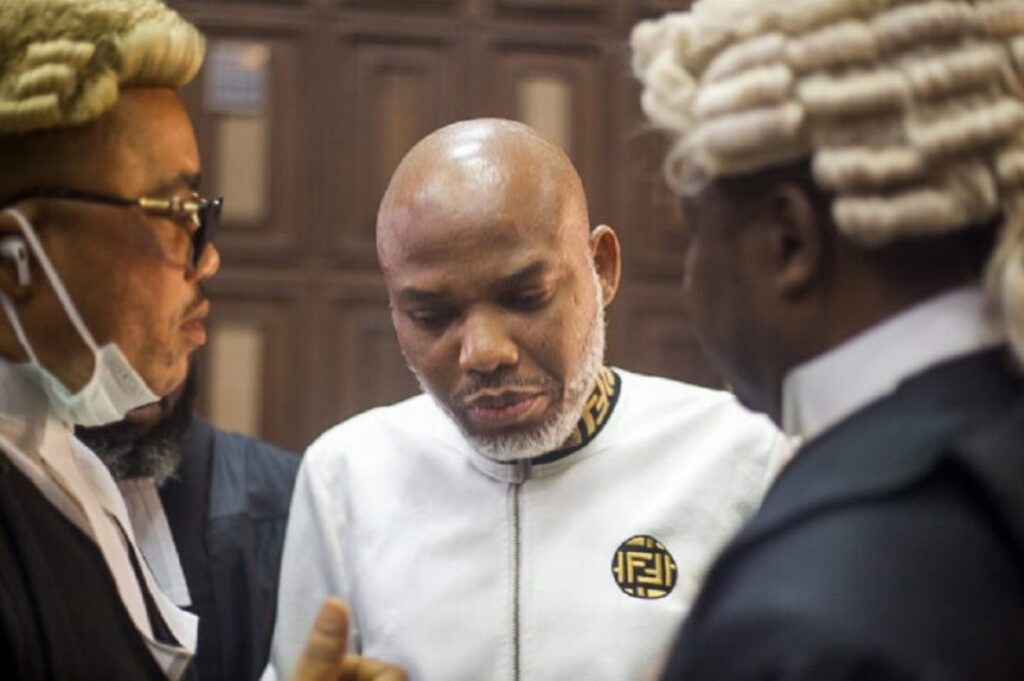
He told the court that he planned to “testify on his own behalf, providing a sworn account of the facts, denying the allegations, and explaining the political context of his statements and actions.”
Among his list of “compellable witnesses” are prominent figures, including former Minister of Defence, Gen. Theophilus Danjuma (rtd), former Chief of Army Staff, Gen. Tukur Buratai (rtd), Lagos State Governor, Babajide Sanwo-Olu, and Imo State Governor, Hope Uzodinma.
Others include the Minister of the Federal Capital Territory, Nyesom Wike, Minister of Works, Dave Umahi, former Abia State Governor, Okezie Ikpeazu, and the immediate past Minister of Justice, Abubakar Malami, SAN. Also listed were the former Director General of the National Intelligence Agency (NIA), Ahmed Rufai Abubakar, and the Director General of the State Security Service (SSS), Yusuf Magaji Bichi, alongside several unnamed witnesses.
Kanu pledged to “provide the sworn statements of all voluntary witnesses to this honourable court, and to notify the prosecution within a reasonable time.” He assured that “no precious time of the honourable court would be delayed,” and that “it would interest the honourable court and the general public that justice is not only done but manifestly seen to have been done.”
Meanwhile, on the same day Kanu made his submission, a magistrate court in Abuja ordered the remand of his special counsel, Aloy Ejimakor, and 12 others who participated in protests calling for Kanu’s release.
The 13 defendants were charged with offences including criminal conspiracy, disobedience of lawful orders, inciting disturbance, and causing a public breach of peace—violating sections 152, 114, and 113 of the Penal Code.
Those charged include Ejimakor, Kanu’s brother Emmanuel, Joshua Emmanuel, Wilson Anyalewechi, Okere Kingdom Nnamdi, Clinton Chimeneze, Gabriel Joshua, Isiaka Husseini, Onyekachi Ferdinand, Amadi Prince, Edison Ojisom, Godwill Obioma, and Chima Onuchukwu.
After hearing the case, the magistrate ordered their remand at the Kuje Correctional Centre and adjourned the matter to October 24 for arraignment.
What you should know
Nnamdi Kanu, the self-proclaimed leader of the Indigenous Peoples of Biafra (IPOB), has been in detention since his controversial extradition to Nigeria in 2021.
He faces charges bordering on treasonable felony and incitement. His decision to personally conduct his defence marks a major shift in his legal strategy, signaling a more confrontational approach to the proceedings.
The inclusion of high-profile political and military figures among his proposed witnesses has drawn public attention and could shape the trajectory of the case. Meanwhile, the arrest of his supporters highlights the ongoing tension surrounding his detention and the broader Biafra movement.