In a development that signals Africa’s determination to chart its own course toward financial stability and integration, Nigeria and Angola have formalized a comprehensive partnership designed to strengthen central banking operations and deepen economic ties between two of the continent’s most influential economies.
The Central Bank of Nigeria (CBN) and the Bank of Angola sealed a Memorandum of Understanding on Thursday in the U.S. capital, leveraging the high-profile gathering of the IMF/World Bank Annual Meetings to announce what officials are calling a watershed moment in intra-African financial cooperation.
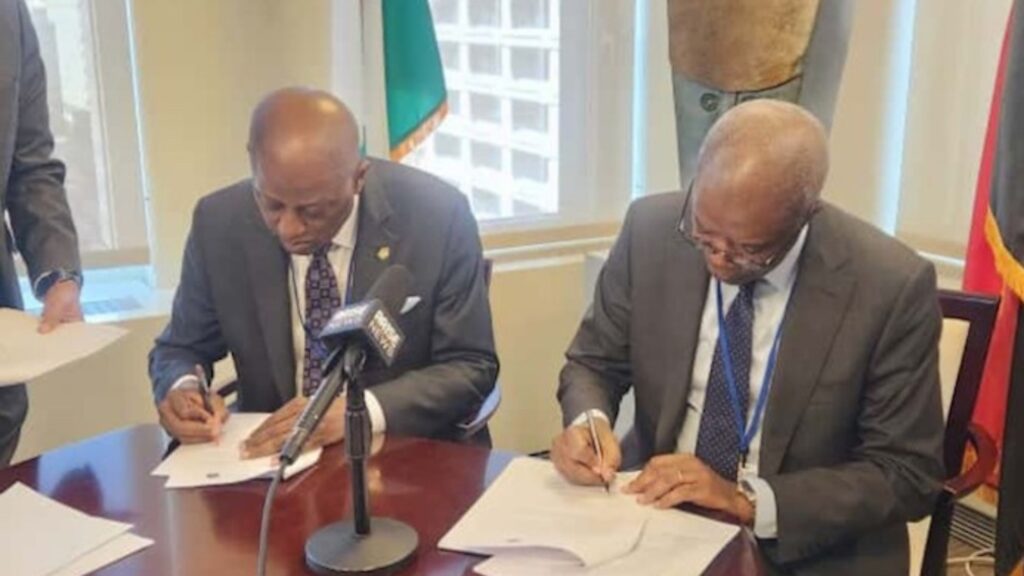
The ceremony, presided over by CBN Governor Yemi Cardoso and his Angolan counterpart, Manuel Antonio Tiago Diaz, brought together two central banks that collectively oversee economies representing significant oil wealth, large populations, and strategic importance in their respective regions of West and Southern Africa.
A Strategic Timing
Governor Cardoso was emphatic about the symbolic and practical significance of the venue and timing. “What we have done today reflects the very spirit of the annual and spring meetings of the World Bank Group,” he told those assembled at the signing ceremony. His remarks underscored a broader theme increasingly articulated by African policymakers: that the continent’s financial institutions must collaborate more closely to address shared vulnerabilities and reduce dependence on external frameworks.
The choice to formalize the agreement on the sidelines of the IMF/World Bank meetings appears calculated to send a message that African nations are actively building South-South partnerships even as they engage with traditional multilateral institutions. Cardoso noted that such global forums provide invaluable platforms for forging the kind of lasting institutional relationships that can translate into tangible economic benefits back home.
“Greater cooperation among African central banks will help address shared challenges and strengthen regional financial stability,” the governor emphasized, pointing to issues ranging from exchange rate volatility to cross-border payment system inefficiencies that have long hampered intra-African trade and investment.
The Technical Architecture
Mohammed Abdullai, the CBN’s Deputy Governor for Economic Policy, provided a detailed breakdown of what the MoU will entail in practice. Far from being merely ceremonial, the agreement establishes a bilateral forum designed to facilitate reciprocal technical exchanges and create mechanisms for cross-border supervision of financial institutions operating in both jurisdictions.
The scope of cooperation is expansive. According to Abdullai, priority areas include exchange control mechanisms, financial market development, foreign reserve management, currency management, and joint research and economic monitoring. Additionally, the framework encompasses payment systems management—an increasingly critical area as digital transactions proliferate—as well as financial sector development, banking supervision and regulation, and market conduct oversight.
Perhaps most significantly, the agreement places considerable emphasis on human capital development. Staff training programs and experience-sharing initiatives will form the backbone of the collaboration, with both institutions committing to fostering institutional capacity and promoting best practices. This focus on knowledge transfer suggests that both central banks recognize that sustainable cooperation requires not just formal agreements but also the cultivation of technical expertise and professional networks.
Cross-Border Supervision in Focus
One of the more intriguing elements of the partnership involves enhanced cross-border supervision of authorized financial institutions. As African banks increasingly expand beyond their home markets—a trend accelerated by pan-African banking groups and regional integration initiatives—the need for coordinated regulatory oversight has become more pressing.
The CBN-Bank of Angola framework appears designed to address potential regulatory gaps and ensure that financial institutions operating across both jurisdictions maintain consistent standards. This is particularly relevant given ongoing efforts across the continent to harmonize banking regulations and prevent regulatory arbitrage.
The Broader Context
The Nigeria-Angola partnership arrives at a pivotal moment for African economic cooperation. Regional integration efforts, while often frustratingly slow, have gained momentum in recent years through initiatives like the African Continental Free Trade Area. However, financial integration has lagged behind trade ambitions, with payment system fragmentation and regulatory inconsistencies continuing to impede cross-border commerce.
Both Nigeria and Angola bring substantial assets to the partnership. Nigeria, Africa’s most populous nation with over 200 million people, possesses the continent’s largest economy and most sophisticated financial sector, anchored by a dynamic banking industry that has weathered significant macroeconomic turbulence in recent years. Angola, a major oil producer still recovering from the commodity price collapse of the mid-2010s and working to diversify its economy, has undertaken significant economic reforms and seeks to modernize its financial architecture.
The timing is also notable given both countries’ recent economic trajectories. Nigeria has grappled with foreign exchange challenges, inflation pressures, and the need to rebuild external reserves following years of currency management difficulties. Angola, meanwhile, has been implementing an IMF-supported reform program aimed at stabilizing its economy and attracting foreign investment.
Looking Ahead
As Deputy Governor Abdullai noted, the MoU represents a “critical milestone” rather than a destination. The true test will lie in implementation—whether the technical exchanges materialize, whether the bilateral forum meets regularly and productively, and whether the collaboration yields measurable improvements in financial stability and cross-border economic activity.
Yet the symbolism matters too. At a time when African nations face pressure to demonstrate the viability of regional solutions to continental challenges, the Nigeria-Angola partnership offers a template for how peer-to-peer cooperation among major economies can complement broader multilateral frameworks.
The agreement underscores what Cardoso called “the growing recognition of intra-African financial cooperation as a foundation for sustainable economic growth and resilience.” Whether this recognition translates into the kind of deeper, more transparent, and more integrated banking systems both central banks envision will depend on sustained political will and technical follow-through in the months and years ahead.
For now, officials from both nations are framing the MoU as evidence that Africa’s financial future need not be dictated solely from Geneva, Basel, or Washington—but can increasingly be shaped by Africans themselves, working together to build more robust and interconnected financial systems across the continent.
WHAT YOU SHOULD KNOW
Nigeria and Angola have signed a landmark banking agreement that represents a significant shift toward African-led financial solutions. The key takeaway: Africa’s two major economies are moving beyond rhetoric to establish practical mechanisms for cooperation—including joint supervision of banks, shared management of foreign reserves, and technical knowledge exchange—that could serve as a blueprint for continental financial integration.
This isn’t just another MoU gathering dust; it’s a deliberate attempt by African central banks to build their own capacity, reduce external dependence, and create the regulatory infrastructure needed for meaningful cross-border commerce.
If successfully implemented, this partnership could demonstrate that African nations can solve African problems through African collaboration—a message as important as the technical cooperation itself.