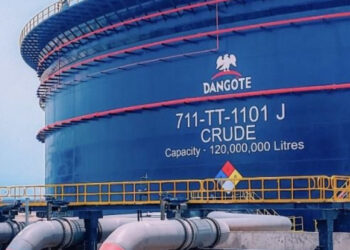
In a development the Federal Government has hailed as transformative for the nation’s petroleum sector, Nigeria has commissioned the Otakikpo Oil Export Terminal, a $400 million state-of-the-art facility positioned to significantly enhance the country’s crude oil evacuation capacity and unlock billions of barrels in previously stranded reserves.
The terminal, situated in Ikuru Town within the Andoni Local Government Area of Rivers State, represents a historic achievement as the first onshore oil export facility constructed in Nigeria in half a century. With a throughput capacity of 365,000 barrels per day, the installation signals a major leap forward in addressing long-standing infrastructure bottlenecks that have constrained the nation’s oil production potential.
Presidential Endorsement and Strategic Vision
Speaking at the commissioning ceremony, President Bola Tinubu — represented by Senator Heineken Lokpobiri, Minister of State for Petroleum Resources (Oil) — characterized the project as a critical milestone in the administration’s broader strategy to revitalize Nigeria’s oil and gas sector.
“This project aligns with our administration’s core priorities to ramp up oil production, expand export infrastructure, and promote indigenous investment under the PIA and Presidential Directives 40 and 41,” President Tinubu stated. He emphasized that the facility would serve as a crucial evacuation corridor for crude oil from Ogoniland and surrounding fields, areas that have long faced production and transportation challenges.
The President further noted that the terminal is expected to “unlock billions of barrels of reserves and create value for the economy,” underscoring the facility’s potential to substantially boost national revenue and energy security.
Indigenous Achievement and Technical Specifications
In what industry observers are celebrating as a landmark for Nigerian technical capacity, Professor Anthony Adegbulugbe, Chairman and CEO of Green Energy International Limited (GEIL), the company behind the project, revealed that the terminal was entirely conceived, designed, and constructed by Nigerian professionals.
Remarkably, the facility was delivered within a two-year timeframe, ahead of its original schedule — a rarity in Nigeria’s infrastructure development landscape, often plagued by delays and cost overruns.
Professor Adegbulugbe outlined the terminal’s impressive technical capabilities: an initial storage capacity of 750,000 barrels with expansion potential to three million barrels, and a pumping capacity of 360,000 barrels per day. The facility has already demonstrated its operational viability, having exported over one million barrels of crude oil since commencing operations in June 2025.
Unlocking Stranded Assets
Perhaps most significantly, the terminal is poised to address one of Nigeria’s most persistent challenges in the oil sector: stranded assets. According to Professor Adegbulugbe, the Otakikpo facility has the potential to unlock more than 40 oil fields in the Niger Delta region that have remained undeveloped due to a lack of evacuation infrastructure.
These fields collectively hold an estimated three billion barrels of reserves and could contribute an additional 200,000 barrels per day to Nigeria’s national output — a substantial increase that would bring the country closer to its production targets and OPEC quota.
Regulatory Perspective and Sector Impact
Engr. Gbenga Komolafe, Chief Executive of the Nigerian Upstream Petroleum Regulatory Commission (NUPRC), described the commissioning as a breakthrough moment for indigenous players in Nigeria’s oil industry, which has historically been dominated by international oil companies.
Komolafe highlighted several strategic advantages the terminal offers: it provides an alternative export hub that reduces the sector’s dependence on aging and often congested terminals, lowers operational costs for local producers, and substantially improves Nigeria’s overall crude evacuation efficiency.
The facility’s location in the Andoni Local Government Area also holds promise for economic development in the host community, with potential spinoff benefits including job creation, improved infrastructure, and enhanced revenue generation for the state and local governments.
Broader Implications
The commissioning of the Otakikpo terminal comes at a critical juncture for Nigeria’s oil sector, which has struggled with production challenges, aging infrastructure, theft, and vandalism. The facility represents a tangible implementation of the Petroleum Industry Act (PIA) objectives and the Tinubu administration’s directives aimed at increasing domestic participation and production capacity.
As Nigeria seeks to maximize revenue from its petroleum resources amid global energy transition pressures, projects like the Otakikpo terminal demonstrate the government’s commitment to infrastructure modernization and could serve as a template for future indigenous-led energy projects.
With operations already underway and expansion plans in place, the $400 million facility stands as both a testament to Nigerian engineering capability and a beacon of hope for an oil sector seeking renewed vigor and competitiveness on the global stage.
WHAT YOU SHOULD KNOW
Nigeria has commissioned its first onshore oil export terminal in 50 years — a $400 million facility built entirely by Nigerians in just two years. The Otakikpo terminal can process 365,000 barrels daily and has already exported over one million barrels since June 2025.
Most critically, this facility could unlock 40 stranded oil fields containing three billion barrels of reserves, potentially adding 200,000 barrels per day to national production. It provides Nigeria with a modern alternative to aging terminals, reduces export costs, and proves local capacity to deliver world-class energy infrastructure.