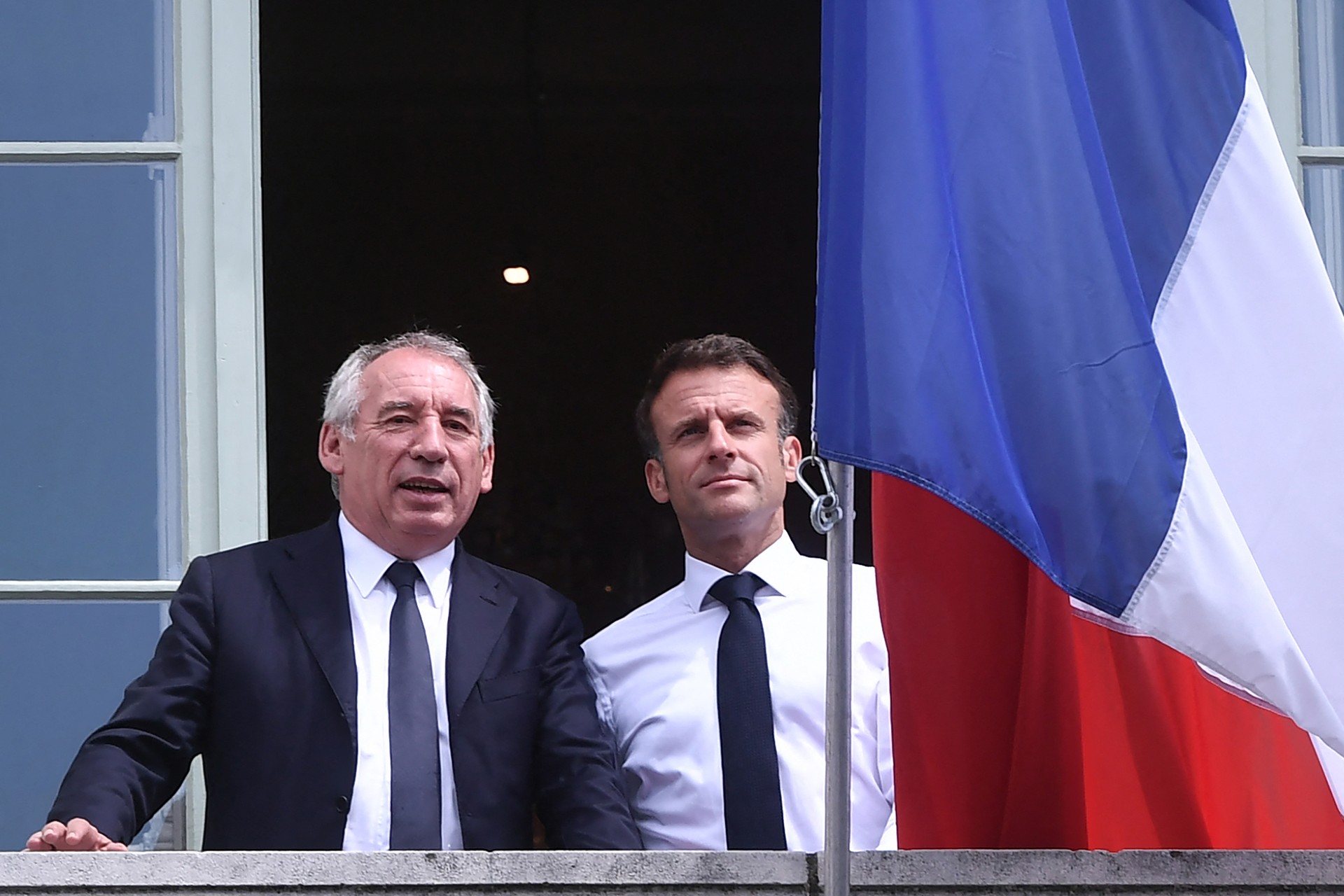
French President Emmanuel Macron on Wednesday offered his “full support” to embattled Prime Minister Francois Bayrou, who has announced that he will seek a crucial confidence vote in parliament next month.
This move could potentially topple his government.
Bayrou, struggling to unite a bitterly divided parliament, said the confidence vote would take place on September 8 as he seeks backing for his controversial plan to cut state spending. The proposal has already met fierce resistance, with opposition parties making clear they will not support it. The far right has pressed Macron to dissolve parliament and call fresh elections, while the hard left has gone further, insisting the president himself should step down.
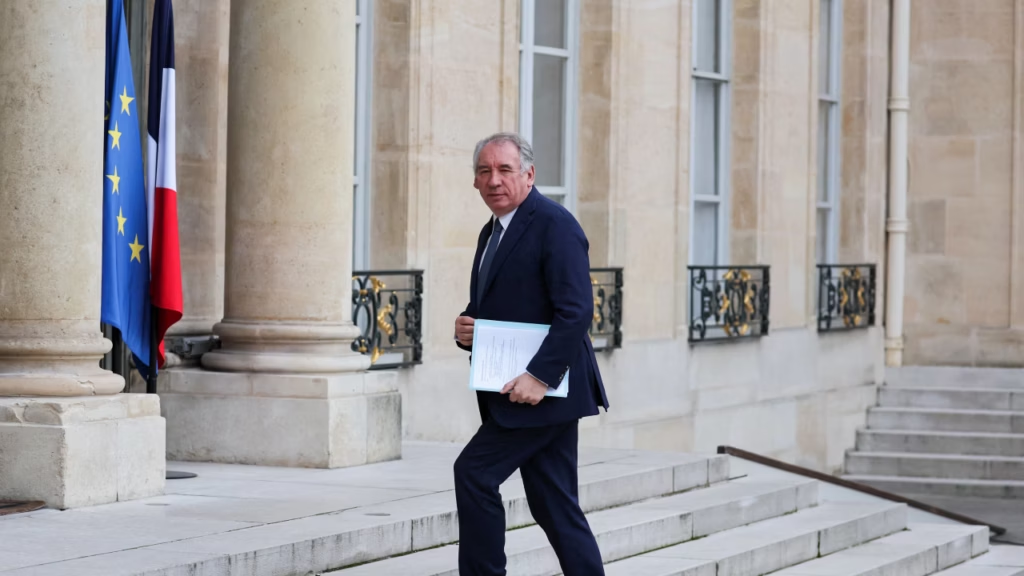
The political stakes are high for Macron, who is already on his sixth prime minister since first assuming office in 2017. On Wednesday, he chaired a cabinet meeting where his spokeswoman, Sophie Primas, said the president had given “full support” to Bayrou’s initiative. Macron also called on political parties “to act responsibly” in the face of mounting tensions.
“The French president said, and I’ll use his exact words, that there is neither denial of reality nor exaggeration of France’s financial situation,” Primas explained. “France is a solid country, with economic resilience and significant financial capacity.”
Bayrou, vowing to “fight like a dog” to keep his government afloat, was expected to appear on television later that evening to defend his position ahead of the crucial vote.
As France edges toward a political showdown, speculation is mounting over Macron’s next steps if the government falls. The president could appoint another prime minister, dissolve parliament for fresh elections, or even resign. Each option carries its own risks.
Macron has already tested the dissolution route, calling snap parliamentary elections last summer in hopes of strengthening his authority and checking the far right’s momentum. But the gamble backfired, producing a deadlocked parliament and intensifying political uncertainty.
Even within Macron’s inner circle, there is growing acceptance that another dissolution may be inevitable. “No one wants it, but it is inevitable,” a senior presidential ally told AFP anonymously. Macron himself has signaled reluctance to repeat the move but has not ruled it out entirely.
Former prime minister Edouard Philippe, a key centrist figure and likely candidate for the 2027 presidential race, expressed support for Bayrou but acknowledged that dissolution could once again be necessary. “If nothing happens, if no government can prepare a budget, how can this issue be resolved? Through dissolution,” he said.
Meanwhile, opposition voices are sharpening their demands. Green Party leader Marine Tondelier urged Macron to appoint a left-wing prime minister, arguing that such a move would better reflect the outcome of last summer’s elections. Although a leftist coalition emerged with the most seats, it still fell short of a majority.
“There is no suspense about the fact that Francois Bayrou will fall on September 8,” Tondelier told AFP, confirming that her movement was already working on a “crisis exit plan.”
The political turmoil has spilled into the streets as well. A broad left-backed campaign, “Bloquons tout” (“Let’s block everything”), has called for a nationwide shutdown on September 10 to protest Bayrou’s fiscal measures.
France’s debt, now standing at 114 percent of GDP, is the third highest in the eurozone after Greece and Italy, putting the country under pressure from the European Union to rein in its deficit. Bayrou has proposed saving around 44 billion euros ($51 billion) through drastic steps such as freezing spending growth and reducing the number of public holidays.
These measures were outlined in his 2026 budget proposal unveiled in July, but they have been met with widespread opposition and discontent. The austerity plan comes at a time when political maneuvering ahead of the 2027 presidential election is intensifying, with the far right positioning itself for a serious bid for power once Macron’s second term ends.
“There is only one way out of this political impasse we find ourselves in, and that is to return to the polls,” said Jordan Bardella, leader of the far-right National Rally, in an interview on TF1.
What you should know
Emmanuel Macron has thrown his weight behind Prime Minister Francois Bayrou, who faces a confidence vote on September 8 over his austerity plan aimed at cutting France’s debt.
Opposition parties are lining up against him, raising the likelihood of a government collapse.
With parliament deeply divided and the far right gaining ground, Macron may soon be forced to dissolve parliament once again or even consider more drastic options, as France’s political future remains highly uncertain.