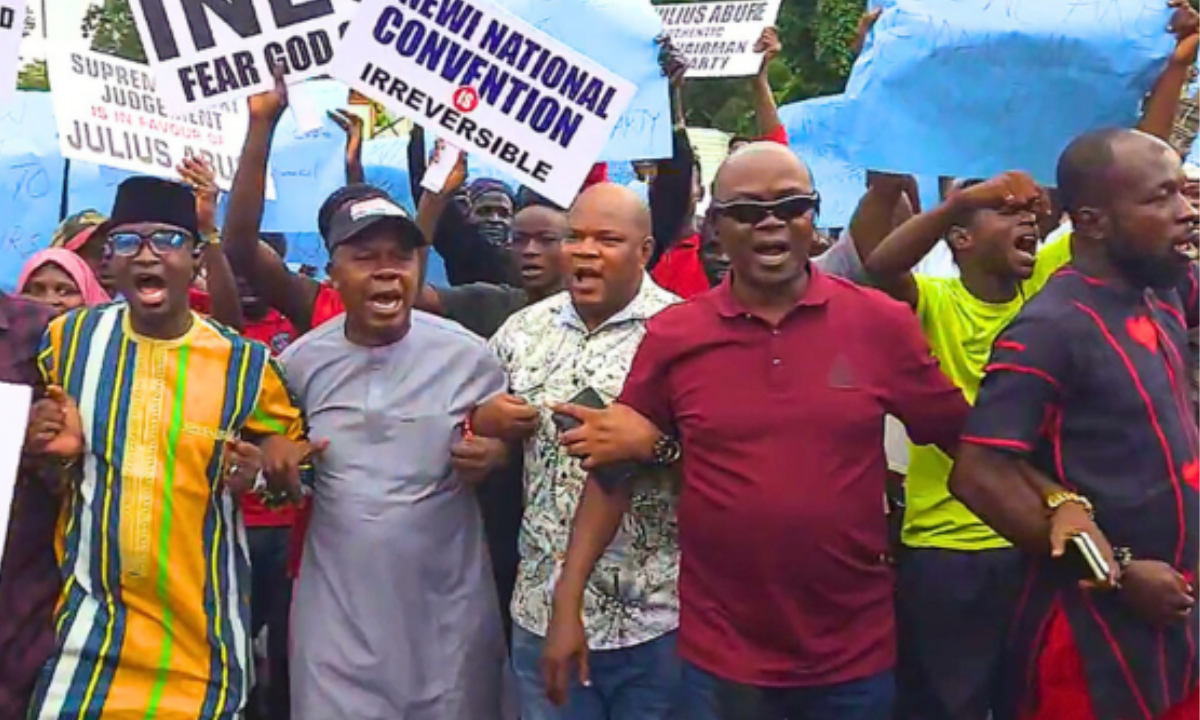
Tensions within the Labour Party took a public turn on Wednesday as members of the Julius Abure-led faction staged a protest at the Abuja headquarters of the Independent National Electoral Commission (INEC), condemning the electoral body’s decision to exclude their candidates from upcoming elections.
The demonstration was sparked by INEC’s refusal to publish names of Labour Party candidates submitted by Abure’s group for both the Federal Capital Territory Area Council polls and some scheduled National Assembly bye-elections. Protesters brandished placards bearing strong messages such as “INEC should respect the rule of law,” “Supreme Court judgement favours Julius Abure,” “Caretaker committee is not a political party,” and “INEC should not kill the greatest opposition party in Nigeria.”
Security operatives stood by as the protest unfolded around INEC’s premises, while the demonstrators marched and chanted in frustration over what they described as an attempt to sideline a legitimate faction of the Labour Party.
Despite their show of solidarity, the broader leadership of the Labour Party had already made its position clear. On Tuesday, ahead of the demonstration, the faction led by Interim National Chairman Senator Nenadi Usman disavowed any connection to the protest. In a statement signed by Ken Eluma Asogwa, Senior Special Adviser on Media to the interim leadership, the protest was declared unauthorized and its organizers labeled as “political impersonators.”
According to the Usman-led leadership, the protest lacked formal endorsement by the party’s national organs and was being coordinated by individuals whose leadership claims had already been invalidated by a Supreme Court decision. The statement reiterated the April 4, 2025 ruling, which affirmed that Julius Abure’s tenure as Labour Party chairman officially ended on June 8, 2023.
The Labour Party’s internal struggle has only intensified in recent months. In July, the party’s National Executive Committee, under the leadership of Abia State Governor Alex Otti, appointed a new interim leadership team. Senator Nenadi Usman was named Interim National Chairman, while Darlington Nwokocha took over as Interim National Secretary. The NEC also announced plans for a national convention and released a timetable for ward, local government, state, and zonal congresses.
But not everyone welcomed these changes. Kennedy Ahanotu, the party’s National Youth Leader and an ally of Abure, rejected the appointments and maintained that Abure remains the valid national chairman. He described the interim leadership as a violation of both the party’s constitution and the Electoral Act.
The persistent divisions now threaten the Labour Party’s cohesion and readiness ahead of the 2027 general elections. The split between the Abure camp and the faction aligned with Peter Obi, Governor Otti, and Nenadi Usman has cast a long shadow over the party’s stability and public image.
While the Abure-led protesters claim legitimacy and continue to push back against what they describe as political exclusion, the party’s recognized leadership insists on INEC’s compliance with the judiciary and the rule of law.
What You Should Know
The Labour Party remains deeply fractured, with a legal and political dispute dividing its ranks as Nigeria approaches the 2027 elections.
At the heart of the crisis is Julius Abure, whose chairmanship has been declared expired by a Supreme Court ruling, and Senator Nenadi Usman, who now leads the court-recognized interim leadership.
The protest at INEC by the Abure-led group underscores ongoing resistance to the party’s official transition, further highlighting the internal conflicts that could affect its electoral strength and unity moving forward.