In a landmark move aimed at addressing perennial flood disasters across the country, the Federal Government has officially unveiled a new Anticipatory Action Framework on Floods, marking a major shift in disaster response from reactive efforts to early, coordinated action.
Speaking at the Presidential Villa in Abuja during the formal submission of the draft framework and consolidated budget by the Anticipatory Action Task Force (AATF), Vice President Kashim Shettima emphasized the importance of embracing science and proactive planning in national disaster management efforts.
“Disasters are security issues. Over the years, we have only been reacting instead of practicing proactive disaster management. By seizing this initiative and believing in science, we have carried out all the due processes of finding a roadmap,” Shettima said.
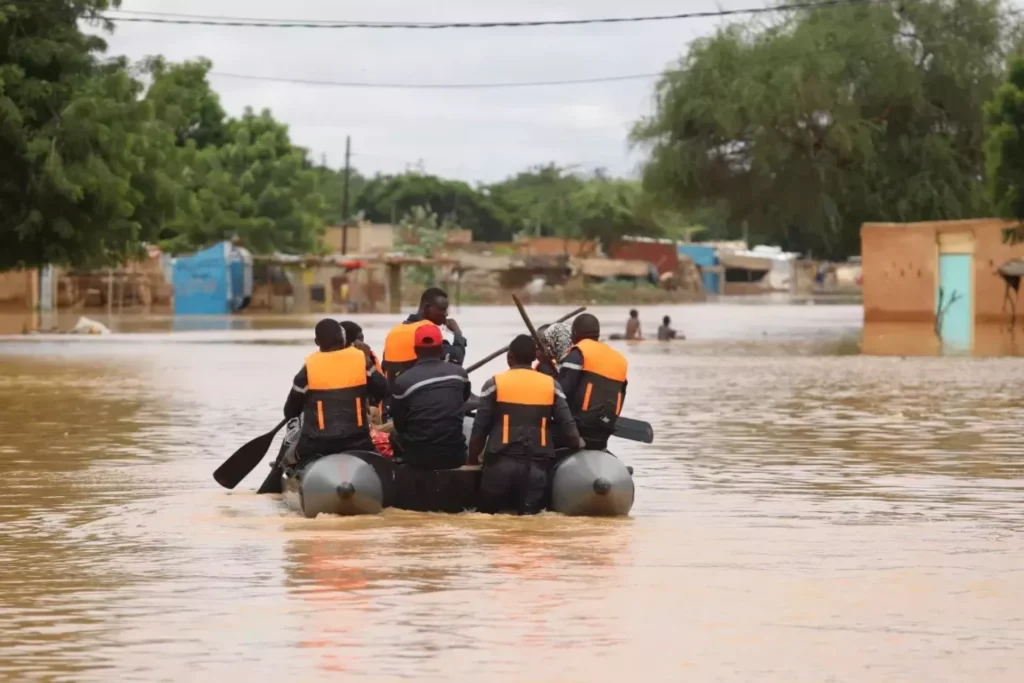
The framework incorporates both scientific and traditional data-gathering techniques, clearly defined triggers for early action, and a consolidated national budget to ensure timely responses to predicted flood events. It is designed to build resilience in Nigeria’s most vulnerable communities and mitigate the extensive damage caused by seasonal flooding.
Shettima lauded President Bola Ahmed Tinubu for his leadership and praised the Office of the National Security Adviser (ONSA) for coordinating efforts around the new strategy.
“We will engage all the major stakeholders in the Nigerian project for them to come and support us. Collectively, we can marshal resources and address our core issues,” the Vice President added.
Also speaking, Minister of Humanitarian Affairs and Poverty Alleviation, Prof. Nentawe Goshwe Yilwatda, described the initiative as a “paradigm shift” in the country’s approach to flood disasters.
“We are shifting from reaction to recovery. We are also shifting from losses to prevention,” the Minister stated. He highlighted the economic and humanitarian toll of past floods, citing the 2004 disaster which displaced 1.2 million people, destroyed 1.3 million hectares of farmland, and caused over $1 billion in damages. “If we can allocate just one per cent of that money, we can save much more than what we lost,” Yilwatda added.
National Security Adviser, Mallam Nuhu Ribadu, stressed the urgency of adopting a forward-looking approach. “Often, natural disasters are outside of our control, but reaction is ours. And this is what matters the most — the ability for us to get ready for a situation that is not under our control,” he said.
Providing further insight into the project, Mrs. Inna Audu, Special Assistant to the President on Humanitarian Affairs and Development Partners, explained that the AATF had worked since March through several key phases — from its inauguration and a validation workshop to comprehensive data collection using both scientific tools and traditional knowledge systems.
She also revealed the creation of a Strategic Communication Working Group under the NSA’s office within the National Counter Terrorism Centre (NCTC), led by Major General Adamu Garba Laka, to ensure public awareness, preparedness, and timely response at all levels of governance.
What you should know
The Anticipatory Action Framework on Floods marks Nigeria’s most strategic and science-driven effort to prevent flood-related disasters.
With the involvement of top national security and humanitarian agencies, the plan focuses on early detection, timely funding, and active community engagement — signaling a major policy shift toward preventive disaster management.