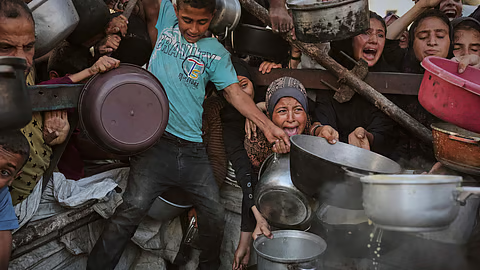
More than a hundred humanitarian and rights organizations have jointly raised a grave warning over what they describe as an escalating crisis of “mass starvation” in Gaza.
The call for action comes amid a dire humanitarian emergency that continues to spiral, even as diplomatic efforts intensify to broker a ceasefire and restore essential aid flows to the war-ravaged Palestinian territory.
The warning came on Wednesday, as the United States announced that its senior envoy, Steve Witkoff, would be traveling to Europe for discussions focused on achieving a ceasefire and establishing a functional humanitarian corridor in Gaza. According to U.S. State Department spokesperson Tammy Bruce, the envoy is expected to bring “a strong hope that we will come forward with another ceasefire as well as a humanitarian corridor for aid to flow, that both sides have in fact agreed to.”
Israel, meanwhile, continues to face intensifying scrutiny and international condemnation over the catastrophic conditions inside Gaza, where over two million residents have been battling life-threatening shortages of food, clean water, and medical supplies following nearly two years of armed conflict.
Despite these concerns, Israeli officials maintain that they are not preventing aid from entering the territory. A senior Israeli security official, as quoted by the Times of Israel, stated: “We have not identified starvation at this current point in time but we understand that action is required to stabilise the humanitarian situation.” According to Israeli authorities, about 950 trucks loaded with aid are already inside Gaza but are awaiting collection and distribution by international humanitarian groups.
On the ground, the Israeli military continues to conduct operations in northern Gaza and Gaza City, reportedly targeting dozens of what it described as “terror targets.” Gaza’s civil defence authorities reported that 17 people were killed in Israeli airstrikes overnight, including a pregnant woman.
The United Nations weighed in earlier this week, revealing that over 1,000 Palestinians had been killed by Israeli forces while attempting to access food aid since the launch of the Gaza Humanitarian Foundation (GHF) in May—an initiative backed by Israel and the United States that has effectively sidelined the UN’s existing humanitarian coordination.
A joint statement signed by 111 organizations—including Doctors Without Borders (MSF), Oxfam, and Save the Children—described the situation in Gaza as devastating. “Our colleagues and those we serve are wasting away,” the statement read, emphasizing the need for an immediate ceasefire, unrestricted access through all land crossings, and the restoration of UN-led aid coordination.
Though Israel began easing its two-month blockade on humanitarian aid in late May, widespread suffering persists across Gaza. Israeli authorities argue that aid is being allowed through and have accused Hamas of exacerbating the crisis by allegedly seizing food for resale and attacking people waiting for distributions. The GHF has accused the United Nations of having an “operational and capacity problem” and has called for enhanced collaboration to ensure the efficient delivery of life-saving assistance.
Israel’s Coordination of Government Activities in the Territories (COGAT), which manages civil matters in the Palestinian territories, reported that nearly 4,500 aid trucks carrying flour, baby food, and high-calorie meals for children have recently entered Gaza. However, COGAT also claimed that aid collection by international agencies has significantly decreased over the past month, creating a “bottleneck” that prevents continuous aid delivery.
Humanitarian organizations countered these claims, insisting that the fundamental problem lies in the limited permissions from Israeli authorities and the complex coordination required to transport and distribute aid safely. “Palestinians are trapped in a cycle of hope and heartbreak, waiting for assistance and ceasefires, only to wake up to worsening conditions,” the aid groups said. They described the ongoing ordeal not just as physical torment but as a deep psychological trauma. “Survival is dangled like a mirage,” they added, stressing that humanitarian efforts cannot depend on empty promises or uncertain timelines.
According to the director of Gaza’s largest hospital, 21 children have died from starvation and malnutrition in just the past three days—yet another tragic reminder of the stakes involved. The grim toll adds to the mounting death toll of the conflict: 59,219 Palestinians have been killed, the majority of them civilians, since the war began. The violence erupted following Hamas’s October 7, 2023, attack on Israel, which left 1,219 people dead, most of them civilians, according to an AFP compilation of official figures.
Negotiators from both sides have been meeting in Doha since July 6, in a bid to secure a ceasefire agreement. There is growing anticipation that the U.S. envoy, Witkoff, will soon join those final-stage talks. Meanwhile, over two dozen Western nations issued a joint statement on Monday urging an immediate end to hostilities, asserting that the humanitarian suffering in Gaza has now “reached new depths.”
What you should know
The humanitarian crisis in Gaza continues to deteriorate, with over 100 aid agencies warning of “mass starvation.” Though Israel claims to be facilitating aid entry, coordination, access, and safety remain major challenges.
Diplomatic efforts are underway to negotiate a ceasefire and restore aid channels, but human suffering, especially among children, is reaching devastating levels.