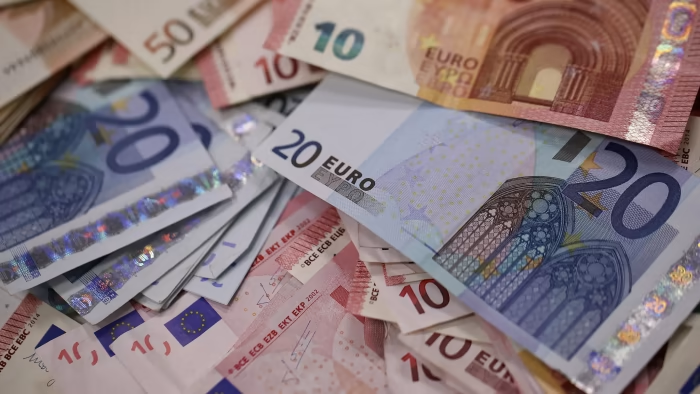
The U.S. dollar posted modest gains in early Monday trading as President Donald Trump escalated his trade war rhetoric, threatening to impose sweeping 30% tariffs on imports from the European Union and Mexico beginning August 1. The announcement sent the euro tumbling to its lowest level in three weeks before recovering some losses.
Trump delivered the tariff ultimatum through separate letters to European Commission President Ursula von der Leyen and Mexican President Claudia Sheinbaum, which he posted on his Truth Social platform over the weekend. The move represents the latest salvo in what has become an increasingly aggressive trade policy stance since his return to office in January.
The euro initially plunged in Asian trading sessions, hitting a three-week trough before clawing back ground to trade 0.13% lower at $1.1676 by Monday’s close. Against the Mexican peso, the dollar strengthened 0.28% to 18.6763, reflecting immediate market concerns about the economic impact on one of America’s largest trading partners.
However, the overall market reaction remained surprisingly subdued, suggesting that investors have grown increasingly accustomed to Trump’s frequent tariff threats. This desensitization was evident as U.S. stocks continued their march to record highs despite the trade tensions, while the dollar’s gains remained modest compared to previous tariff announcements.
Both targeted governments swiftly condemned the proposed measures. The European Union characterized the tariffs as “unfair and disruptive” while extending its suspension of countermeasures against existing U.S. tariffs until early August in hopes of reaching a negotiated settlement. Mexico’s response echoed similar concerns about the disruption to established trade relationships.
The latest tariff announcement comes just days after Trump revealed plans for a 35% tariff on Canadian imports and suggested broader tariff measures against other trading partners, creating a pattern of escalating trade tensions that has become a hallmark of his economic policy approach.
Beyond traditional currencies, cryptocurrency markets surged on the news, with bitcoin scaling new heights above $120,000 as investors positioned for potential policy wins for the digital asset industry. The world’s largest cryptocurrency traded 2.6% higher at $122,248.59, while ether gained 2% to $3,052.
Other major currencies showed mixed performance in the wake of the announcement. Sterling declined 0.15% to $1.3470, while the Japanese yen managed slight gains to 147.31 per dollar. The Australian dollar fell 0.12% to $0.6566, and the New Zealand dollar dropped 0.37% to $0.5987.
The muted market response underscores a broader trend where investors have become increasingly skeptical about whether Trump’s tariff threats will translate into actual policy implementation. This growing desensitization represents a significant shift from earlier periods when such announcements would trigger more dramatic market volatility.
As markets brace for potential retaliation and further escalation, the focus now turns to whether the threatened August 1 implementation date will hold and how the targeted nations will respond to what appears to be an increasingly confrontational approach to international trade relations.
WHAT YOU SHOULD KNOW
President Trump’s threat of 30% tariffs on EU and Mexico imports starting August 1 caused only modest currency fluctuations, with the euro briefly hitting a three-week low before recovering.
The muted market response signals that investors have become increasingly desensitized to Trump’s frequent tariff announcements, as evidenced by U.S. stocks continuing to reach record highs despite the trade tensions.