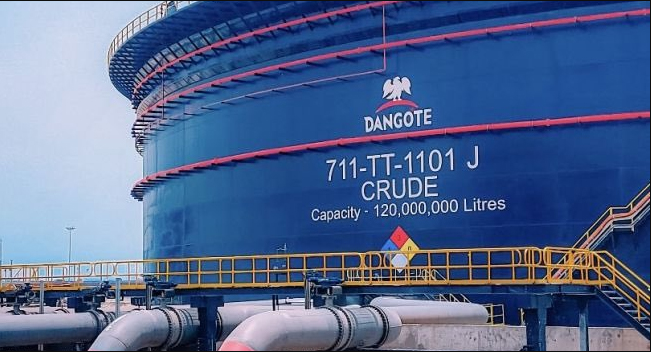
In a significant development for Nigerian consumers, Dangote Petroleum Refinery announced a ₦40 reduction in its ex-depot petrol price on Monday, bringing the cost down from ₦880 to ₦840 per liter. The price cut comes amid a broader easing of oil markets following the cessation of hostilities between Israel and Iran.
Tony Chiejina, spokesman for the $20 billion Lagos-based facility, confirmed that the new pricing structure took effect on June 30, 2025, just one week after the refinery had increased prices to ₦880 per liter. The adjustment reflects the facility’s responsiveness to global crude oil price fluctuations, particularly those influenced by geopolitical developments in the Middle East.
The price reduction coincides with a dramatic 6% drop in international oil prices as markets responded to the Israel-Iran ceasefire, with Brent crude falling to around $67 per barrel from previous levels near $80. This represents a significant retreat from the elevated prices that had emerged during the two-week conflict period.
Filling stations operating under special agreements with Dangote Refinery, including major retailers such as MRS Oil & Gas, Ardova Plc, and Heyden, are expected to implement corresponding reductions at the pump, potentially bringing retail prices below the ₦900 per liter threshold. This development offers some relief to consumers who have been grappling with elevated fuel costs in recent years.
The timing of this price adjustment coincides with Dangote Refinery’s ambitious expansion of its distribution network. On June 15, the 650,000 barrels-per-day capacity facility announced plans for free distribution of petrol and diesel to marketers and dealers nationwide, backed by a fleet of 4,000 new CNG-powered tankers set to launch on August 15, 2025.
The refinery has also introduced innovative financing mechanisms, offering credit facilities to bulk purchasers of 500,000 liters or more, allowing them to obtain an additional 500,000 liters on credit for two weeks under bank guarantee arrangements. However, these expansion moves have drawn criticism from existing petrol marketers and truck operators who fear the initiative could undermine traditional distribution channels and threaten smaller operators in the supply chain.
Nigeria’s energy sector transformation comes against a backdrop of decades-long challenges. The country, despite being Africa’s largest oil producer, has historically depended heavily on imported refined petroleum products due to the prolonged dysfunction of its state-owned refineries. The Nigerian National Petroleum Corporation (NNPC) served as the primary importer of these essential commodities until recently.
The impact of energy policy changes has been particularly acute for Nigerian consumers. Since President Bola Tinubu removed fuel subsidies in May 2023, petrol prices have increased fivefold from approximately ₦200 per liter to around ₦1,000 per liter. This dramatic price escalation has compounded economic pressures on citizens who rely on petrol not only for transportation but also for powering generators due to the country’s persistent electricity supply challenges.
The current price reduction, while modest, represents a rare instance of downward pressure on fuel costs in a market that has experienced relentless upward trends. However, the sustainability of this relief will largely depend on the stability of global oil markets and the continued operational efficiency of the Dangote Refinery as it scales up its domestic production capacity.
For a nation where reliable electricity remains elusive and millions depend on petrol-powered generators for basic power needs, even marginal price reductions carry significant economic implications. The performance of the Dangote Refinery in the coming months will serve as a crucial test of Nigeria’s capacity to achieve greater energy independence and price stability in its domestic fuel market.
WHAT YOU SHOULD KNOW
Dangote Refinery has reduced petrol prices by ₦40 to ₦840 per liter following a drop in global oil prices caused by the Israel-Iran ceasefire. While this offers modest relief to Nigerians who have seen fuel costs rise fivefold since subsidy removal in 2023, the reduction highlights Nigeria’s continued vulnerability to international oil market fluctuations.
The real significance lies in demonstrating that local refining capacity, as exemplified by Dangote, can provide a buffer against import dependency; however, sustainable fuel affordability remains tied to global geopolitical stability and the refinery’s long-term operational success.