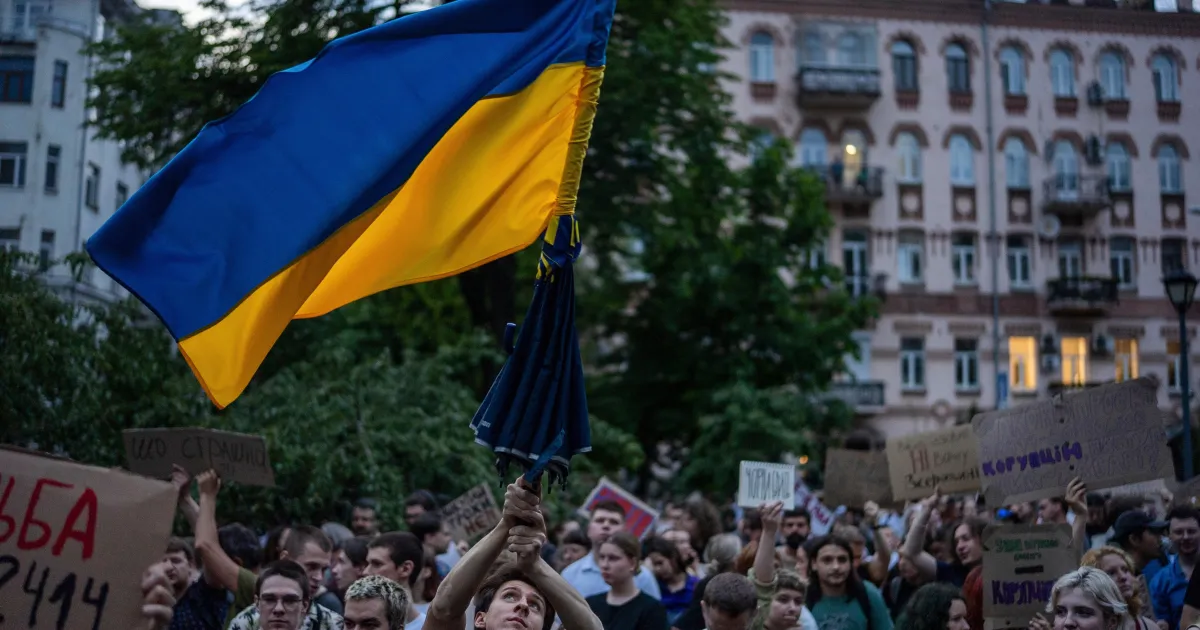
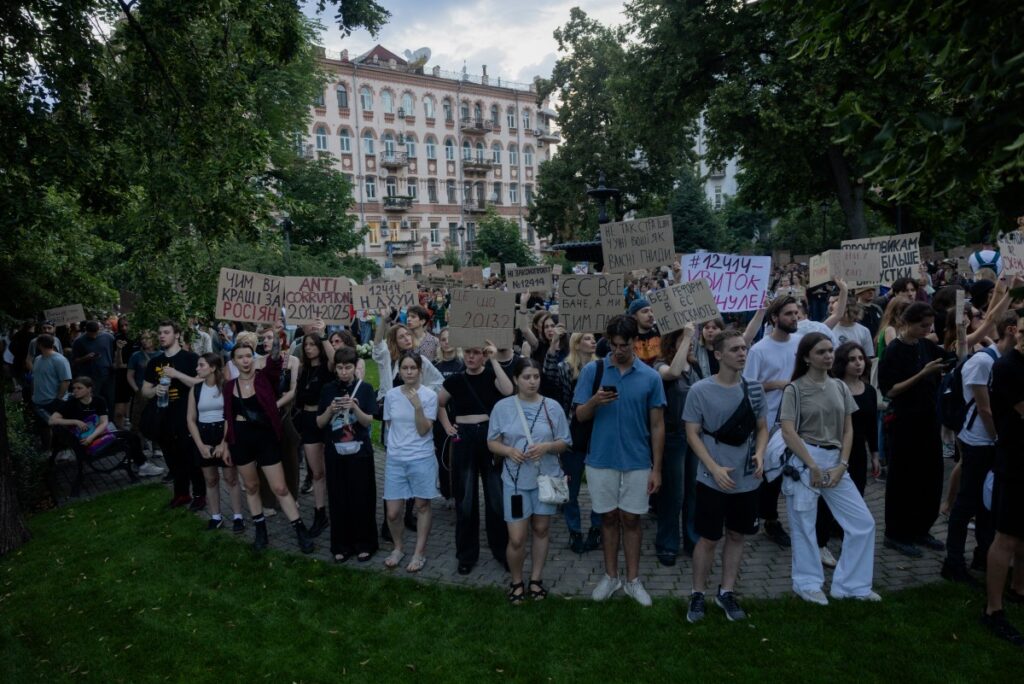
Thousands of demonstrators, largely comprised of youth, assembled in Kyiv’s city centre on Wednesday in a rare and powerful protest against a newly signed law that effectively strips two of Ukraine’s major anti-corruption institutions of their autonomy.
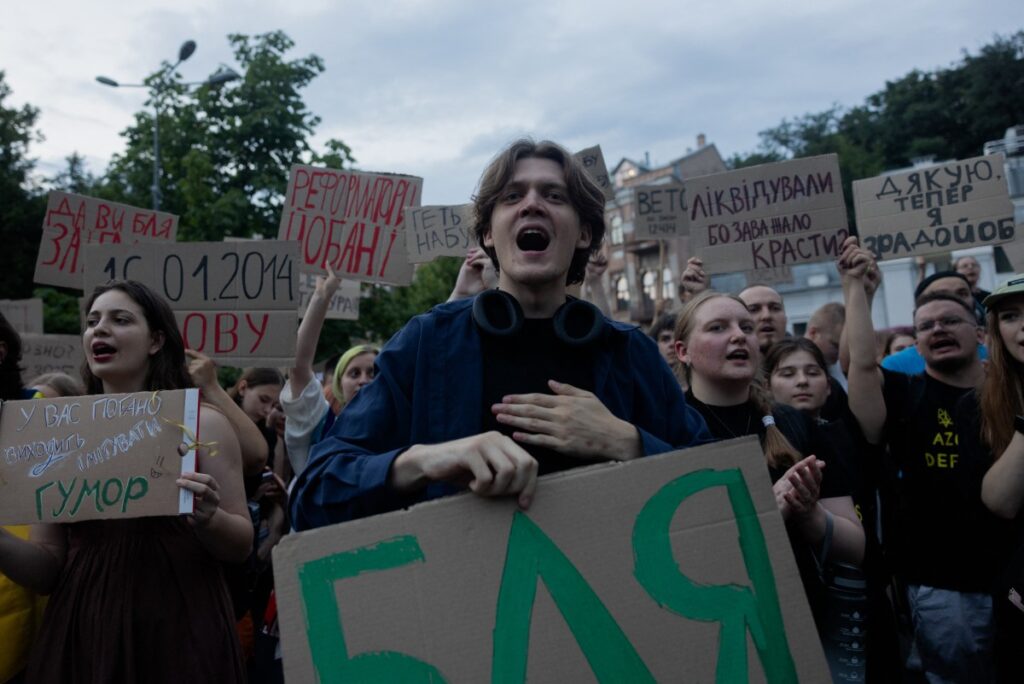
This legislation, recently endorsed by President Volodymyr Zelensky, has ignited concern among civil society activists who are warning of its potential to derail Ukraine’s reform agenda and EU accession ambitions. The protest—the largest since Russia’s full-scale invasion in 2022—was marked by chants, banners, and pleas for Zelensky to annul the decision.
The new law places the National Anti-Corruption Bureau of Ukraine (NABU) and the Specialised Anti-Corruption Prosecutor’s Office (SAPO) under the control of the Prosecutor General, a position appointed directly by the president. Critics see this move as a power grab that could compromise the impartiality of corruption investigations, particularly those involving senior officials.
President Zelensky, however, has defended the move, insisting it was necessary to eliminate suspected Russian interference within the anti-corruption apparatus. “We all share a common enemy: the Russian occupiers,” Zelensky declared following a meeting with key law enforcement and anti-corruption officials. He added that Ukraine needs “a strong enough law enforcement system—one that ensures a real sense of justice.”
In a subsequent message posted on social media, the president pledged to introduce a new bill to reinforce the independence of these institutions. Despite his assurance, both NABU and SAPO maintained their criticism of the legislative amendments, urging immediate corrective actions to restore their previously guaranteed independence.
The public backlash was visible and forceful. Protesters gathered outside the Ivan Franko Theatre in Kyiv, projecting messages that read “Veto the Law,” and promising to return the following evening in continued defiance. Their frustration echoed across social media platforms and conversations on the streets, signalling widespread disapproval.
Prominent voices within Ukraine’s civil society have also spoken out. Oleksandra Matviichuk, head of the Nobel Peace Prize-winning Centre for Civil Liberties, warned that the law could be seen as “a gift to Putin,” potentially undermining the unity and democratic gains achieved since the 2014 pro-European uprising.
Outside Ukraine, the move has alarmed Western allies. European Commission President Ursula von der Leyen has called for clarity from Zelensky, with her spokesperson citing “strong concerns” about the legislative changes. EU Enlargement Commissioner Marta Kos described the development as “a serious step back,” emphasizing that the weakening of NABU’s independence compromises Ukraine’s alignment with European democratic standards.
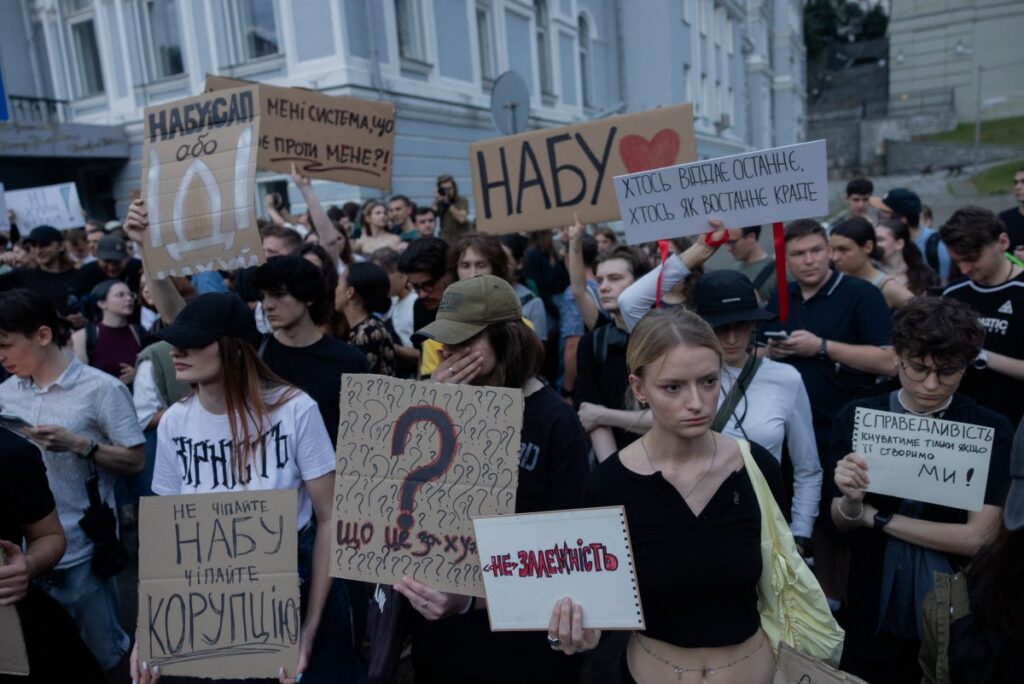
Established in 2015, NABU has played a key role in exposing high-level corruption, including scandals involving Zelensky’s administration. Yet just days before the protests, Ukrainian law enforcement raided NABU headquarters and arrested one employee on suspicion of espionage for Russia—an act Transparency International’s Ukraine office condemned as an attempt to erode the post-Maidan anti-corruption legacy.
Adding to the tension, the government recently dismissed the proposed head of the Bureau of Economic Security over alleged ties to Russia, a decision that also drew criticism from activists. Meanwhile, Vitaliy Shabunin, a leading anti-corruption campaigner, is facing charges that many believe are politically motivated retaliation linked to his investigations into close associates of the president.
As protests intensify, the rift between the government and reform advocates deepens, casting a shadow over Ukraine’s European aspirations and efforts to preserve institutional integrity in the midst of war.
What you should know
Volodymyr Zelensky, Ukraine’s president, is under scrutiny after approving a controversial law that undermines the autonomy of anti-corruption bodies NABU and SAPO.
The move has sparked widespread protests, international criticism, and concern that it could hinder Ukraine’s path to EU membership. Despite Zelensky’s defense that the change targets Russian interference, many fear it consolidates power and jeopardizes judicial independence.