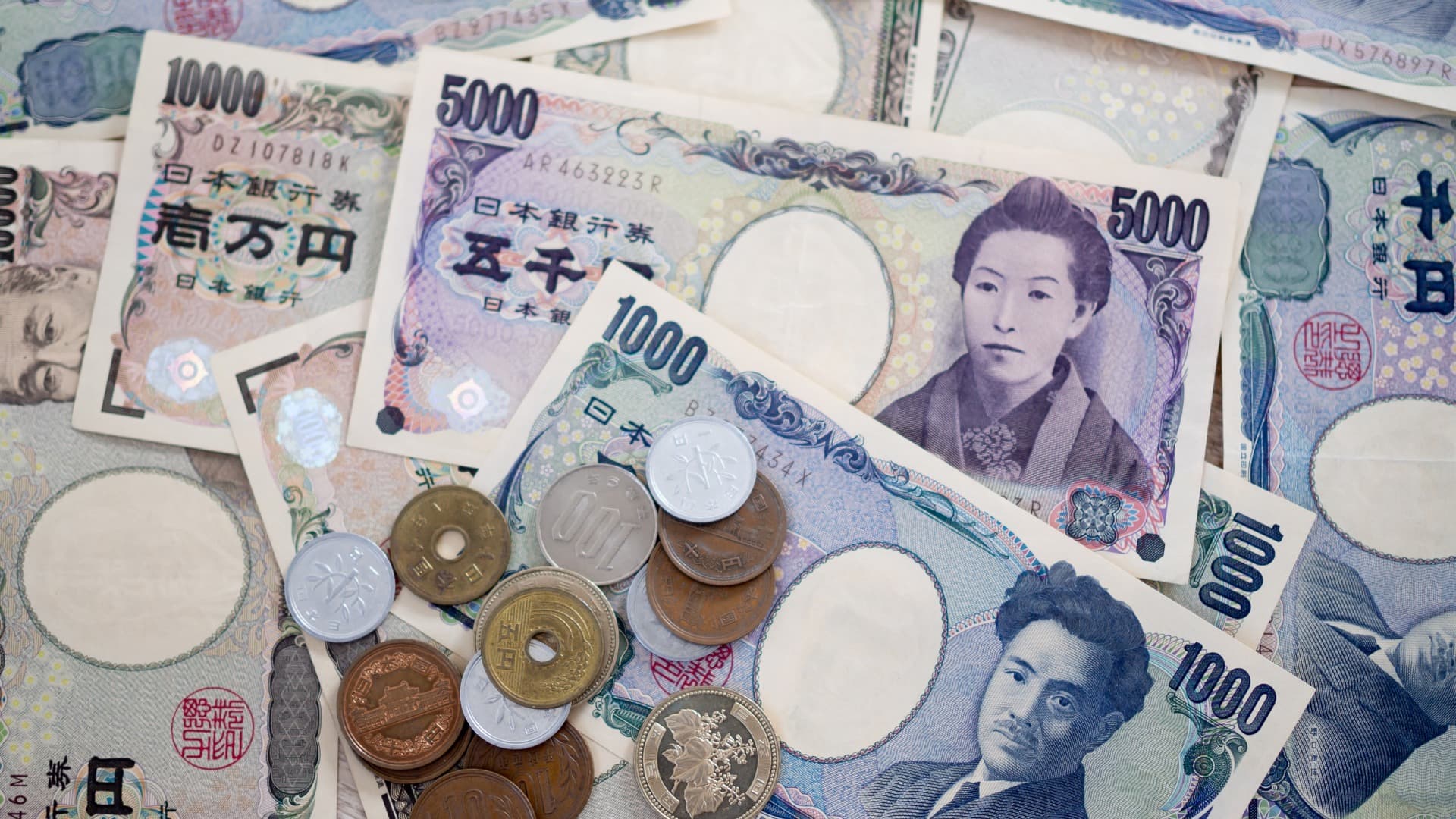
The Japanese yen pulled back slightly on Friday, paring what remains its strongest weekly performance since May, as currency markets navigate a complex landscape of central bank signals, political uncertainty, and global economic headwinds.
The yen weakened 0.3% to 147.72 against the dollar in Friday trading, yet still maintained a 1.2% gain for the week—its sharpest advance in more than four months. The currency’s trajectory reflects the delicate balancing act facing traders as they parse mixed signals from the Bank of Japan while bracing for a pivotal leadership contest that could reshape the country’s economic policy direction.
Central Bank Chief Tempers Rate Hike Expectations
Bank of Japan Governor Kazuo Ueda adopted a decidedly cautious stance in remarks delivered Friday, focusing attention on global economic uncertainties—particularly the health of the U.S. economy—and their potential impact on Japanese wage growth and inflation. The comments effectively dampened market expectations for an imminent interest rate increase, despite recent signs of improving business sentiment.
“Ueda’s speech supports our view that the possibility of an October rate hike is very low,” Goldman Sachs economists wrote in a research note, underscoring how the governor’s emphasis on external risks has pushed back the timeline for policy tightening.
The central bank chief’s remarks came just days after the BOJ’s quarterly tankan survey showed confidence among major manufacturers improving for the second consecutive quarter. Deputy Governor Shinichi Uchida had struck a more optimistic note Thursday, highlighting resilient corporate profits and an improving business climate, though he acknowledged pressure from U.S. tariffs on exports.
Political Uncertainty Adds to Market Volatility
Adding another layer of complexity, Japan’s ruling Liberal Democratic Party holds a leadership election Saturday that will determine the country’s next prime minister. The outcome carries significant implications for fiscal and monetary policy, with markets closely monitoring the positions of leading candidates.
Among the frontrunners, party veteran Sanae Takaichi—known for her dovish monetary stance—could potentially trigger fresh volatility in bond markets, analysts warn. By contrast, farm minister Shinjiro Koizumi and Chief Cabinet Secretary Yoshimasa Hayashi are viewed as less likely to pursue dramatic policy shifts.
“With yen-depreciation pressure likely to linger ahead of this weekend’s LDP leadership election, the pair is likely to hover around current levels,” said Hirofumi Suzuki, chief currency strategist at Sumitomo Mitsui Banking Corporation.
Dollar Resilient Despite Government Shutdown
In U.S. trading, the greenback demonstrated unexpected resilience despite a federal government closure that has suspended publication of crucial economic indicators, including the highly anticipated September employment report originally scheduled for Friday’s release.
The dollar index, which tracks the currency against a basket of major rivals, edged up 0.1% to 97.90. The euro gained 0.1% to $1.1722, while sterling held steady at $1.3437.
“The government shutdown has not had a major short-term impact, but if anything, underlying pressure remains toward a weaker dollar,” Suzuki noted, reflecting broader market sentiment about the currency’s medium-term trajectory.
Mixed Signals from the U.S. Labor Market
Despite the absence of official jobs data, alternative indicators painted a nuanced picture of the American labor market. A Chicago Federal Reserve report combining private and available public data estimated the September unemployment rate at 4.3%—unchanged from August—suggesting that fears of rapidly accelerating job losses have not yet materialized.
However, beneath the surface, signs of softening emerged. ADP’s National Employment report revealed that private sector payrolls contracted by 32,000 jobs in September, reinforcing expectations that the Federal Reserve will implement two additional interest rate cuts before year-end.
Markets are pricing in a 25-basis-point reduction at the Fed’s October meeting as virtually certain, with traders assigning an 89% probability to another cut in December, according to CME Group’s FedWatch Tool.
Dallas Fed President Lorie Logan offered a measured assessment Thursday, defending last month’s rate cut as appropriate insurance against labor market deterioration while emphasizing that the cooling has been gradual. Her comments suggested reluctance to support aggressive further easing absent clearer signs of economic stress.
Commodity Pressure Weighs on Canadian Dollar
The Canadian dollar languished near a four-month nadir against its U.S. counterpart, trading at 1.3968 after touching 1.3986 on Thursday—its weakest intraday level since mid-May. The loonie’s struggles reflected a sharp decline in oil prices, which fell more than 2%, alongside investor anxiety over negotiations to renew the United States-Mexico-Canada trade agreement.
Market Outlook
As the trading week draws to a close, currency markets find themselves at a crossroads, buffeted by central bank policy divergence, political transitions, and persistent economic uncertainty. The yen’s trajectory in the coming weeks will likely hinge on both the outcome of Saturday’s LDP election and any fresh signals from BOJ officials regarding the timing of future policy adjustments.
Meanwhile, the dollar’s resilience in the face of deteriorating economic data and government dysfunction underscores the complexity of current market dynamics, where traditional relationships between fundamentals and currency values have grown increasingly unpredictable.
WHAT YOU SHOULD KNOW
The Japanese yen is caught in a tug-of-war between competing forces: while it posted its strongest weekly gain in four months, BOJ Governor Ueda’s cautious stance has effectively ruled out an imminent rate hike, and Saturday’s leadership election could dramatically reshape Japan’s economic policy direction.
Meanwhile, the dollar shows surprising resilience despite a government shutdown and weakening U.S. labor data, with markets nearly certain the Fed will cut rates twice more by year-end.
Currency markets are being driven more by political uncertainty and central bank caution than by traditional economic fundamentals, making the yen’s near-term direction heavily dependent on this weekend’s election outcome and subsequent BOJ policy signals.