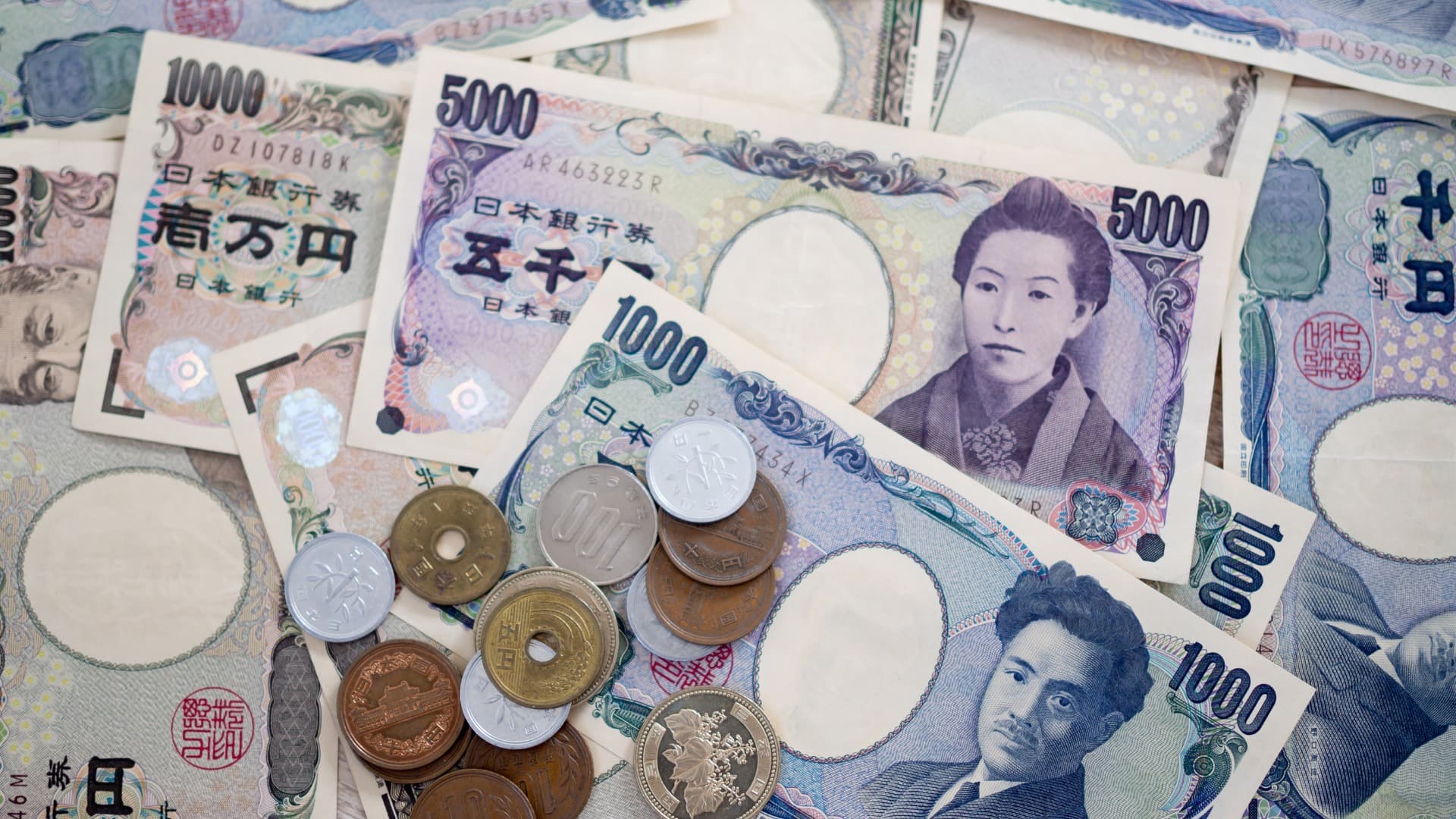
The Japanese yen tumbled to its weakest level against the U.S. dollar in eighteen months on Wednesday, reaching 159.45 per dollar in early Asian trading before recovering slightly amid heightened market volatility, as currency traders brace for potential government intervention while political uncertainty grips Japan’s economic policy landscape.
The currency’s downward spiral, which has seen it shed approximately 3% against the greenback over just two months, has raised alarm bells in Tokyo’s financial district and sparked intense speculation that Japanese authorities may soon be forced to take emergency action to stem the yen’s decline. By midday European trading, the dollar had eased to 158.66 yen, down 0.3%, but the reprieve offered little comfort to officials monitoring the situation.
At the heart of the yen’s weakness lies growing market anxiety over Prime Minister Sanae Takaichi’s aggressive fiscal expansion agenda. Traders are positioning for the possibility that Takaichi could call a snap election as early as next month, potentially securing a commanding parliamentary majority that would give her government free rein to implement large-scale spending programs. Such fiscal stimulus, while potentially boosting short-term growth, would likely further pressure Japan’s currency by widening budget deficits and raising concerns about the sustainability of government finances.
The situation is drawing uncomfortable parallels to earlier episodes last year when Japanese authorities felt compelled to intervene directly in foreign exchange markets. In both April and July 2024, officials stepped in to support the yen after it had depreciated nearly 6% over two-month periods. The current pace of decline, while somewhat slower, has nonetheless put markets on high alert.
“Obviously, the fixation is on dollar-yen, but I think we need to keep a close eye on some of those other yen crosses because they’ve also been surging—euro-yen is at record levels, for example,” said Jeremy Stretch, head of G10 FX strategy at CIBC Capital Markets. He emphasized that intervention decisions typically hinge less on specific currency levels and more on the velocity of movements.
The yen’s troubles extend beyond its relationship with the dollar. The currency has weakened broadly across the board in recent months, depreciating against everything from the euro to emerging market currencies like the Mexican peso, reflecting deep-seated concerns about Japan’s economic trajectory under its new leadership.
Japanese Finance Minister Satsuki Katayama issued a thinly veiled warning on Wednesday, stating that officials stand ready to take “appropriate action against excessive FX moves without excluding any ‘options'”—diplomatic language that currency traders interpret as a signal that intervention remains firmly on the table.
Meanwhile, across the Pacific, the U.S. dollar maintained its strength near a one-month peak against a basket of major currencies. Tuesday’s consumer inflation data, which came in largely as expected, has reinforced market expectations that the Federal Reserve will hold interest rates steady at its upcoming meeting later this month, despite extraordinary political pressure from the White House to cut rates.
The Fed has found itself at the center of an unprecedented political firestorm after President Donald Trump threatened to pursue criminal indictment proceedings against Federal Reserve Chair Jerome Powell on Monday. The threat triggered a sharp sell-off in the dollar, but the currency quickly recovered as a united front of global central bank officials, former Fed chairs, and Wall Street’s top executives publicly rallied to Powell’s defense.
“There’s a very loud chorus of opinion coming from politicians, former Fed chairmen, and other officials that Fed independence is sacrosanct and cannot be interfered with,” observed Brian Martin, head of G3 Economics at ANZ in London, underscoring the broad institutional support for maintaining the central bank’s autonomy.
Adding another layer of uncertainty to currency markets, traders are closely watching for a potential U.S. Supreme Court ruling on the legality of Trump’s emergency tariffs. While analysts at ING suggested markets might “just move on” regardless of the outcome, the decision could have significant implications for trade policy and international economic relations.
In Asian markets, the U.S. dollar held steady at 6.9752 yuan against China’s offshore currency following the release of December trade figures showing the world’s second-largest economy posted a record annual surplus of nearly $1.2 trillion for the year.
In European currency trading, the euro remained flat at $1.1646, while sterling gained 0.2% to reach $1.3447, as traders digested the complex interplay of political pressures, central bank policies, and geopolitical uncertainties shaping global foreign exchange markets.
As the yen hovers dangerously close to the psychologically significant 160-per-dollar threshold, all eyes remain fixed on Tokyo, where officials face the delicate challenge of defending their currency without appearing to panic—a balancing act that could define Japan’s economic credibility in the months ahead.
WHAT YOU SHOULD KNOW
The Japanese yen has plunged to its weakest level in 18 months, hitting 159.45 per dollar, driven primarily by fears that Prime Minister Sanae Takaichi’s big-spending fiscal plans—potentially turbocharged by a snap election next month—will further weaken the currency.
Japanese authorities are now on high alert and have warned they’re prepared to intervene in currency markets “without excluding any options” if the yen continues its rapid descent toward the critical 160-per-dollar mark. The currency’s 3% drop in just two months signals that Tokyo may soon be forced to take emergency action to defend the yen, repeating interventions seen in 2024.