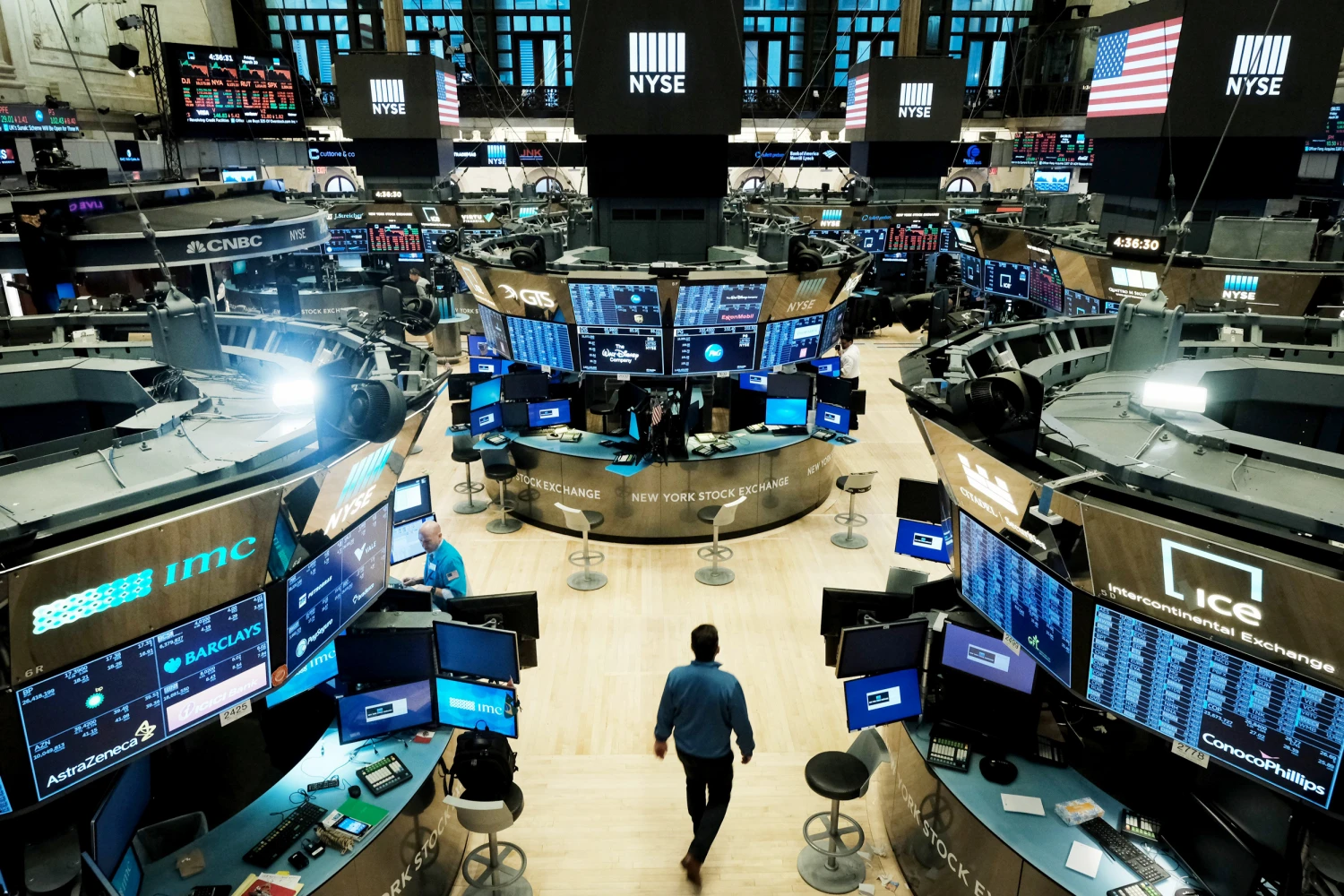
Wall Street wrapped up a lackluster first trading session of 2026 on Friday, with investors navigating thin holiday volumes and positioning themselves for what promises to be a year dominated by Federal Reserve politics and the uncertain payoff from billions in artificial intelligence investments.
The major indexes painted a mixed picture in choppy trading. The S&P 500 edged up 0.19% to close at 6,858.47, while the Dow Jones Industrial Average gained 0.66%, adding 319 points to finish at 48,382.39. Both blue-chip benchmarks snapped four-session losing streaks. The tech-laden Nasdaq Composite, however, slipped 0.03% to 23,235.63, dragged down by weakness in megacap technology stocks.
The subdued action reflected typical post-holiday malaise. “Today is kind of a holiday trading day, lighter volumes, people not engaged normally,” noted Jed Ellerbroek, portfolio manager at Argent Capital in St. Louis. Despite the muted start, value stocks outperformed their growth counterparts, with particular strength in utilities, industrials, and energy sectors—companies positioned to benefit from the buildout of AI infrastructure.
All three major indexes posted losses for the abbreviated trading week, underscoring lingering caution as investors digest the turbulent year that was 2025. Markets demonstrated remarkable resilience last year despite navigating a gauntlet of challenges: escalating tariff disputes, the longest government shutdown in American history, persistent geopolitical tensions, and extraordinary political pressure on the Federal Reserve.
As 2026 unfolds, market participants are zeroing in on monetary policy and the future leadership of the nation’s central bank. Jerome Powell’s tenure as Fed chairman is winding down, and the question of Federal Reserve independence has taken center stage amid President Trump’s vocal criticism of current interest rate levels.
“One of the most important things will be maintaining Fed independence,” said Thomas Martin, senior portfolio manager at Globalt in Atlanta. “Even though the newest members were appointed by Trump and they’re more dovish, they want to at least give the appearance that the Fed is independent because once you lose that, you’re kind of in trouble.”
However, not all market observers share Martin’s optimism about preserving the central bank’s autonomy. Ellerbroek offered a more stark assessment: “President Trump has made it clear that he’s going to appoint someone as chair who is willing to take direction from him, and he wants rates significantly lower than they are today.” He added that “the short-term excitement that lower rates offer is tangible,” suggesting markets may welcome a more accommodative monetary stance regardless of its implications for Fed credibility.
The policy outlook will come into sharper focus in the coming days as a backlog of economic indicators—delayed by the recent government shutdown—finally hits the tape. Employment data due next week will be particularly scrutinized for clues about the economy’s trajectory and the appropriate path for interest rates.
Another critical storyline for 2026 will be whether the massive capital deployed into artificial intelligence infrastructure begins generating meaningful returns. Corporate America has poured hundreds of billions into AI-related projects, from data centers to semiconductor capacity, betting on transformative productivity gains. Investors are growing impatient for concrete evidence that these investments will pay off.
The market action on Friday hinted at this dynamic, with AI beneficiary stocks in industrials and utilities posting gains even as the tech giants that pioneered AI applications sagged.
While U.S. markets treaded water, European bourses roared into the new year with record-setting performances. The pan-European STOXX 600 climbed 0.67%, approaching the symbolic 600-point threshold for the first time. London’s benchmark FTSE 100 achieved its own milestone, crossing 10,000 points for the first time in history. Technology and defense stocks led the European advance.
Emerging market equities surged 1.71%, while Asia-Pacific shares outside Japan jumped 1.75%. Japan’s Nikkei bucked the regional trend, slipping 0.37% to 50,339.48.
Precious metals consolidated after extraordinary 2025 gains. Gold rose a modest 0.36% to $4,329.57 per ounce, having notched its largest annual increase in 46 years. Silver advanced 1.6% to $72.39. The metals benefited last year from Fed rate cuts, geopolitical instability, aggressive central bank purchases, and strong ETF inflows.
The dollar index edged up 0.19% to 98.43, recovering slightly after posting its steepest annual decline in eight years. The euro slipped 0.21% to $1.172.
In cryptocurrency markets, Bitcoin gained 1.69% to $89,789.87, while Ethereum rallied 4.5% to $3,121.09.
Oil prices dipped, with U.S. crude settling at $57.32 per barrel and Brent at $60.75, following their worst annual performance since 2020 as oversupply concerns overshadowed geopolitical risk premiums.
Treasury yields climbed across the curve, with the benchmark 10-year note rising 3.8 basis points to 4.191% as traders positioned ahead of next week’s employment reports.
Looking forward, 2026 promises no shortage of market-moving events. U.S. congressional midterm elections this autumn, ongoing negotiations to resolve Russia’s war in Ukraine, and continuing Middle East tensions all threaten to inject volatility into trading.
After a year that tested investors’ mettle, the message from Friday’s session was clear: uncertainty remains the only certainty as markets navigate the political and economic crosscurrents of a new year.
WHAT YOU SHOULD KNOW
Markets began 2026 on shaky footing with mixed results and muted volumes, but the year’s defining issue is already clear: Federal Reserve independence is under threat.
President Trump is signaling his intent to appoint a Fed chair who will take direct guidance on interest rates, fundamentally challenging the central bank’s autonomy.
This represents a potential paradigm shift in U.S. monetary policy that could have far-reaching consequences for market stability and economic credibility.
Meanwhile, investors are also watching whether the massive AI investment boom—hundreds of billions poured into infrastructure—will finally deliver tangible returns or prove to be overhyped.