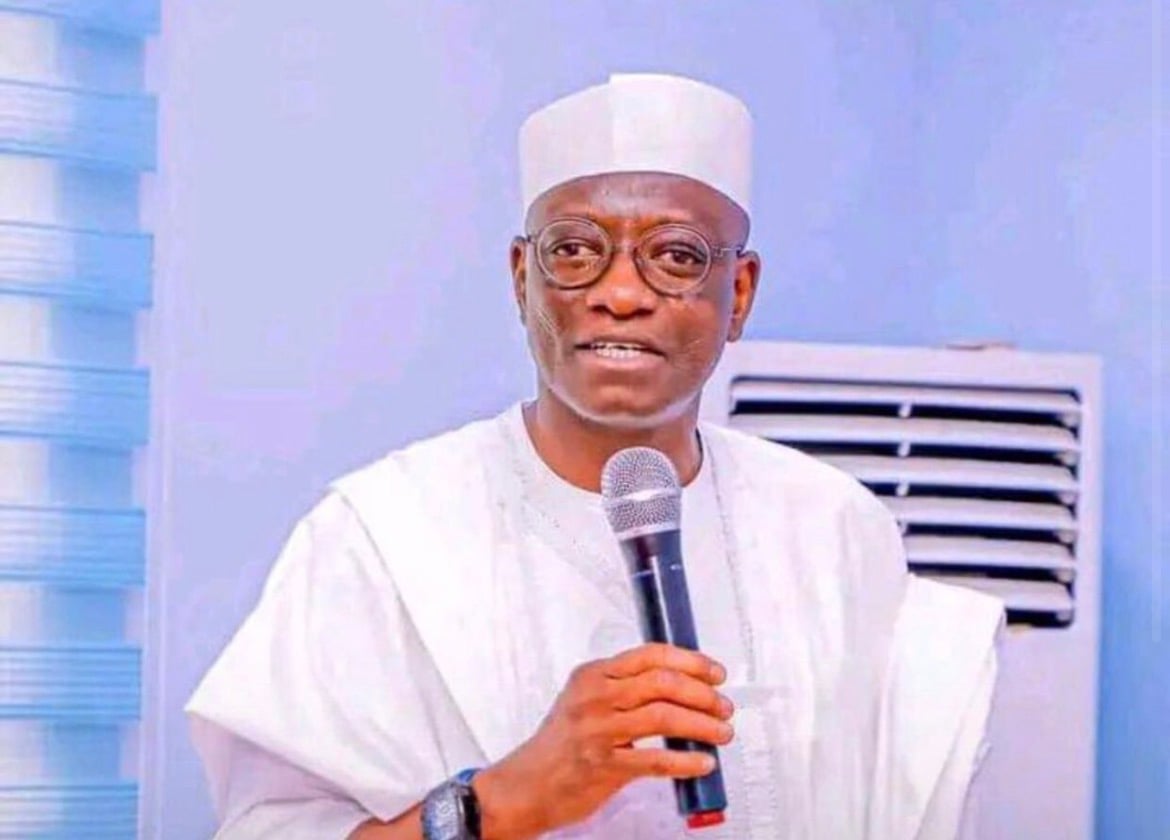
Governor Abdullahi Audu Sule‘s endorsement of Senator Ahmed Aliyu Wadada as his preferred successor has unleashed a torrent of grievances and long-suppressed rivalries threatening to tear Nasarawa APC apart.
At the center of the storm is a single question that is reverberating through the corridors of power in Lafia: in a democracy, does a sitting governor have the right to anoint his successor without consulting the very stakeholders who built the party alongside him?
Speaking with unmistakable conviction, Governor Sule threw his full weight behind Wadada at a public gathering, invoking the philosophy that has defined his administration.
“We have to look for people who have the capacity to win this election. Now all the support, now all of us, if we are sincere about the so-called Muje Maha, now it is the period that Muje Maha is Wadada,” the governor declared, framing the endorsement not merely as a personal preference but as a test of collective loyalty to the governing spirit of his administration.
The Muje Mah philosophy, loosely translated as “we are together,” has been the ideological cornerstone of Governor Sule’s tenure, built on the premise of political inclusion and shared purpose. The irony, his critics now argue, is that the manner of Wadada’s endorsement represents everything that philosophy was designed to avoid.
Few voices in Nasarawa’s political landscape carry the weight of former Governor Umaru Tanko Al-Makura, a two-term senator and one of the APC’s most influential powerbrokers in the North Central geopolitical zone. His reaction to the endorsement was swift, pointed, and deeply personal.
“I was never consulted. This is an aberration. It is too hasty at a time when the party has not even released guidelines,” Al-Makura declared, words that amounted to a public rebuke of a sitting governor from within the same political family.
For Al-Makura, the issue is not Wadada the man, but the process, or the alarming lack of it. His objection cuts to the heart of what democratic party management is supposed to look like. Primaries, consultations, and stakeholder engagements exist precisely so that decisions of this magnitude are not reduced to the preferences of one individual, however powerful.
“We do not have any problem with Wadada or any other aspirant, but let procedures unfold,” he said, a statement that, while measured in tone, was unmistakably a warning shot.
The significance of Al-Makura’s pushback cannot be overstated. As a former governor with a deep political network that stretches from the grassroots in Nasarawa to the highest offices in Abuja, he signals that Governor Sule’s preferred succession plan will face a formidable internal challenge.
Faced with mounting criticism, Governor Sule showed no signs of retreat. Through his media aide, the governor dismissed suggestions of wrongdoing, characterising the endorsement as a carefully considered act of statesmanship rather than political imposition.
“This is careful, deliberate leadership, not imposition,” his office said in a statement that, to critics, seemed to underestimate the depth of the brewing discontent.
The governor further defended his decision to present Wadada to President Bola Ahmed Tinubu at the Presidential Villa, arguing that keeping the party’s national leader informed was not only appropriate but politically necessary.
In doing so, he framed the endorsement within a larger national political context, one where the APC’s federal leadership plays a significant role in shaping outcomes at the state level.
Whether that argument will be enough to pacify the party’s disaffected stakeholders remains to be seen.
Adding another layer of complexity to an already crowded field, former Inspector General of Police Abubakar Adamu has refused to be cowed by the governor’s endorsement of a rival.
In language that left no room for ambiguity, Adamu declared his intention to contest the governorship and defeat Wadada at the polls, regardless of how many political patrons the senator assembles.
His defiance represents a broader mood among aspirants who believe they have been prematurely shut out of a race that has barely begun. For several of them, the governor’s move is not merely premature; it is an affront to the democratic rights of party members who are constitutionally entitled to seek elective office.
The presence of credible, well-connected aspirants like Adamu means that even if Wadada secures the APC governorship ticket through the primary process, the path to victory in the general election could be significantly complicated by the bitterness of aggrieved party members who may choose to sit on their hands, or worse, actively work against the party’s candidate.
Not everyone in the APC is in revolt. The Majority Caucus of the Nasarawa State House of Assembly, led by Speaker Danladi Jatau, has lined up firmly behind Wadada, pledging loyalty to the governor’s decision and calling on other aspirants to close ranks in the interest of party unity.
“We are fully supporting and backing Senator Wadada as Governor Sule’s successor. We will remain loyal to the party and the governor’s decision,” the caucus said, in a show of solidarity that underscores the significant institutional support the governor still commands.
Yet even as the lawmakers urged unity, uncomfortable questions about Wadada himself were surfacing in political circles. Political analyst Charles Agum was blunt in his assessment of the senator’s recent public appearances, suggesting that the endorsed candidate has yet to demonstrate the intellectual and political depth required of a chief executive.
“Instead of focusing on solutions, he seemed more interested in attacking fellow aspirants. That exposed a worrying lack of readiness,” Agum said, a critique that, if widely shared among voters, could undermine the very electability argument that Governor Sule used to justify his choice.
Perhaps the most stinging rebuke came from Douglas Otaru, a former APC Publicity Secretary in Nasarawa State, who combined measured praise for the governor with a devastating political prognosis.
“I will say it again: I won’t stoop too low to criticize Governor Abdullahi Alhaji Sule. He has done well to the best of his conviction, but letting the party run on autopilot for this long has been his biggest mistake,” Otaru said.
He went further, accusing political opportunists within the party of exploiting the governor’s inattentiveness to consolidate power behind the scenes, a charge that paints a picture of an administration that may have lost its grip on the internal dynamics of the very political machinery that brought it to power.
Most provocatively, Otaru called on Governor Sule to recuse himself from overseeing the primary process, arguing that his declared bias in favour of Wadada automatically disqualified him from presiding over any exercise that could be considered free and fair.
“If he values his integrity, he should consider stepping aside to allow for free, fair, and credible primaries ahead of the 2027 general elections,” he stated an appeal that, if ignored, could become a rallying cry for opposition forces both within and outside the APC.
Beneath the surface of the procedural dispute lies a deeper and more historically charged debate about zoning, the informal but politically powerful arrangement through which Nasarawa’s three senatorial districts have traditionally shared access to the governorship since the return to democracy in 1999.
Governor Sule has argued that equity demands the governorship slot be returned to Nasarawa West, the zone from which Wadada hails. It is a position that carries some logical weight, particularly given that Nasarawa South has produced two governors, Al-Makura, who served eight years, and the late Aliyu Akwe Doma, who served four, giving the zone a combined twelve years in the saddle.
But critics, led by a coalition of religious, political, and indigenous community leaders, argue that the zoning conversation must go beyond senatorial districts and reckon with the equity of federal constituency representation.
Their position is that the Nasarawa/Toto Federal Constituency stands as the only constituency in the state yet to produce a governor since the state’s creation, and that this historical omission must be corrected before any other zone makes a second claim.
“It is unjustifiable to return the governorship ticket to the same federal constituency. Equity demands inclusion,” the coalition, led by Alhaji Ali Baba Nasarawa and Mallam Abdulrahman Sani Toto, stated in a joint communiqué.
The group also leveled a particularly sharp charge at Governor Sule, accusing him of abandoning the very zoning principles he once championed, a reversal they warned could cost the APC dearly at the ballot box if left unaddressed.
As the dust continues to settle or more accurately, to swirl around the Wadada endorsement, the Nasarawa APC finds itself at a critical crossroads. The party goes into the 2027 election cycle holding the governorship, controlling the state assembly, and, at least on paper, enjoying the backing of the federal government. These are formidable advantages.
But internal cohesion, the one asset no amount of federal patronage can substitute, is now visibly fraying. The combination of procedural grievances, personal ambitions, unresolved zoning disputes, and open defiance from experienced political actors suggests that Governor Sule’s endorsement, far from closing the succession question, has succeeded only in bringing every unresolved tension within the party roaring to the surface.
Whether Wadada ultimately emerges as the APC’s candidate and whether that candidate can unite a fractured party behind a single flag will depend less on the governor’s endorsement and far more on whether the party’s leadership has the wisdom and the will to manage these competing interests before they consume the party from within.
For now, in Nasarawa State, the real primary season has already begun, and it is not being fought at the ballot box.
WHAT YOU SHOULD KNOW
Governor Sule’s endorsement of Senator Wadada as his preferred successor has done more harm than good, exposing deep cracks within the Nasarawa APC rather than projecting the image of a united, forward-looking party.
A consequential decision was made unilaterally, bypassing the consultation and due process that party democracy demands. Senior stakeholders feel sidelined, credible aspirants feel shut out, and long-standing debates around zoning and equity have been reignited rather than resolved.
In Nigerian politics, an anointed candidate without internal party consensus is a vulnerable candidate. If Governor Sule cannot broker genuine unity among the party’s competing factions before 2027, his endorsement of Wadada may ultimately weaken rather than strengthen the APC’s hold on Nasarawa State.