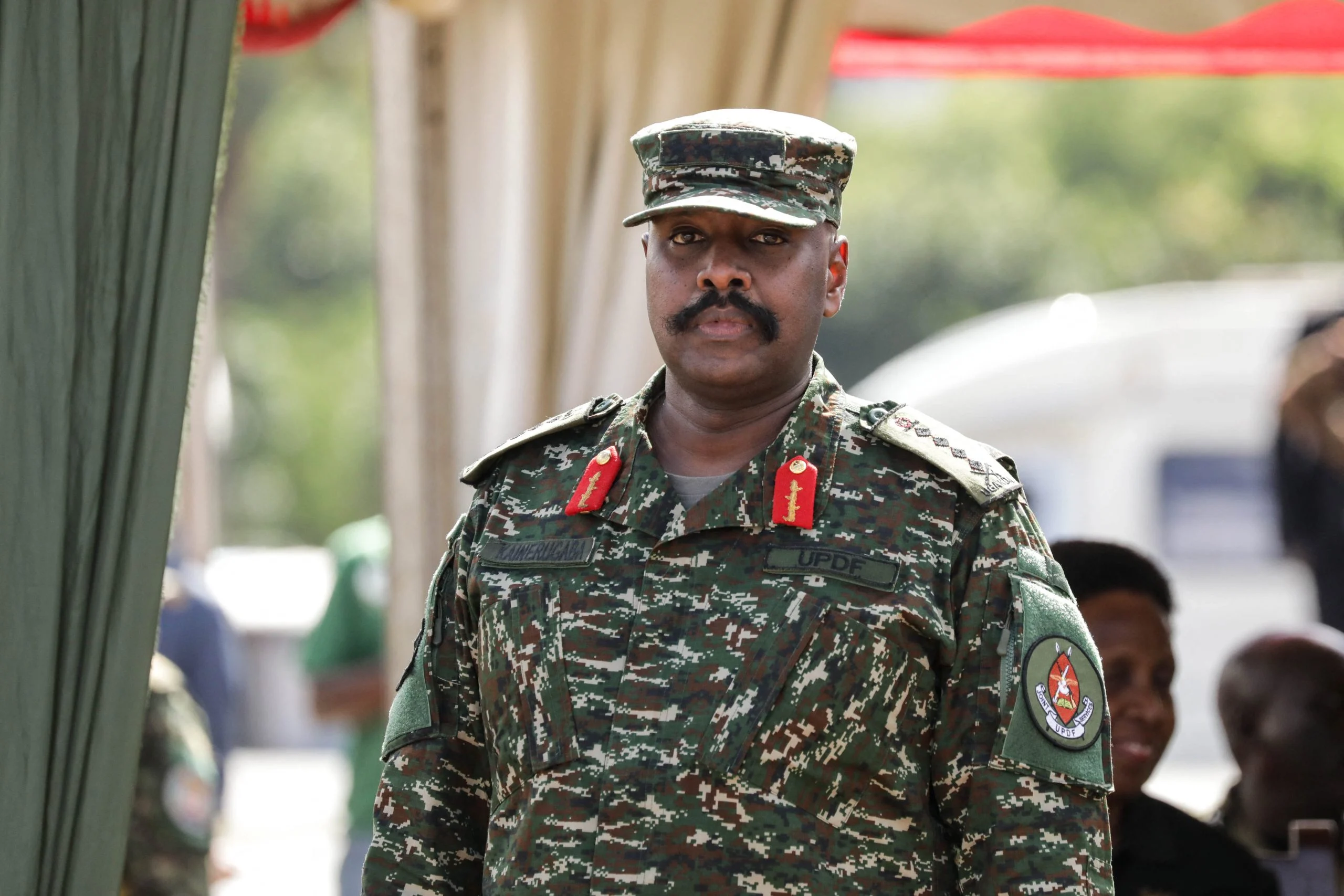
Uganda’s military chief, General Muhoozi Kainerugaba, on Sunday shut down two of the country’s leading media outlets, openly declaring his opposition to a free press in what many are calling the boldest act of media suppression in the country’s recent history.
Kainerugaba, who commands the Uganda People’s Defence Force and is the son of long-serving President Yoweri Museveni, announced a series of posts on X, the social media platform formerly known as Twitter, in what appeared to be an unfiltered and unapologetic display of authoritarian instinct.
“In Uganda, I do not believe in a free press. The press should be guided by cadres of the revolution,” he wrote, in remarks that drew immediate international attention and alarm from press freedom advocates worldwide.
The announcement was no idle threat. Within hours, military personnel had been deployed to the Kampala offices of Nation Media Group, the Nairobi Securities Exchange-listed Kenyan media conglomerate that owns both affected outlets. Journalists, editors, and support staff were prevented from entering or exiting the premises, effectively grinding operations to a halt.
The two organizations targeted are no minor players. The Daily Monitor stands as Uganda’s largest and most widely read independent newspaper, with a decades-long reputation for holding power to account.
NTV Uganda is among the country’s biggest private television broadcasters, commanding a significant share of the national audience. By Sunday morning, NTV Uganda, along with other Nation Media Group television and radio stations operating in Uganda, had gone dark, according to a report by Reuters Africa; their frequencies were silent, their broadcasts interrupted mid-stride.
At the time of publication, General Kainerugaba had offered no specific justification for the shutdowns beyond his sweeping ideological declaration, leaving staff, media owners, and the public to speculate over what, precisely, had triggered the decision.
The Ugandan government’s response was conspicuous in its absence. Government spokesperson Alan Kasujja did not respond to requests for comment, offering no official state position on whether the closures were sanctioned by the presidency or carried out unilaterally by the military chief.
Susan Nsibirwa, the managing director of Nation Media Group Uganda, was equally tight-lipped, stating she had no immediate comment, a silence that speaks volumes in the context of armed soldiers stationed at her organization’s front door.
For those with a long memory of Ugandan politics, Sunday’s events carry the unmistakable echo of history. In 2013, the government of President Museveni shut down the Daily Monitor for ten days following reporting on sensitive succession politics, a move widely condemned at the time as a direct act of political intimidation.
More than a decade later, the same newspaper finds itself shuttered again, this time by the man widely tipped to be his father’s political heir.
Indeed, Kainerugaba’s name has featured prominently in discussions about presidential succession, with many political analysts and opposition figures long suggesting that the general’s carefully cultivated public profile, amplified by an aggressive and often incendiary social media presence, is as much a political project as a military one.
His record on X has previously drawn controversy. Among his more inflammatory posts were threats directed at opposition leader and musician-turned-politician Bobi Wine, real name Robert Kyagulanyi, who has remained one of the most vocal critics of the Museveni administration.
What makes Sunday’s closure particularly disturbing to press freedom advocates is not merely the act itself but the ideological candor with which it was carried out.
Unlike the 2013 shutdown, which was dressed in the language of legal process and government grievance, Kainerugaba’s declaration is notable for its raw honesty: there was no pretense of procedural justification, no reference to court orders or regulatory violations. It was simply the wielding of power, announced publicly, without apology.
“The press should be guided by cadres of the revolution,” he wrote, language that signals not just a disdain for journalistic independence but an ambition to subordinate the fourth estate entirely to the political will of the ruling establishment.
For Ugandan journalists, civil society groups, and ordinary citizens who rely on independent media to navigate an increasingly complex political landscape, the message could not be clearer or more ominous.
WHAT YOU SHOULD KNOW
Uganda’s military chief and presidential heir-apparent, General Muhoozi Kainerugaba, has ordered the shutdown of the country’s largest independent newspaper, the Daily Monitor, and top private broadcaster NTV Uganda not through legal process but through a blunt, public declaration that he simply does not believe in a free press.
Armed soldiers were deployed to enforce the closure. What makes this moment especially alarming is its naked honesty: this was not bureaucratic suppression dressed in legal clothing but the open, unapologetic use of military power to silence independent journalism.
In a country already watching closely to see who succeeds President Museveni, this act sends a stark warning about what kind of Uganda a Kainerugaba leadership would look like.