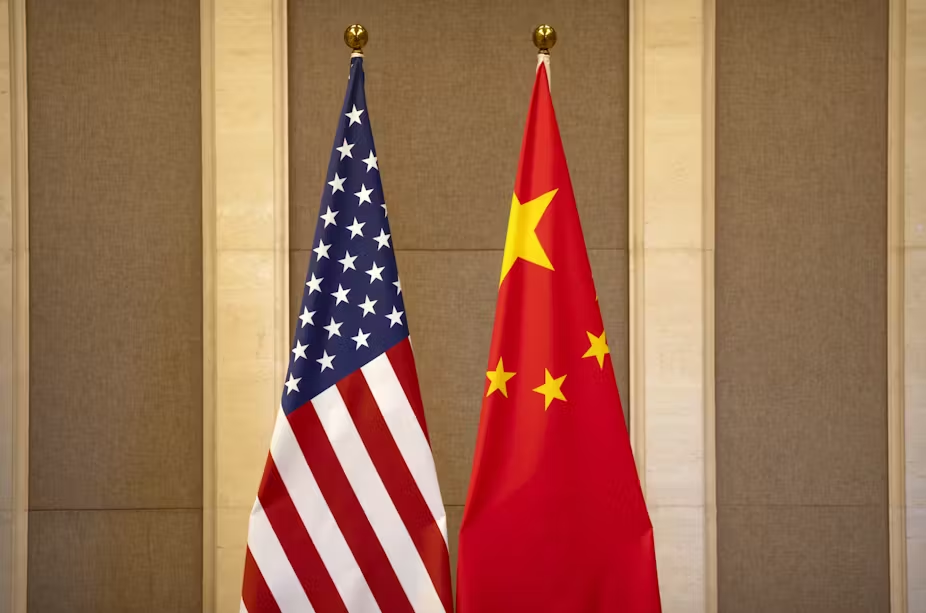
In a dramatic escalation of trade tensions, President Donald Trump on Friday imposed sweeping new tariffs on Chinese imports, shattering a fragile détente between the world’s two largest economies and raising concerns about global economic stability.
The president announced a punishing 100% tariff on all Chinese goods bound for the United States, effectively doubling the cost of products from the Asian giant. The move represents one of the most aggressive trade actions of Trump’s tenure and comes alongside new export restrictions on critical software technologies, set to take effect by November 1.
The announcement arrives with particular urgency as existing tariff relief measures are scheduled to expire just nine days after the software export deadline, setting the stage for a potential full-scale trade confrontation between Washington and Beijing.
Rare Earth Elements Trigger U.S. Response
Trump’s decision came in direct response to China’s recent expansion of export controls on rare earth elements—a category of minerals crucial to manufacturing semiconductors, smartphones, electric vehicles, and advanced defense systems. China controls an estimated 70-80% of global rare earth production, giving Beijing significant leverage in the technology supply chain.
“It was shocking,” Trump told reporters, characterizing China’s move as “very, very bad,” referring to the fact that Beijing’s export restrictions were not explicitly aimed at the United States. The president’s characterization suggests Washington views the Chinese action as a strategic threat to American technological and economic interests.
Summit in Jeopardy
Adding to the uncertainty, Trump cast doubt on a previously announced meeting with Chinese President Xi Jinping, scheduled to take place in South Korea in three weeks. In a post on his Truth Social platform, the president suggested, “Now there seems to be no reason” for the summit to proceed.
However, Trump appeared to soften his stance later when speaking with reporters at the White House. “I haven’t canceled,” he clarified. “I would assume we might have it.” Notably, Beijing has never officially confirmed the meeting, leaving its status ambiguous even before Friday’s escalation.
The diplomatic uncertainty underscores the volatility of U.S.-China relations, which have oscillated between confrontation and negotiation throughout Trump’s presidency.
Economic and Geopolitical Implications
The 100% tariff effectively doubles the price American importers must pay for Chinese goods, costs that are likely to be passed on to consumers and businesses. Economists warn that such measures could reignite inflation, disrupt supply chains, and potentially trigger retaliatory measures from Beijing.
The timing of Trump’s announcement is particularly significant, coming as both nations navigate an increasingly complex geopolitical landscape. China’s dominance in rare earth elements has long been viewed as a vulnerability for the United States, particularly as Washington seeks to bolster domestic semiconductor production and reduce dependence on foreign supply chains.
The new export controls on critical software represent an expansion of existing U.S. restrictions on technology transfers to China, reflecting growing concerns in Washington about technological competition and national security.
What Comes Next
With the November 1 deadline for software export controls looming and tariff relief set to expire days later, both nations face critical decisions in the coming weeks. Whether diplomatic channels can prevent further escalation—or whether the Trump-Xi summit materializes at all—remains unclear.
For now, the trade war that many hoped had been relegated to recent history has returned with renewed intensity, threatening to reshape global commerce and deepen the strategic rivalry between the world’s preeminent superpowers.
WHAT YOU SHOULD KNOW
President Trump has dramatically escalated the U.S.-China trade war by imposing 100% tariffs on all Chinese imports and restricting critical software exports, responding to Beijing’s expanded controls on rare earth elements—minerals essential to technology manufacturing that China dominates globally.
With a potential Trump-Xi summit now uncertain and existing tariff relief expiring in November, this marks a return to full-scale trade confrontation between the world’s two largest economies, threatening higher consumer prices, supply chain disruptions, and deeper geopolitical tensions. The bottom line: the brief trade truce is over, and Americans should brace for economic ripple effects.