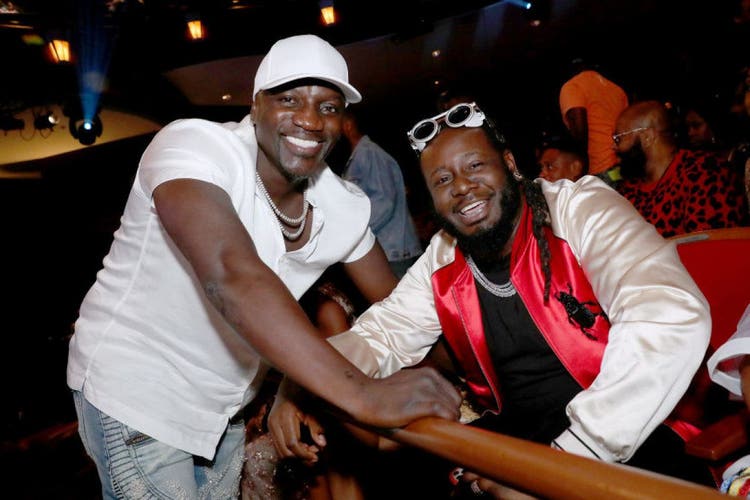
Grammy-winning singer T-Pain has reignited his long-running legal battle with Akon’s Konvict Entertainment, filing a new lawsuit in Fulton County Superior Court that accuses the label of stiffing him on nearly half a million dollars in royalties even after the two sides thought they’d put their dispute to rest just last year.
According to the Atlanta Journal-Constitution, which first reported the filing, the dispute traces back to a $1.3 million payment more than $1.3 million from a distributor in March for music sales generated during the second half of 2025.
Under the terms of his recording agreement, T-Pain says he’s entitled to 75 percent of the net royalties Konvict collects from distributors. By his math, that should have translated into a substantial payout, but the label paid him $489,047 in June while still allegedly owing him another $489,047.
When the remaining balance didn’t materialize, T-Pain’s team says they were redirected elsewhere. Court filings indicate that on June 2, 2026, he was instructed to reach out to BuVision, an independent label managed by Akon’s younger brother Abou “Bu” Thiam, to collect the outstanding balance. But that path reportedly went nowhere.
T-Pain alleges that after attempting to contact BuVision on June 12, 2026, without success, he was left with no option but to sue.
This isn’t T-Pain and Konvict’s first trip to the courthouse. The relationship dates back to 2005, when the singer, born Faheem Rasheed Najm, signed with Akon’s Konvict Muzik at the start of his career, a partnership that helped launch hits off his debut album and cemented him as one of the defining voices of mid-2000s R&B and hip-hop.
That partnership soured over money in 2018, when T-Pain first sued Konvict, alleging he hadn’t been properly paid in connection with his fifth studio album, Oblivion. That fight dragged on for years before finally resolving in a 2025 settlement, under which Konvict agreed to pay T-Pain $114,000 without admitting liability.
Now T-Pain’s attorneys argue that the settlement doesn’t cover the money at issue in this new suit, since the royalties in question stem from sales in the back half of 2025 after the settlement’s cutoff. The new complaint accuses Konvict of breaching both the original 2005 recording contract and the 2025 settlement agreement in one fell swoop.
The lawsuit also notes that T-Pain has been receiving some royalty payments directly from the distributor rather than through Konvict specifically for Freaknik: The Musical, a separate project of his. That detail suggests his business dealings with the label’s distribution partners have grown more fragmented since the original 2005 deal was signed, and it may become relevant if the case turns on how royalties are supposed to flow between the distributor, Konvict, and the artist.
T-Pain is now seeking the remaining $489,047.76, along with prejudgment interest and attorney’s fees. Outlets including XXL have reached out to his legal team for further comment, and Konvict has not yet issued a public response to the new allegations.
For an artist whose distinctive Auto-Tuned sound helped define an era of pop and hip-hop, the recurring litigation underscores a familiar tension in the music industry: legacy contracts signed early in an artist’s career, long before their commercial value was fully realized, can generate disputes that resurface again and again even after a settlement appears to close the book.
Whether this second lawsuit ends in another negotiated payout or heads toward a courtroom decision remains to be seen, but it’s clear the two sides’ 2005 handshake is still, twenty years on, far from fully settled.
WHAT YOU SHOULD KNOW
T-Pain is suing Akon’s Konvict Entertainment for $489,047 in unpaid royalties, alleging the label breached both their original 2005 recording deal and a 2025 settlement that was supposed to close their first legal battle.
Even a signed settlement didn’t end the dispute; new royalty payments from 2025 record sales fell outside that agreement’s scope, pulling both parties right back into court. It’s a reminder that in the music business, old contracts can keep generating fresh legal fights long after an artist’s career takes off.