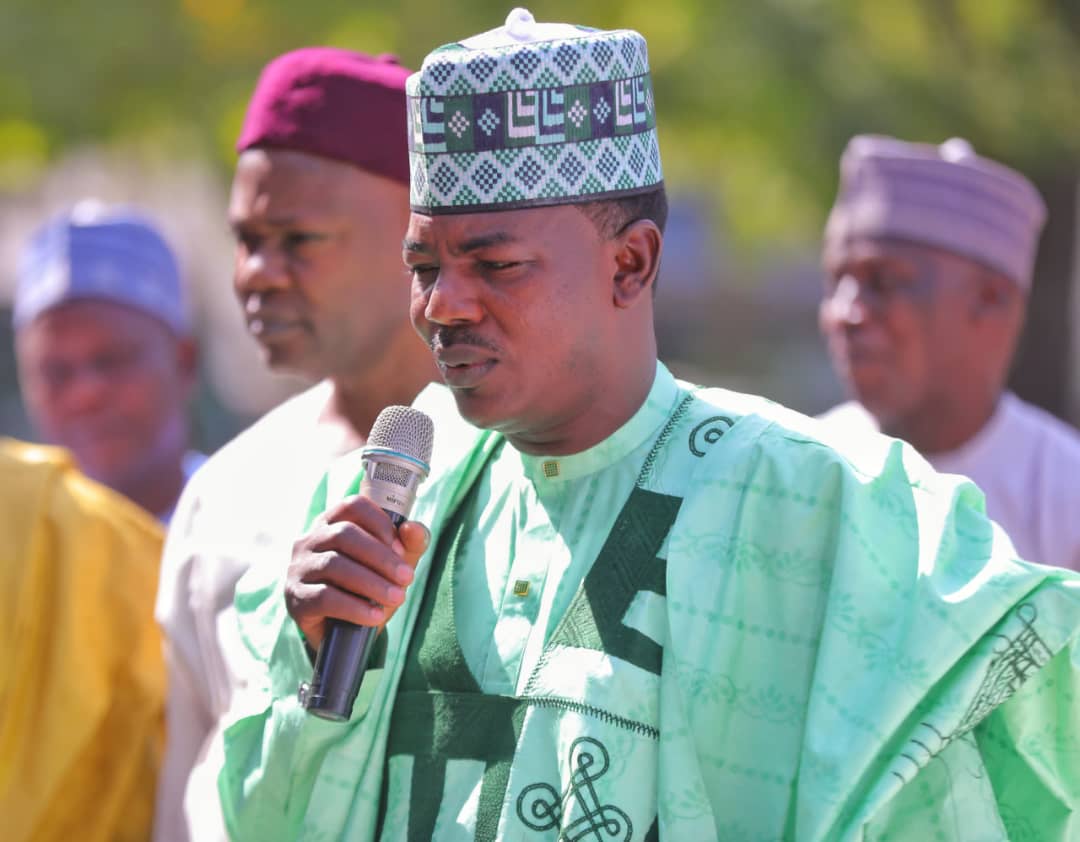
Senator Kaka Shehu Lawan formally withdrew from Borno governorship race and threw his weight behind Mustapha Gubio as the APC’s consensus candidate.
The announcement, which came after a high-powered stakeholders’ meeting held in the nation’s capital, Abuja, effectively ends what had been a potentially divisive internal contest within APC ranks in one of Nigeria’s most strategically significant northeastern states.
The gathering that sealed Lawan’s fate was no ordinary party caucus. Chaired by Vice President Kashim Shettima, himself a former two-term governor of Borno State and a figure whose political influence in the region remains formidable, the meeting brought together an impressive constellation of party heavyweights.
Governor Babagana Zulum, APC leaders, National Assembly members, and members of the respected Borno Elders Forum were all in attendance, lending the proceedings both institutional gravitas and the air of finality.
The presence of the vice president as chair was itself a statement. It signaled that this was not merely a local party affair, but one with the tacit blessing and active facilitation of the presidency itself.
According to a statement released by the senator’s legislative aide, Usman Alkali, the stakeholders resolved unambiguously that Lawan should stand down “to pave the way for Gubio’s emergence as the party’s governorship candidate.” The language, measured and diplomatic, nonetheless left no room for ambiguity: the decision had been made, and it had been made collectively.
For Senator Lawan, the withdrawal is undoubtedly a political concession, yet it is one cushioned by a significant assurance. Alkali confirmed that the senator is expected to retain his Senate seat representing Borno Central Senatorial District following the development.
Whether this was always part of a quiet negotiation or whether it emerged organically from Thursday’s deliberations remains unclear. What is certain is that Lawan’s cooperation was pivotal to the party’s broader objective of presenting a seamless, uncontested front ahead of the elections.
In Nigerian politics, such cooperation rarely comes without some form of assurance, and the retention of his Senate seat appears to be that assurance.
With Lawan’s exit from the race, all eyes now turn to Mustapha Gubio, the man anointed as the APC’s consensus choice.
In a separate statement, Governor Zulum’s spokesperson, Dauda Illiya, confirmed that Zulum himself presented Gubio to Vice President Shettima in Abuja as the party’s preferred candidate, a formal act of endorsement that carries enormous symbolic and political weight.
Zulum, whose own popularity in Borno State remains high on account of his active governance style, described the decision as “a reflection of a united position within the party in the state.” His personal presentation of Gubio to the vice president was as much a political endorsement as it was a ceremonial affirmation that the APC’s internal machinery had reached consensus.
Governor Zulum did not miss the opportunity to acknowledge the role of President Bola Ahmed Tinubu in the outcome, commending him for what he described as leadership and support in navigating the party’s affairs in Borno.
It was a pointed nod to the influence the presidency wields in shaping APC affairs across the federation and a reminder that in Nigeria’s ruling party, very little of this magnitude happens without the awareness, if not the direction, of Abuja’s highest office.
Vice President Shettima’s role as the meeting’s chairman further underscores the federal government’s active interest in ensuring stability within APC-controlled states, particularly in the Northeast, a region that carries both strategic and symbolic importance for the administration.
With the Abuja conclave concluded, party leaders and stakeholders are expected to return to Maiduguri, Borno’s state capital, for further consultations in the coming days.
These follow-up engagements will likely focus on consolidating the consensus, managing any residual tensions, and charting the path forward for Gubio’s formal emergence as the party’s flagbearer.
The APC’s move to resolve its internal contest early through consensus rather than a bruising primary contest reflects a growing recognition within the party that internal divisions are a luxury it can ill afford, particularly in a state that has long been a stronghold of the party and where governance stability is closely linked to the ongoing security challenges in the Lake Chad Basin region.
For now, at least, Borno’s APC appears to have found its man. Whether the consensus holds, and whether Gubio can translate Thursday’s political choreography into an electoral mandate from the people of Borno, remains the defining question as Nigeria’s political season heats up.
WHAT YOU SHOULD KNOW
At a high-powered Abuja meeting chaired by Vice President Kashim Shettima, Borno Central Senator Kaka Shehu Lawan stepped aside from the governorship race, clearing the path for Mustapha Gubio to emerge as the APC’s consensus candidate in Borno State.
With Governor Zulum’s backing and the presidency’s fingerprints firmly on the process, the party has chosen unity over internal contest, a calculated political move designed to secure its grip on one of Nigeria’s most critical northeastern states ahead of the forthcoming elections.