Introduction
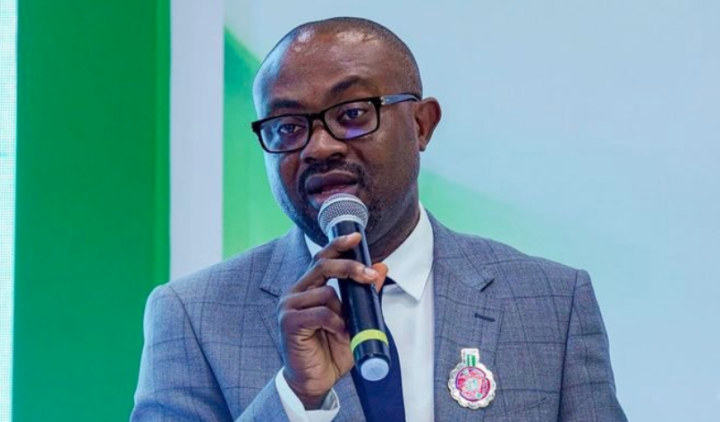
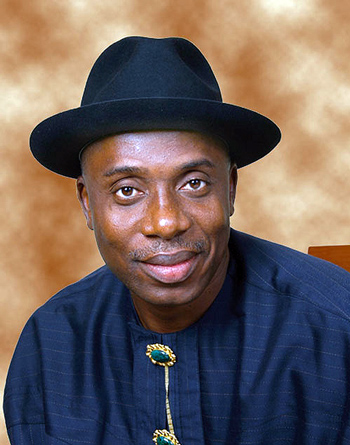
In the turbulent waters of Nigerian politics, few figures navigate with as much controversy, ambition, and resilience as Chibuike Rotimi Amaechi, CON. From his humble beginnings in Ubima, Rivers State, to becoming one of Nigeria’s longest-serving state speakers, a two-term governor, Minister of Transportation, and now a determined presidential aspirant, Amaechi’s journey embodies both the triumphs and tribulations of Nigerian democracy. His dramatic court battle that made him governor, his defection from PDP to APC that helped bring President Buhari to power, his ambitious railway modernization projects, and his bitter feud with successor Nyesom Wike have made him one of Nigeria’s most polarizing political figures. As 2025 ends and he sets his sights on the 2027 presidential election, Amaechi remains a political force whose story is far from finished.
Early Life and Foundation
Chibuike Rotimi Amaechi was born on May 27, 1965, in Ubima, a community in Ikwerre Local Government Area of Rivers State, southeastern Nigeria. He was born to Elder Fidelis Amaechi and Mary Orduah Amaechi (born August 28, 1942), devout Christian parents who raised their children with strong moral values and emphasis on education.
Growing up in the oil-rich but underdeveloped Niger Delta region, young Rotimi witnessed firsthand the contradictions of Nigerian federalism, immense natural resources flowing from his region, while local communities remained impoverished. This early exposure to inequality and injustice would later fuel his political activism and development agenda.
His family background was modest but supportive. His younger brother, Chidi Amaechi, and other siblings formed a close-knit family that emphasized education, hard work, and community service, values that would shape Rotimi’s approach to politics and governance.
Educational Journey
Primary and Secondary Education
Amaechi began his educational journey at St. Theresa’s Primary School from 1970 to 1976. After completing primary school, he enrolled at Government Secondary School, Okolobiri, where he obtained his West African Senior School Certificate (WASC) in 1982.
During his secondary school years, Amaechi developed leadership skills and an interest in public speaking and debate, talents that would later define his political career.
University of Port Harcourt
After secondary school, Amaechi proceeded to the University of Port Harcourt, where he studied English Studies and Literature. During his time at UNIPORT, he was highly active in student politics, serving as President of the National Union of Rivers State Students (NURSS), a position that provided his first taste of political leadership and activism.
He graduated in 1987 with a Bachelor of Arts (Honours) degree in English Literature, having distinguished himself both academically and as a student leader.
NYSC and Early Career
In 1988, Amaechi completed his mandatory National Youth Service Corps (NYSC) program. After NYSC, rather than pursuing a career in teaching or journalism as his English degree might suggest, he joined Pamo Clinics and Hospitals Limited, owned by Dr. Peter Odili, who would later become Deputy Governor and then Governor of Rivers State.
Working at Pamo Clinics from 1988 to 1992 brought Amaechi into the orbit of Peter Odili, establishing a mentor-mentee relationship that would prove pivotal to his political career, though it would later collapse spectacularly.
Recent Academic Achievement
In a remarkable demonstration of lifelong learning, on November 19, 2022, Amaechi announced on social media that he had become a certified graduate of law, posting pictures of his convocation. This law degree, earned while serving as Minister and preparing for his presidential campaign, added legal expertise to his political experience.
Business Interests
Beyond his employment at Pamo Clinics, Amaechi served as a director of several companies, including West Africa Glass Industry Limited and Risonpalm Nigeria Limited, gaining business experience that would inform his later governance approach.
Political Career: The Rise Through Rivers State
Early Political Involvement (1990s)
Amaechi’s political journey began during Nigeria’s turbulent transition programs in the early 1990s:
- Third Republic Transition: Secretary of the National Republican Convention (NRC) in Ikwerre Local Government Area
- 1992-1994: Special Assistant to Peter Odili, then Deputy Governor of Rivers State
- 1996: Rivers State Secretary of the Democratic Party of Nigeria (DPN) caretaker committee during General Sani Abacha’s transition program
Rivers State House of Assembly (1999-2007)
When Nigeria returned to democracy in 1999, Amaechi contested and won a seat in the Rivers State House of Assembly representing his Ikwerre constituency on the PDP platform.
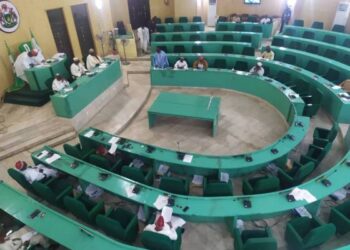
Speaker of the House (1999-2007): Amaechi was elected Speaker of the Rivers State House of Assembly, a position he held for an unprecedented eight years across two legislative terms (1999-2003, 2003-2007). This longevity as Speaker was extraordinary in Nigerian politics, where such positions are usually hotly contested.
National Recognition: As Speaker, Amaechi was elected Chairman of Nigeria’s Conference of Speakers of State Assemblies, giving him national visibility and influence.
Constitutional Victory: In 2003, when the National Assembly attempted to assume control of state house of assembly functions, Amaechi and his colleagues challenged this in the Supreme Court, winning a landmark judgment that affirmed the independence of state legislatures.
The Governorship Saga: Democracy by Judiciary
The 2007 Electoral Battle
In 2007, Amaechi’s relationship with his mentor, Peter Odili, collapsed when Amaechi sought to succeed Odili as governor. What followed became one of Nigeria’s most dramatic electoral sagas:
Winning the Primary: Amaechi contested and won the PDP gubernatorial primary in Rivers State, the real contest in a PDP-dominated state.
Substitution Drama: Despite winning the primary, the PDP national leadership, allegedly influenced by powerful forces including then-President Olusegun Obasanjo, substituted Amaechi’s name with Celestine Omehia, a last-minute replacement.
Legal Challenge: Refusing to accept this injustice, Amaechi challenged the substitution in court, beginning a legal battle that would last months.
Supreme Court Victory: On October 25, 2007, the Supreme Court delivered a landmark judgment, ruling that Amaechi was the rightful PDP candidate and winner of the April 2007 election. The Court ordered that Amaechi be sworn in as governor.
Historic Swearing-In: On October 26, 2007, Chibuike Rotimi Amaechi was sworn in as the fifth Governor of Rivers State, replacing Celestine Omehia, who had served for only five months. This remains one of Nigerian democracy’s most unusual transitions, a governor removed by court order and replaced by the rightful winner.
Governorship: Infrastructure and Controversy (2007-2015)
First Term (2007-2011)
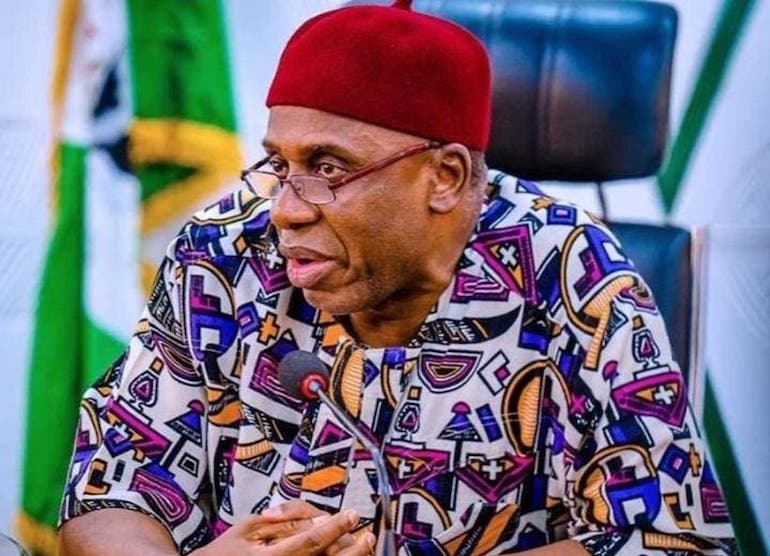
Amaechi’s first term was characterized by ambitious infrastructure projects:
Road Network Development: Massive construction and rehabilitation of roads across Rivers State, connecting previously isolated communities.
Port Harcourt Monorail: Perhaps his most ambitious project, Amaechi initiated construction of a monorail system for Port Harcourt, a pioneering mass transit project that was approximately 70% complete by the time he left office but was later abandoned by his successor.
Power Projects: Construction of power plants at Afam, Trans Amadi, and Onne to improve the electricity supply.
Education Reform: Modernization of primary and secondary schools; UNICEF recognized him as Best Performing Governor in Education in 2012.
Health Infrastructure: Upgraded healthcare facilities across the state.
Airport Development: Construction of the new Port Harcourt International Airport terminal.
Nigeria Governors’ Forum (2011-2015)
In 2011, Amaechi was elected Chairman of the Nigeria Governors’ Forum (NGF), succeeding Dr. Bukola Saraki. He was re-elected in 2013 in a controversial election that split the forum, with Jonah Jang of Plateau State claiming victory in a parallel poll. This position amplified Amaechi’s national influence and visibility.
The G-7 Rebellion and APC Defection
In August 2013, Amaechi joined six other governors to form the G-7 faction within the PDP, opposing President Goodluck Jonathan’s administration and the party’s direction.
On November 30, 2013, Amaechi and five other G-7 governors defected to the newly formed All Progressives Congress (APC), a move that fundamentally altered Nigeria’s political landscape.
Buhari’s Campaign Director-General (2014-2015): Amaechi became the Director-General of Muhammadu Buhari’s 2015 presidential campaign. His organizational skills, political networks, and financial resources were instrumental in Buhari’s historic victory, Nigeria’s first opposition-led electoral defeat of an incumbent president.
Minister of Transportation (2015-2022)
Appointment and Focus
Following Buhari’s victory, Amaechi was appointed Minister of Transportation in November 2015, a position he held for nearly seven years through two presidential terms.
Railway Modernization: The Signature Achievement
Amaechi’s ministerial tenure focused primarily on railway infrastructure modernization, attempting to revive Nigeria’s long-neglected rail sector:
Abuja-Kaduna Rail Line: Completion and commissioning of the 187km standard gauge railway (begun by previous administrations but completed under his watch).
Lagos-Ibadan Rail Line: Construction of the 156km standard gauge railway, with extension to Lagos Port Complex.
Itakpe-Warri Rail Line: Completion of this long-abandoned project connecting the iron ore-rich Kogi State to Delta State.
Port-Harcourt-Maiduguri Rehabilitation: 1,178km narrow gauge line rehabilitation.
Ongoing Projects: Work on the Ibadan-Kano rail line segments and other railway extensions.
Maritime Sector Reforms
Beyond railways, Amaechi oversaw initiatives in Nigeria’s maritime sector:
- Deep Blue Project: Acquisition of special mission vessels, aircraft, and helicopters for maritime security
- NIWA-Lagos State Settlement: Ending a 10-year legal dispute
- Port Modernization: Infrastructure upgrades at major Nigerian ports
Controversies and Corruption Allegations
Amaechi’s ministerial tenure was shadowed by serious allegations:
₦96 Billion Misappropriation: His successor as Rivers governor, Nyesom Wike, accused Amaechi of stealing ₦96 billion ($232 million) from Rivers State treasury, including:
- Selling Rivers State oil and gas assets
- Diverting proceeds to fund Buhari’s 2015 campaign
- Personal enrichment
NDDC Contracts: Wike alleged that Amaechi’s wife’s company received ₦4 billion monthly from the Niger Delta Development Commission to “train Niger Delta women.”
Railway Contract Controversies: Questions about procurement processes, costs, and contractor selection for railway projects.
Amaechi has consistently denied these allegations, describing them as politically motivated attacks by Wike.
The 2023 Presidential Campaign
Declaration and Campaign
On April 9, 2022, Amaechi formally declared his intention to contest for the Nigerian presidency under the APC platform. On May 17, 2022, he resigned as Minister of Transportation to focus on his campaign.
The Primary Defeat
At the APC Presidential Primary on June 8, 2022, Amaechi finished second to Bola Ahmed Tinubu, who eventually won the presidency. Despite his campaign infrastructure, political experience, and railway achievements, Amaechi could not overcome Tinubu’s superior delegate mobilization and financial resources.
The defeat was particularly bitter given Amaechi’s role in bringing the APC to power and his seven years of ministerial service.
The Bitter Feud with Nyesom Wike
The relationship between Amaechi and Wike, once political allies in Rivers State, has become one of Nigerian politics’ most vicious feuds:
Origins: The feud intensified after Wike succeeded Amaechi as governor in 2015 and immediately began investigating Amaechi’s administration.
Mutual Accusations: Both men regularly trade accusations of corruption, incompetence, and character deficiencies.
2024-2025 Escalation: The feud reached new heights in 2024-2025, with both men giving inflammatory interviews and making personal attacks. In July 2025, Wike (now FCT Minister) challenged Amaechi’s academic qualifications and dared President Tinubu to release the NDDC forensic audit that allegedly indicts Amaechi.
Personal Life and Family
Marriage and Children
Amaechi is married to Dame Judith Amaechi, a women’s rights advocate and founder of the Empowerment Support Initiative (ESI), an NGO focused on women and children in the Niger Delta.
The couple has three sons:
- Lemchi Amaechi
- Chimkamkpa Amaechi
- Obinna Amaechi (graduated from a Canadian university in 2019)
Despite his public profile, Amaechi has maintained relative privacy around his family, rarely discussing his children in interviews.
Faith and Values
Amaechi is a devout Roman Catholic and holds the title of Knight of St. John. His Catholic faith has been a guiding force throughout his political career, though critics argue his political practices don’t always align with Christian principles.
Traditional Honours
- Dan Amanan Kasar Hausa of Daura – Honorary title from the Emir of Daura, Katsina State
National Honour
- Commander of the Order of the Niger (CON) – One of Nigeria’s highest civilian honors
Net Worth and Lifestyle
Amaechi’s estimated net worth ranges from $5 million to $30 million (18 billion Naira at higher estimates), though exact figures are disputed. His wealth derives from:
- Political salaries and allowances over 26+ years
- Business interests and directorships
- Alleged proceeds from government positions (per critics)
The Infamous “Unemployment” Statement
In 2020, Amaechi sparked national outrage when he admitted: “I joined politics because I was unemployed, not because I wanted to solve Nigeria’s problems.” This candid confession, intended as honesty, was widely condemned as revealing the selfish motivations of many Nigerian politicians who enter public service for personal gain rather than national development.
Current Status: The 2027 Presidential Ambition
Leaving APC for ADC
Following his 2023 primary defeat, Amaechi has positioned himself for another presidential run in 2027. In late 2025, he confirmed plans to seek the African Democratic Congress (ADC) presidential ticket, arguing it is “the turn of Southern Nigeria” to produce Nigeria’s next president.
Campaign Promises
In December 2025, Amaechi announced his cabinet plan if elected:
- 21 male ministers and 21 female ministers (equal gender representation)
- Significant appointments for young people
- Gender-blind performance evaluation
Campaign Activities
Kaduna Posters (December 2025): Campaign posters featuring Amaechi with messages about “unity, equality, stability, and development” appeared across the Kaduna metropolis, fueling speculation about intensifying campaign preparations.
Rejection of VP Slot: Amaechi dismissed reports that Atiku Abubakar was considering him as a running mate, insisting he is pursuing the presidency, not a subordinate position.
Legacy Assessment
Achievements
- Eight years as Speaker – unprecedented longevity
- Infrastructure Governor – roads, bridges, monorail, power plants
- Railway Modernization – reviving Nigeria’s rail sector
- Political Kingmaker – instrumental in Buhari’s 2015 victory
- Democratic Fighter – The Supreme Court battle established important legal precedents
Controversies
- Corruption Allegations – unresolved claims of misappropriating billions
- Abandoned Monorail – signature project incomplete
- Railway Cost Questions – procurement transparency concerns
- “Unemployment” Admission – damaged public trust
- Wike Feud – toxic political warfare
Conclusion: A Political Survivor Eyes One More Fight
At 60 years old (as of December 2025), Rotimi Amaechi remains one of Nigerian politics’ most formidable figures, experienced, connected, and relentlessly ambitious. His journey from Ubima village to national power, marked by both genuine achievements and serious controversies, embodies Nigeria’s political paradoxes.
Whether he can overcome his 2023 defeat, the corruption allegations, and the stigma of being a “political freeloader” (as the APC labeled him in 2024) to achieve his presidential dream in 2027 remains uncertain. What is certain is that Amaechi, the man who joined politics because he was unemployed but went on to govern one of Nigeria’s wealthiest states and modernize the country’s railways, will not fade quietly into retirement.
As campaign posters proliferate and 2027 approaches, Chibuike Rotimi Amaechi prepares for perhaps the most important political battle of his life. Win or lose, his story will remain a defining chapter in Nigeria’s democratic journey, a testament to the possibilities, perils, and persistent ambiguities of Nigerian politics.
Quick Reference: Rotimi Amaechi at a Glance
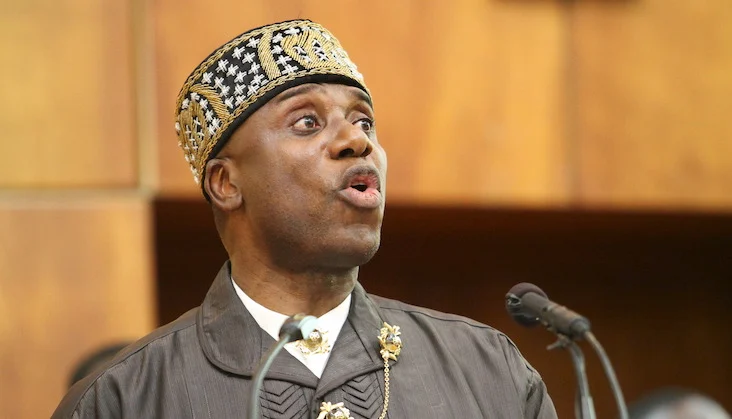
Full Name: Chibuike Rotimi Amaechi, CON
Date of Birth: May 27, 1965
Age: 60 years (as of December 2025)
Place of Birth: Ubima, Ikwerre LGA, Rivers State
Parents: Elder Fidelis Amaechi and Mary Orduah Amaechi
Education:
- St. Theresa’s Primary School (1970-1976)
- Government Secondary School, Okolobiri (WASC, 1982)
- University of Port Harcourt (B.A. Honours in English Literature, 1987)
- Law degree (graduated 2022)
Political Career:
- Speaker, Rivers State House of Assembly (1999-2007, 8 years)
- Governor of Rivers State (October 26, 2007 – May 2015, 2 terms)
- Chairman, Nigeria Governors’ Forum (2011-2015)
- Director-General, Buhari Presidential Campaign (2014-2015, 2018-2019)
- Minister of Transportation (2015-2022)
- 2023 Presidential Aspirant (APC Primary – 2nd place)
- 2027 Presidential Aspirant (ADC platform)
Wife: Dame Judith Amaechi (NGO founder)
Children: Three sons (Lemchi, Chimkamkpa, Obinna)
Religion: Roman Catholic (Knight of St. John)
National Honour: Commander of the Order of the Niger (CON)
Traditional Title: Dan Amanan Kasar Hausa of Daura
Net Worth: $5-30 million (estimates vary)
Major Achievements:
- Supreme Court victory establishing democratic precedent
- Infrastructure development in Rivers State
- Railway modernization as the Transportation Minister
- Education reforms (UNICEF Best Governor, 2012)
Major Controversies:
- ₦96 billion corruption allegations by Wike
- Abandoned Port Harcourt monorail project
- “I joined politics because I was unemployed” statement (2020)
- Bitter feud with successor Nyesom Wike
Current Status: Preparing for 2027 presidential campaign under ADC; promises 50/50 male-female cabinet