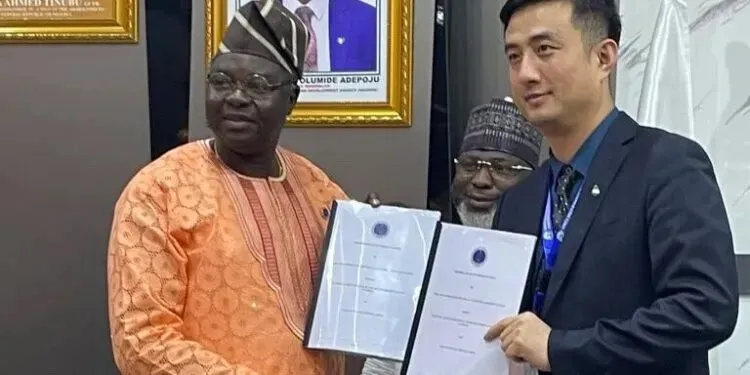
In a landmark agreement poised to redefine Nigeria’s digital future, the National Space Research and Development Agency (NASRDA) on Wednesday formalized a partnership with China’s Galaxy Space to roll out nationwide direct-to-device (D2D) satellite communication by the close of 2025.
The memorandum of understanding, signed in Abuja, sets the stage for Nigeria’s integration into Galaxy Space’s low-cost, low-Earth orbit satellite constellation, which has already demonstrated success across parts of Asia and South America.
Under the terms, ordinary mobile phones and laptops will soon be able to access satellite signals directly—bypassing traditional mobile towers and unlocking connectivity for remote communities and vital services.
Dr. Matthew Adepoju, Director-General of NASRDA, hailed the project as a transformational stride. “We are leapfrogging the last mile,” he declared at the ceremony. “When this network goes live, no village, field research station or emergency team will ever again be outside the coverage map.”
The partnership aims not only at infrastructure but also human capital. It includes a robust technology-transfer component, joint research and development laboratories, and the co-construction of a CubeSat with Nigerian engineers onboard. As part of the collaboration, selected engineers will receive hands-on training in Shenzhen this summer, before returning to spearhead local assembly of the satellite infrastructure.
Representing Galaxy Space, executive Sam Xiao praised Nigeria’s potential as a continental innovation hub. “Nigeria is the natural launchpad for Africa,” he said, citing the company’s successful Mini-Spider satellite test that streamed live video between Beijing and Bangkok using a standard mobile device. “The Abuja project could become the blueprint for expansion across the continent.”
Currently, more than 25 million Nigerians lack access to 4G coverage. The advent of D2D satellite technology is expected to close this stubborn connectivity gap, while also serving as a reliable backup for banking systems, hospitals, and critical government infrastructure.
The announcement comes at a pivotal time, as the federal government intensifies efforts to modernize digital access and decentralize high-speed internet services.
Dr. Adepoju also drew a contrast with Elon Musk’s Starlink, whose D2D offering remains exclusive to a handful of wealthy nations. By contrast, Galaxy Space’s roadmap, according to him, sets a commercial target for Nigeria within 18 months.
Beyond connectivity, NASRDA emphasized the national security and industrial benefits of the agreement. “Nigeria must stop importing every critical device,” Adepoju asserted, pointing to plans for local terminal production and satellite development.
The move ties directly into President Bola Tinubu’s broader digital economy strategy, which envisions a $1-trillion tech-driven economy by 2030.
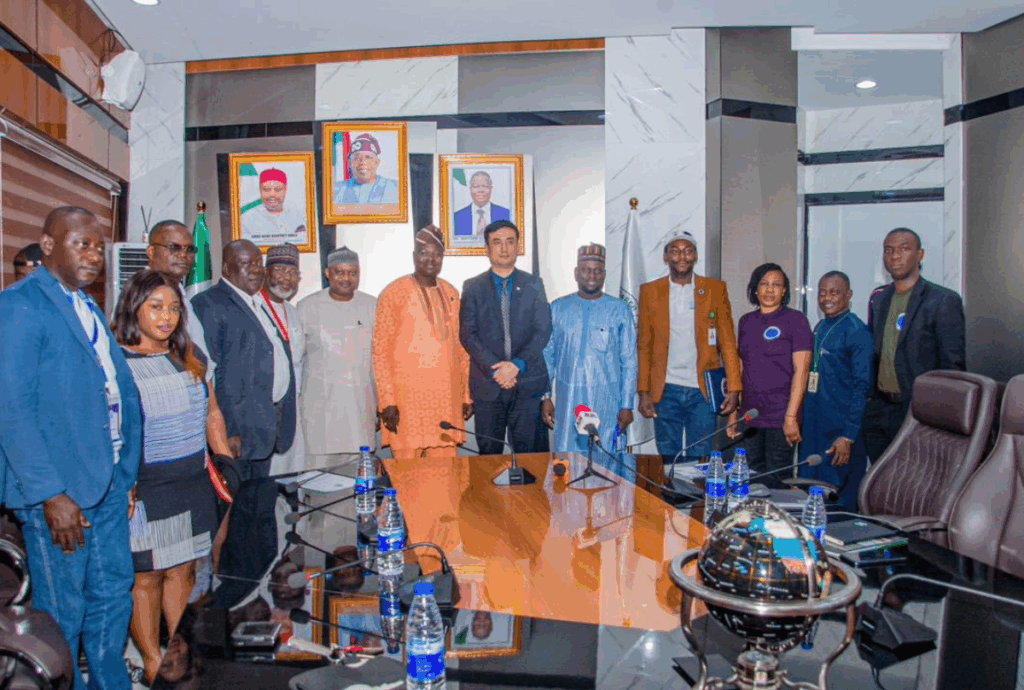
The initiative also supports NASRDA’s ambition to train 1,000 youths annually in space and satellite technologies, with a long-term goal of placing Nigerian astronauts in orbit within the next decade.
Nonetheless, experts urge caution. Coordinating satellite spectrum with existing local telecom providers, as well as maintaining tight cybersecurity standards, will be essential for the project’s success. A ministry official summed up the task ahead with a humorous jab: “If we can put Lagos traffic in orbit, we can certainly put broadband in the bush.”
With contracts inked and joint technical groups established, Nigeria is now positioned to become Africa’s flagship testing ground for direct-to-device satellite communications—ushering in a new era of digital inclusion and technological sovereignty.
What You Should Know
- MoU Signed: NASRDA and Galaxy Space signed an agreement on June 18, 2025, to deploy D2D satellite communication in Nigeria by the end of 2025.
- Technology Integration: Galaxy Space’s low-Earth-orbit satellites will enable unmodified smartphones and laptops to connect directly to orbit, bypassing terrestrial infrastructure.
- Capacity Building: The deal includes technology transfer, joint R&D, and co-production of a CubeSat, with Nigerian engineers training in Shenzhen to assemble equipment.
- Connectivity Gap: The initiative targets Nigeria’s 25 million unconnected citizens, offering resilient links for critical sectors and rural areas.
- Strategic Goals: The project supports Tinubu’s $1 trillion digital economy vision and NASRDA’s plans to train 1,000 youths annually and launch astronauts by 2035.
- Challenges Ahead: Successful implementation requires spectrum coordination with telecoms and strong cybersecurity to protect the network.