Nigerian onion traders have again suspended exports to Ghana, the latest flare-up in a months-long dispute that has kept regional officials scrambling to protect one of West Africa’s busiest trade corridors.
The National Onion Producers and Marketers Association of Nigeria (NOPMAN) announced the suspension through its national president, Alhaji Aliyu Maitasamu, in Sokoto on Sunday, according to a report carried by the News Agency of Nigeria (NAN).
Maitasamu said the association had run out of options after exhausting every available channel to resolve the disagreement, and that the halt would stay in place “until an amicable and mutually acceptable agreement is reached between the two countries on the modalities governing onion trade.”
It is a line Maitasamu has now used more than once this year, and that repetition is itself part of the story.
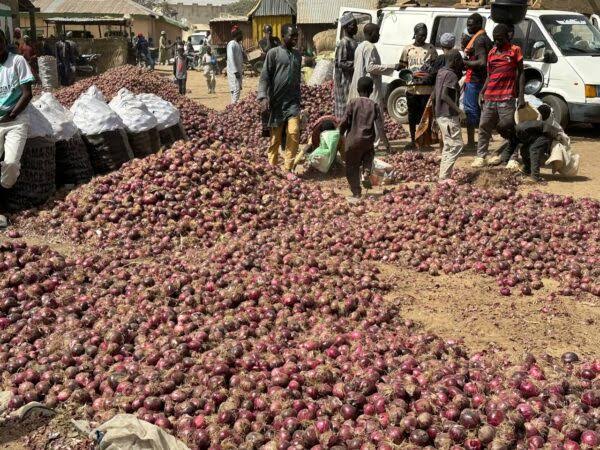
This is not the first time Nigerian traders have shut off the taps to Ghana. The onion corridor between the two countries, a lifeline for farmers in Nigeria’s north and consumers in Ghana’s markets, has been rocked by a string of stoppages since early 2026, each one triggered by disputes over how Nigerian consignments are handled once they cross into Ghanaian territory.
The trouble first came to a head in April, when Nigerian trucks loaded with onions were seized at the Kotoku Market in Accra. Isa Aliyu, then speaking for the association, described the situation as one of persistent harassment and intimidation, and said the confiscation of trucks amounted to a clear violation of trade norms.
The standoff traced back to a dispute over market allocation: certain Ghanaian trader unions were reportedly pushing to have onion volumes traditionally reserved for the Accra Onion Sellers Association reassigned to their own members, and tensions boiled over when more than a dozen Nigerian trucks were impounded as a result.
That April episode was resolved within roughly five days, after diplomatic engagement between Nigeria’s High Commissioner to Ghana and Ghana’s Minister of Trade, alongside Ghanaian authorities’ arrest of those blamed for an outbreak of violence at the market.
Trade resumed, but the underlying grievances were never fully settled, and the association warned even then that talks would need to continue to “finalise everything.”
They didn’t stay finalised for long. Weeks later, similar trouble surfaced again: five more Nigerian trucks were held up at the same Ghanaian market for several days, this time after a traders’ group there blocked the vehicles from offloading.
ECOWAS intervened directly to secure the trucks’ release, a move Maitasamu, who also heads the Regional Observatory of Onion in West and Central Africa (ORO/WCA), praised as timely, while cautioning that the region still lacked the kind of permanent framework needed to stop these flare-ups from becoming routine.
Nigerian exporters have separately put a price tag on the damage: the association has cited losses of roughly N1.2 billion tied to delays and restrictive offloading procedures at Kotoku Market, where consignments have at times been processed at a rate of only two trucks a day.
Against that backdrop, Sunday’s announcement reads less like an isolated incident and more like the latest round in a dispute that keeps resurfacing faster than it can be permanently resolved.
Maitasamu was careful to frame the move as a pressure tactic rather than an act of hostility toward regional trade, insisting the suspension was designed to draw the attention of the relevant authorities to the difficulties faced by Nigerian traders and to secure a lasting solution.
He renewed the association’s call for ECOWAS to intervene and urged the governments of both Nigeria and Ghana to move urgently to resolve the disagreement, language that closely echoes the appeals made after the April crisis and the subsequent truck seizures in July.
Maitasamu also flagged the human cost of letting the standoff drag on. A prolonged disruption, he warned, could inflict significant economic losses across the entire onion value chain farmers, producers, exporters, transporters, wholesalers and retailers alike.
Restoring the flow of onions between the two countries, he argued, would do more than settle accounts on both sides of the border; it would help rebuild confidence in cross-border agricultural commerce across West Africa and protect the livelihoods of the thousands who depend on it.
What makes this latest suspension notable is less the immediate trigger, which NOPMAN has not detailed in as much depth this time, and more the pattern it fits into. Each previous flare-up has ended in a negotiated, ad hoc fix: diplomatic phone calls, arrests, or direct ECOWAS mediation to free detained trucks.
None has produced the kind of binding framework that traders say is actually needed.
That gap has not gone unnoticed within the association itself. Following the July truck seizures, NOPMAN’s umbrella body pressed both the Nigerian and Ghanaian governments, together with ECOWAS, to formalise a memorandum of understanding governing cross-border onion trade one that would spell out clear rules for handling, offloading and dispute resolution, and that would carry real sanctions for any party found to violate the terms.
Officials on both sides welcomed ECOWAS’s swift response to that crisis as proof of the bloc’s commitment to protecting free movement of goods, but the association itself was blunt that the resolution amounted to only a temporary fix.
Sunday’s suspension suggests that temporary fix has, once again, run its course.
Whether this round ends the way the others have with a rushed round of diplomacy and a resumption of trade within days or finally forces the more durable framework traders have been asking for all year may determine whether West Africa’s next onion dispute is its last, or simply its next in a long line.
WHAT YOU SHOULD KNOW
This isn’t a one-off spat; it’s the latest in a string of suspensions this year (April’s Kotoku truck seizures, July’s detained trucks) that keep getting patched over with quick diplomatic fixes instead of a real, binding framework.
Until Nigeria, Ghana, and ECOWAS agree on permanent rules for handling cross-border onion trade, these disruptions will keep recurring and each time, it’s farmers, transporters, and traders on both sides who absorb the losses.