
Nigeria has completed the deportation of the remaining 51 foreign nationals convicted of cyber-terrorism, internet fraud, and related financial crimes in Lagos, marking the end of one of the country’s largest cybercrime crackdowns in recent history.
The operation, jointly carried out by the Economic and Financial Crimes Commission (EFCC), the Nigerian Immigration Service (NIS), and the Nigerian Correctional Service (NCoS), brings the total number of deported convicts to 192.

The mass deportation followed a December 10, 2024, sting operation at Oyin Jolayemi Street, Victoria Island, Lagos, where 759 suspects were arrested after the EFCC received credible intelligence exposing one of Nigeria’s biggest foreign-led cybercrime and Ponzi scheme syndicates.
Following extensive investigations and court proceedings, the Federal High Court in Lagos convicted 192 of the suspects under the Advance Fee Fraud and Other Related Offences Act, 2006, ordering their deportation after serving prison sentences.
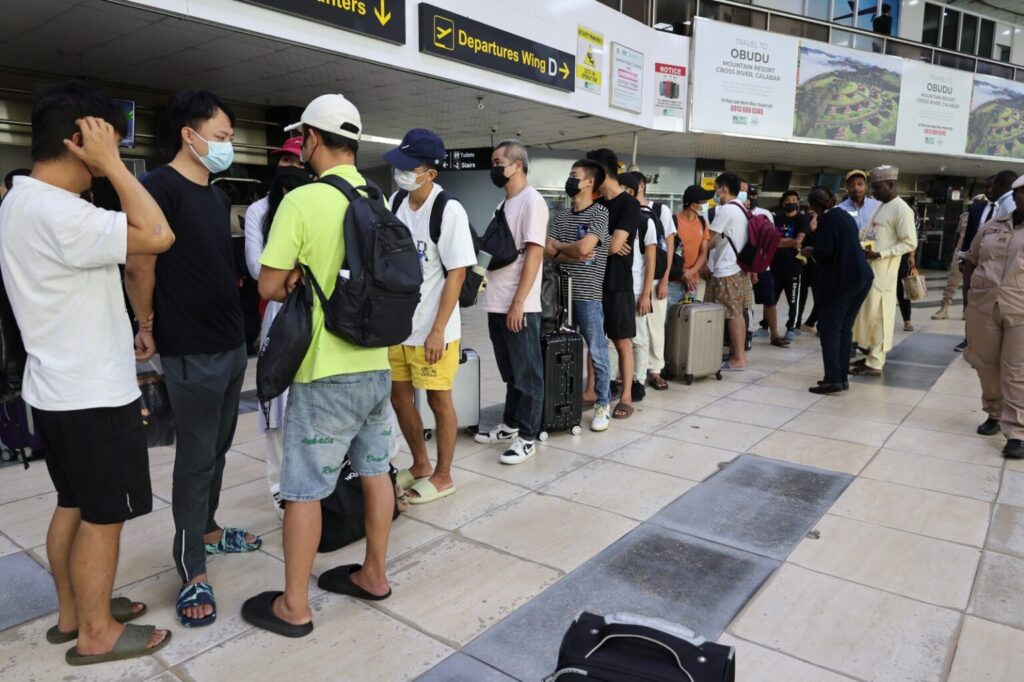
The deportees—comprising nationals from China, the Philippines, Tunisia, Malaysia, Timor-Leste, Pakistan, and Kyrgyzstan—were repatriated in coordinated batches between mid-August and mid-October 2025. The final batch, made up of 50 Chinese nationals and one Tunisian, was flown out on October 16, 2025.
In an official statement, EFCC Chairman Ola Olukoyede hailed the operation as “a strong statement of Nigeria’s resolve to rid its cyberspace of transnational criminal networks.”
“This milestone underscores our commitment to protecting Nigeria’s digital and financial ecosystem. The EFCC, under my leadership, will continue to act swiftly on intelligence, prosecute offenders, and recover proceeds of crime in line with President Bola Ahmed Tinubu’s anti-corruption drive,” Olukoyede stated.

He praised the NIS and NCoS for their collaboration, noting that the synergy among agencies ensured smooth prosecution and deportation processes.
According to EFCC records, the convicted foreigners were involved in large-scale cybercrimes such as identity theft, online romance scams, Ponzi investment schemes, and digital training for fraudulent operations under the guise of Genting International Co. Limited.

The Commission revealed that critical evidence—including confiscated digital devices and servers—played a key role in securing the convictions. It further emphasized that the syndicate’s activities posed a severe threat to Nigeria’s national security and financial integrity.
What You Should Know
The December 2024 Lagos cybercrime raid is considered one of Nigeria’s most significant anti-cybercrime operations.
It not only dismantled a sophisticated foreign-led fraud syndicate but also reinforced the EFCC’s growing effectiveness in tackling transnational financial crimes and safeguarding Nigeria’s digital landscape.