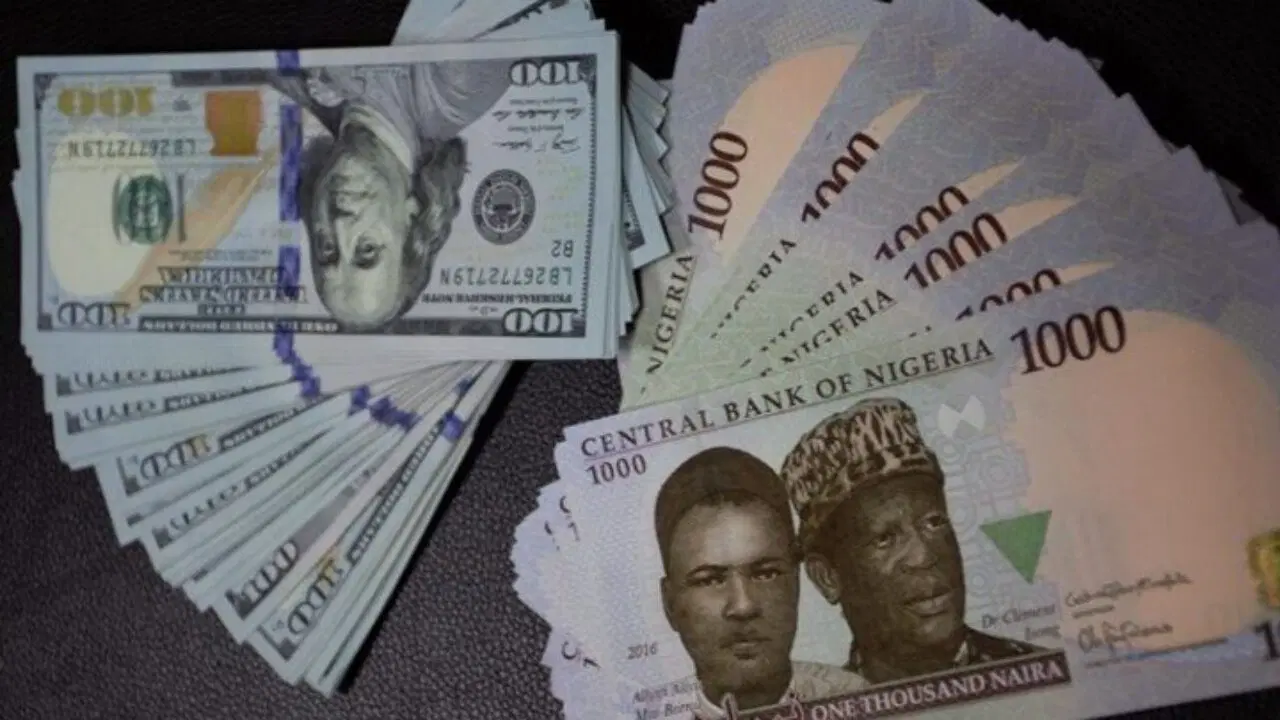
The Nigerian naira delivered a split performance against the United States dollar on Tuesday, closing at ₦1,367.29/$1 on the official Nigerian Foreign Exchange Market (NFEM), even as it came under fresh pressure in the unofficial channel, where dealers quoted the greenback at around ₦1,400.
The figures extend a now-familiar pattern that has defined Nigeria’s currency market through the first week of July: quiet resilience at the formal window, contrasted against creeping depreciation on the street.
At the official rate, Tuesday’s print of ₦1,367.29 represents a slight strengthening of the naira, compared with earlier in the week, when the currency traded at ₦1,370.33 on Monday and ₦1,369.04 on Friday, according to central bank data.
The NFEM rate, published daily by the Central Bank of Nigeria (CBN), is calculated as a volume-weighted average of transactions executed on the platform and serves as the benchmark for government and formal commercial dealings.
The parallel market told a different story. Bureau de Change (BDC) operators and street traders in Lagos, Abuja, and Kano were quoting the dollar for sale at ₦1,400, with buying rates trailing slightly behind at roughly ₦1,385, a gap that some independent trackers pegged even wider, with parallel rates elsewhere touching ₦1,410–₦1,420 in recent days.
That marks a modest but persistent depreciation from the near-convergence seen just days earlier, when official and unofficial rates briefly closed within single digits of each other on July 3.
The spread between the two markets, now sitting at roughly ₦33, remains a fraction of the chasm that once separated Nigeria’s official and black-market rates, a gap that, at its worst in past years, ran into the hundreds of naira and fueled arbitrage, round-tripping, and speculative attacks on the currency.
Analysts point to this narrowing spread as tangible evidence that CBN’s unification and liquidity reforms, rolled out over recent years, are continuing to anchor expectations and choke off the incentive for FX round-tripping.
Still, the persistence of any gap at all underscores an uncomfortable reality for policymakers: demand for dollars outside the official window has not disappeared.
Importers, manufacturers, and individuals unable to secure adequate allocations through NFEM continue to turn to BDCs and street dealers, sustaining pressure on the parallel segment even as the official rate holds firm.
Foreign exchange analysts attribute the parallel market’s softness to sustained dollar demand from end-users who either cannot access the official window or need FX faster than formal channels allow.
This structural demand from businesses covering import bills, travelers, and households sending remittances continues to outstrip the informal market’s supply, even as the official market benefits from more predictable liquidity support.
Looking ahead, analysts say the naira’s trajectory will hinge on a familiar set of variables:
- Dollar liquidity in the banking system and how consistently the CBN can supply it
- Crude oil earnings, still Nigeria’s primary source of foreign exchange
- Foreign portfolio investment (FPI) inflows, which remain sensitive to interest rate differentials and investor sentiment toward emerging markets
- Continued CBN intervention, both direct and through policy tools aimed at improving price discovery
Zooming out, the naira’s current band trading in the ₦1,360s to ₦1,400s reflects a period of relative calm compared to the sharp volatility of previous years.
Year-on-year, the currency has actually strengthened by close to 11%, even though it has softened marginally over the past month. That said, the currency remains far from the sub-₦1,400 lows it touched briefly in February, and analysts caution that any shock to oil revenues or a pullback in portfolio inflows could quickly reopen the gap between Nigeria’s two exchange rate windows.
For now, though, Tuesday’s numbers suggest a market in a holding pattern, one where official reforms are working well enough to keep the two rates from drifting too far apart but not so well as to eliminate Nigeria’s enduring appetite for dollars outside the formal system.
WHAT YOU SHOULD KNOW
The naira’s story on July 7 is one of controlled divergence: stable at ₦1,367.29 officially and weaker at ₦1,400 on the street, but the ₦33 gap between them, not either rate alone, is the number that matters.
It’s the clearest sign that CBN’s reforms are working to keep Nigeria’s two FX markets from drifting apart the way they used to.
For anyone watching, the naira going forward isn’t today’s rate, but whether that spread stays narrow because a widening gap would signal returning dollar scarcity and renewed pressure on the currency, while a stable or shrinking one confirms the reforms are holding.