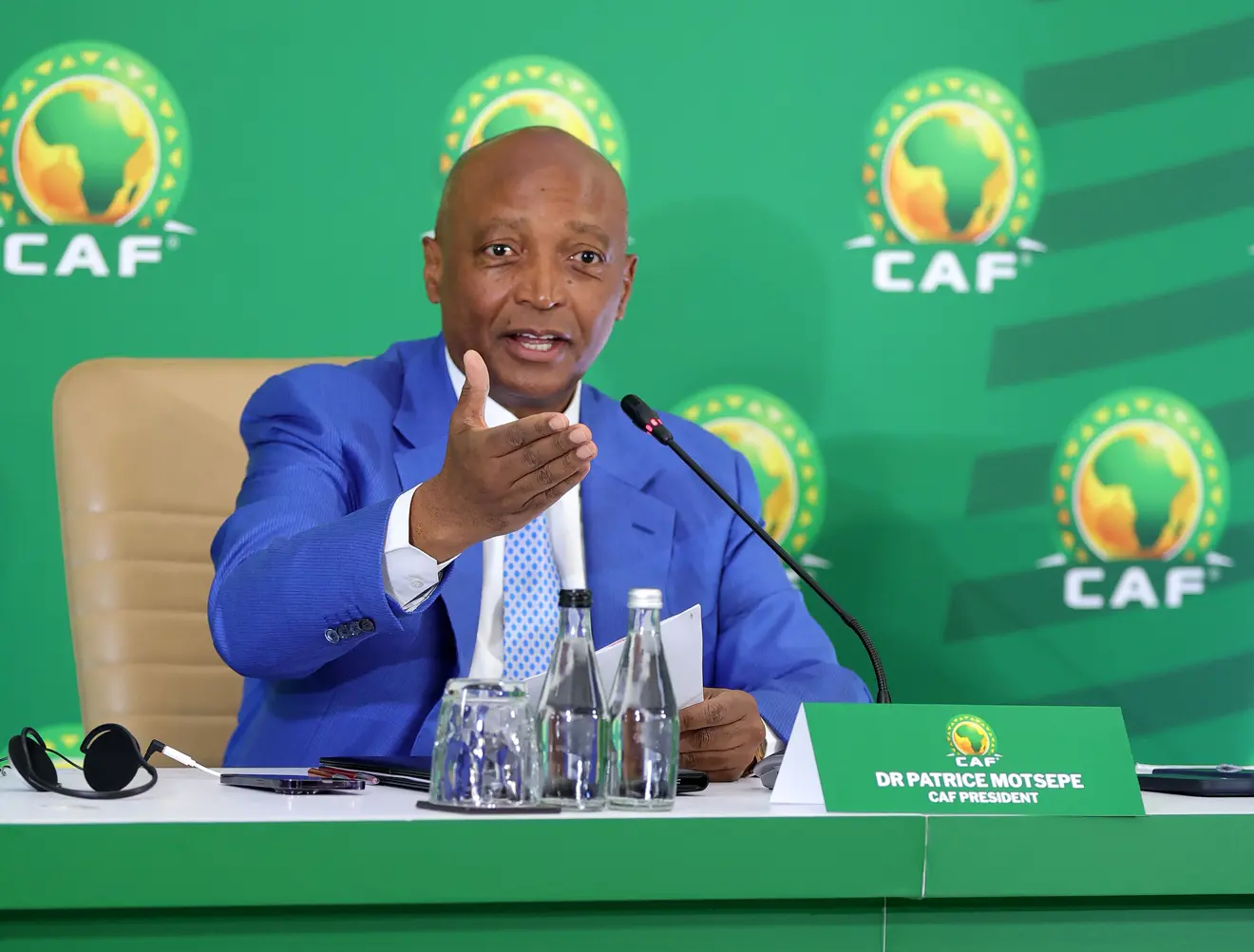
The fight over Gianni Infantino’s future escalated Thursday as CAF president Patrice Motsepe broke his silence, insisting only an election, not internal pressure, should decide whether he stays on as FIFA president.
Motsepe’s intervention, delivered in an interview with Sky News, came on the same day the Football Association of Ireland became the latest national federation to strip Infantino of its backing, joining England and Wales in a rapidly swelling revolt against a president who just two weeks ago was basking in the afterglow of a lucrative World Cup on home soil for North America.
The uprising traces back to a plan Infantino unveiled in late July: a proposed $20 billion commercial venture, dubbed FIFA Forward Enterprise, that would have handed a roughly 20 percent stake in FIFA’s tournament business, including the World Cup itself, to outside investors.
Among the prospective backers was a fund tied to Joshua Kushner, brother of Jared Kushner and brother-in-law of President Trump, a connection that fed existing unease about Infantino’s closeness to the White House during this year’s tournament.
The scheme detonated almost immediately. European federations, through UEFA, branded the secretive way the deal had been struck as an affront to the game itself, while CONCACAF and the AFC lodged their own objections, though they stopped short of UEFA’s threat to boycott FIFA competitions outright.
By the end of that week, senior FIFA insiders had turned on their own president: an adviser resigned in protest, and the organization’s chief operating officer told reporters the project had been driven by “one person” acting without the knowledge of his own staff.
Infantino abandoned the plan within days, but the retreat did little to calm the storm instead, it crystallized into a broader crisis of confidence in his leadership.
This week, UEFA, CONCACAF, and the AFC escalated matters further still, issuing a joint letter to the wider football family warning that trust “is broken through deception” when a leader places himself above the institution that empowered him.
Sky News has reported that the letter was widely read as an attempt to push Infantino toward resigning outright, rather than allowing him to stand for a fresh mandate when FIFA’s presidential election is held in March.
It is against that backdrop that the FAI’s statement landed on Thursday. The Irish federation confirmed its board had voted to formally rescind a letter of support it issued to Infantino earlier this year and had written to FIFA to explain the decision, citing worries over governance, transparency, and a lack of genuine consultation with member associations.
England’s FA and the Football Association of Wales had already taken the same step in the preceding days, giving the rebellion real weight within European football.
Into that fray stepped Motsepe, the South African mining billionaire who doubles as a FIFA vice-president and the most powerful voice in African football, a continent whose 54-strong bloc of votes has traditionally been solidly behind Infantino.
He is the first FIFA vice-president to speak publicly since the row erupted, and his message was one of institutional caution rather than open defence of the embattled president.
Motsepe argued that anyone with grievances against Infantino or indeed anyone else in FIFA’s hierarchy should pursue them through the organization’s established procedures rather than forcing an exit outside of that framework.
He said the matter should go to a vote of FIFA’s 211 member associations, letting the ballot itself reveal whether the federation still has confidence in its president, and cautioned against short-circuiting a process with elections already scheduled for next year.
Notably, Motsepe declined to either condemn or fully defend Infantino. He acknowledged he had heard a “lot of stories” about the controversy but said he was withholding judgment, calling instead for a proper hearing where all sides could be heard fairly.
His remarks came a day after he flew into Salzburg for the UEFA Super Cup specifically to meet UEFA president Aleksander Ceferin, the figure widely seen as spearheading the push for Infantino’s departure for direct talks on the crisis.
CAF, notably, has already thrown its formal support behind Infantino, and Motsepe maintained that African football’s lawyers had found no breach of FIFA’s rules in how the World Cup sell-off talks were conducted, since any final agreement would still have required approval from the full membership.
He conceded, however, that Infantino’s own methods needed fixing, noting that the president had apologized and acknowledged the process should have been handled differently.
With European federations threatening a boycott, Asian and North American confederations voicing their own unease, and now Ireland joining England and Wales in publicly disowning him, Infantino faces the gravest challenge yet to his decade at FIFA’s helm.
Whether the confrontation is resolved through resignation, a tribunal-style hearing of the kind Motsepe floated, or a contested vote at March’s congress remains, for now, an open question, one that will likely determine not just Infantino’s fate but the balance of power between FIFA’s confederations for years to come.
WHAT YOU SHOULD KNOW
Infantino’s authority is eroding fast with England, Wales, and now Ireland pulling their backing, and UEFA, CONCACAF, and the AFC jointly accusing him of betraying FIFA’s trust, but Patrice Motsepe, CAF’s president and a FIFA vice-president, is drawing a hard line that only a formal election in March, not outside pressure, should decide his fate.
The tension between a growing revolt demanding his early exit and Africa’s insistence on due process is now the central fight shaping FIFA’s future.