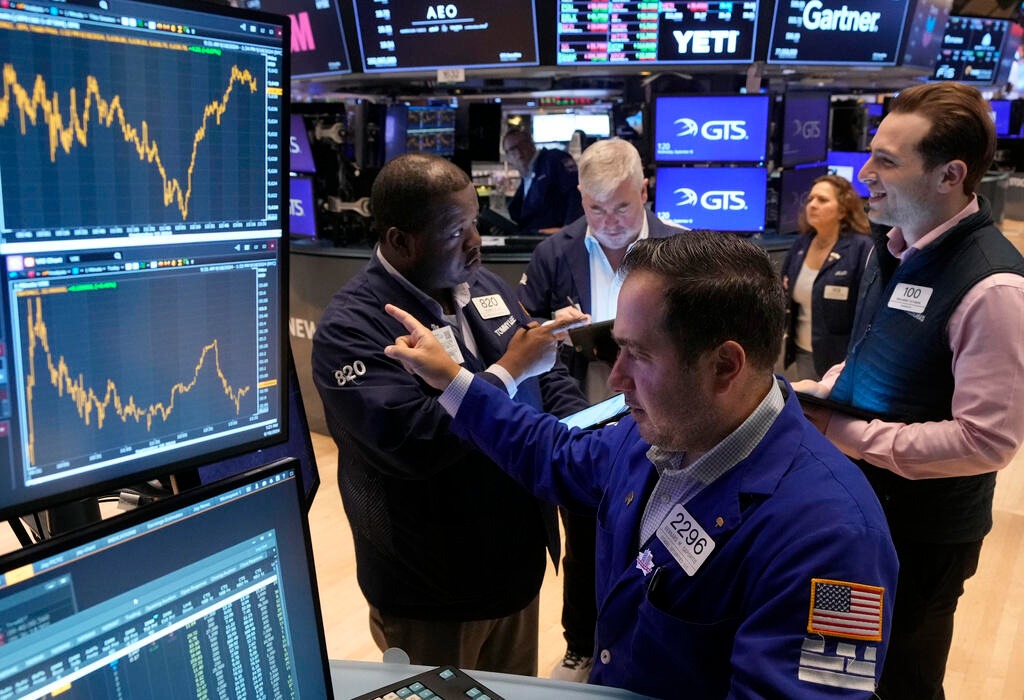
Global markets closed the holiday-shortened week on a cautious note on Friday, with stocks sliding and the dollar weakening after President Donald Trump successfully pushed through his massive tax cut legislation while issuing a stark ultimatum to trading partners worldwide.
The passage of Trump’s signature 869-page spending bill, which narrowly cleared the House following Thursday’s close, has injected fresh uncertainty into markets despite averting an immediate government default.
The legislation is projected to add a staggering $3.4 trillion to the national debt while funding increased border security and military expenditures—a fiscal burden that has traders questioning the long-term implications for U.S. economic stability.
European markets bore the brunt of the selling pressure, with the pan-European STOXX 600 index declining 0.5% as banks, mining stocks, and retailers led the retreat.
Across the Atlantic, U.S. S&P 500 futures pointed to a 0.6% decline when markets reopen, despite the cash index having reached an all-time closing high Thursday with a 0.8% advance in the abbreviated session.
Trade Tensions Escalate
The market’s subdued tone reflects growing anxiety over Trump’s aggressive trade stance, particularly his announcement that Washington would begin dispatching letters to countries Friday outlining specific tariff rates they would face on exports to the United States. This marks a significant departure from earlier promises to negotiate individual trade agreements before the July 9 deadline, when tariffs could spike dramatically.
“Investors are now just waiting for July 9,” noted Tony Sycamore, an analyst at IG, highlighting how the market’s diminished optimism for comprehensive trade deals has particularly pressured export-dependent Asian economies, with Japan and South Korea among the most vulnerable.
The administration’s track record on trade negotiations has been mixed at best. While Trump announced a deal with Vietnam Wednesday to supplement framework agreements with China and Britain, progress on once-promising negotiations with Japan and South Korea appears to have stalled. Treasury Secretary Scott Bessent indicated earlier this week that an agreement with India was nearing completion, but Trump suggested he expects only “a couple” more trade deals before the deadline.
Currency Markets Signal Concern
The dollar’s retreat Friday underscored broader concerns about the sustainability of Trump’s fiscal and trade policies. The dollar index, which had its worst first half since 1973 amid the chaotic rollout of Trump’s tariff regime, gave back some of Thursday’s 0.4% gains to trade 0.1% lower at 96.94 as of 1430 GMT.
The euro strengthened 0.2% to $1.1778, while sterling held steady at $1.3662 as British assets stabilized following two days of volatility triggered by Finance Minister Rachel Reeves’ emotional parliamentary appearance Wednesday.
Bond Markets Reflect Fiscal Anxiety
Despite the Treasury bond market being closed for the Independence Day holiday, yields continued their upward trajectory in overseas trading. The benchmark 10-year Treasury yield rose 4.7 basis points to 4.34%, while the 2-year yield jumped 9.3 basis points to 3.882%—movements that reflect investor concern about the government’s expanding fiscal burden and its potential impact on inflation.
Safe Havens in Demand
Gold emerged as a beneficiary of the risk-off sentiment, firming 0.4% to $3,336 per ounce and positioning for a weekly gain as investors sought refuge in traditional safe-haven assets. The precious metal’s advance underscores the market’s unease about both the U.S. fiscal trajectory and the potential economic disruption from escalating trade tensions.
Oil markets, meanwhile, declined on geopolitical developments, with Brent crude falling 57 cents to $68.23 per barrel and West Texas Intermediate dropping 66 cents to $66.34 after Iran reaffirmed its commitment to nuclear non-proliferation.
Economic Resilience Amid Political Uncertainty
The market’s mixed signals reflect the complex economic landscape facing investors. While Thursday’s surprisingly robust jobs report provided evidence of underlying economic strength and sent all three major U.S. equity indexes higher in the shortened session, the longer-term implications of Trump’s fiscal and trade policies continue to weigh on sentiment.
“The U.S. economy is holding together better than most people expected, which suggests to me that markets can easily continue to do better from here,” Sycamore observed, capturing the tension between short-term economic resilience and longer-term policy uncertainty.
As markets prepare for the July 9 trade deadline, investors find themselves navigating between encouraging economic data and the potential for significant policy-driven disruption—a balancing act that promises to keep volatility elevated in the weeks ahead.
WHAT YOU SHOULD KNOW
Markets are on edge as President Trump’s massive $3.4 trillion tax cut bill passes while his July 9 trade deadline approaches. The critical factor to watch: Trump has abandoned individual trade negotiations in favor of issuing blanket tariff threats to all countries, creating significant uncertainty that’s already weakening the dollar and pressuring global stocks.
With only a handful of trade deals secured and major economies like Japan and South Korea stalled in negotiations, July 9 represents a potential inflection point that could either stabilize or severely disrupt global trade flows and market stability.