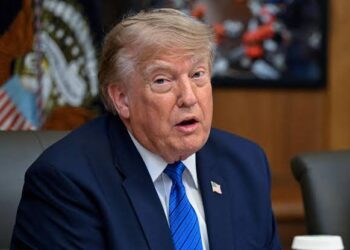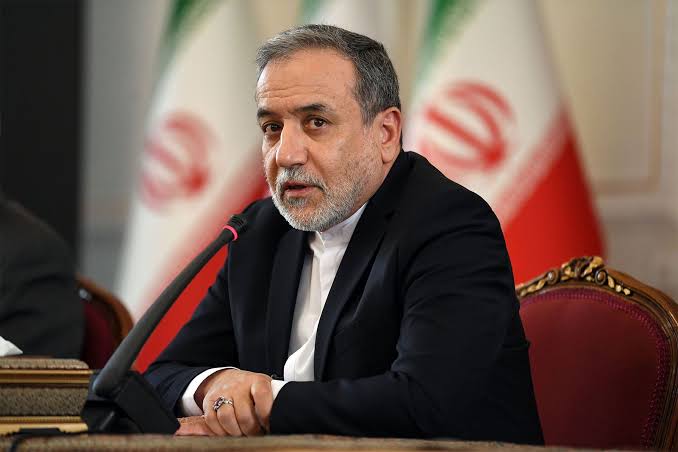
A war of words escalated between Washington and Tehran on Thursday as Iran’s Foreign Minister Abbas Araghchi rejected President Donald Trump’s latest economic offensive against the Islamic Republic, framing it as a smokescreen for America’s own fiscal troubles rather than a position of strength.
The exchange followed Trump’s Wednesday announcement on Truth Social of what he billed as the harshest economic campaign ever directed at a single nation.
The move extends a pressure campaign the administration has waged since April under the banner “Operation Economic Fury,” targeting what officials describe as the regime’s global terror financing and revenue streams.
In his post, Trump vowed that any nation permitting its financial institutions, businesses, airports, or government entities to provide any type of lifeline to Iran would itself face “TREMENDOUS economic consequences.”
He specifically flagged oil smuggling, swap lines, cash transfers, exchange houses, ship registries, and front companies as targets that “need to stop NOW,” warning unnamed violators that “you know who you are.”
Araghchi fired back on X, arguing that the announcement was less a show of American resolve than a distraction from problems at home. He pointed to reports that the U.S. national debt had crossed $40 trillion, citing coverage from CNN and The New York Times, and framed the sanctions push as an attempt to paper over that crisis.
Notably, CNN reporting cited by Araghchi indicated the federal debt had risen by $1 trillion in just five months, according to Treasury Department data.
The foreign minister’s message was blunt: continued escalation would not bend Iran but would instead deepen American isolation and stoke Iranian resentment sentiments consistent with Tehran’s long-standing position that sanctions have failed to alter its conduct.
Beyond the economic dispute, Araghchi added a broader accusation, asserting that Washington’s approach amounted to economic terrorism threatening the global economy and the sovereignty of nations well beyond Iran’s borders.
The economic clash unfolds against the backdrop of a still-simmering military conflict. Trump announced major combat operations against Iran on February 28, involving massive joint U.S.-Israeli strikes, which triggered retaliatory action from Tehran across the region.
An April ceasefire halted the heaviest bombardment, though sporadic clashes have persisted, particularly around the Strait of Hormuz, the narrow but vital energy corridor that Iran has kept blockaded and that remains the conflict’s most combustible flashpoint.
Washington has pressed for the strait to reopen, while Tehran insists it will stay closed until the U.S. lifts its naval blockade on Iranian ports, rescinds oil sanctions, and releases frozen Iranian assets held abroad a standoff that shows no sign of near-term resolution.
Underscoring how quickly the rhetoric can turn martial, an Islamic Revolutionary Guard Corps spokesman, Hossein Mohabi, responded separately on Thursday by warning that Iran would deploy more destructive weaponry should a new war erupt, asserting that the warheads in Iran’s missile arsenal now far exceed the destructive power used in previous rounds of fighting.
The financial fallout was already visible by midday trading. West Texas Intermediate crude ticked up modestly to around $84.35 a barrel, while the euro held a bullish consolidation against the dollar below the 1.1700 level, with traders awaiting fresh U.S. jobless claims data amid lingering Iran-related risk. Gold, meanwhile, hovered just under $4,500, still near multi-month highs.
Trump’s “maximum pressure” doctrine on Iran is not new; he pursued a similar strategy during his first term and reinstated sanctions almost immediately after returning to office in January 2025.
What distinguishes this latest chapter is the scale of ambition Trump has attached to it and the fact that it now arrives layered atop an active, if uneasy, ceasefire rather than a purely diplomatic standoff.
Whether “Economic D-Day” proves to be a genuine turning point or simply the next escalation in a cycle both sides have called ineffective will likely hinge on how allied governments respond to Washington’s ultimatum and on whether Tehran’s calculus around the Strait of Hormuz shifts under the added pressure.
For now, both capitals appear locked into familiar positions: Washington betting that harsher sanctions will eventually force capitulation, and Tehran betting that they won’t.
WHAT YOU SHOULD KNOW
This is a standoff, not a breakthrough. Trump is escalating sanctions to force Iran’s hand; Iran is betting the pressure will backfire on a debt-strained US instead. The real flashpoint remains the Strait of Hormuz until that deadlock breaks, except for more rhetoric, not resolution.