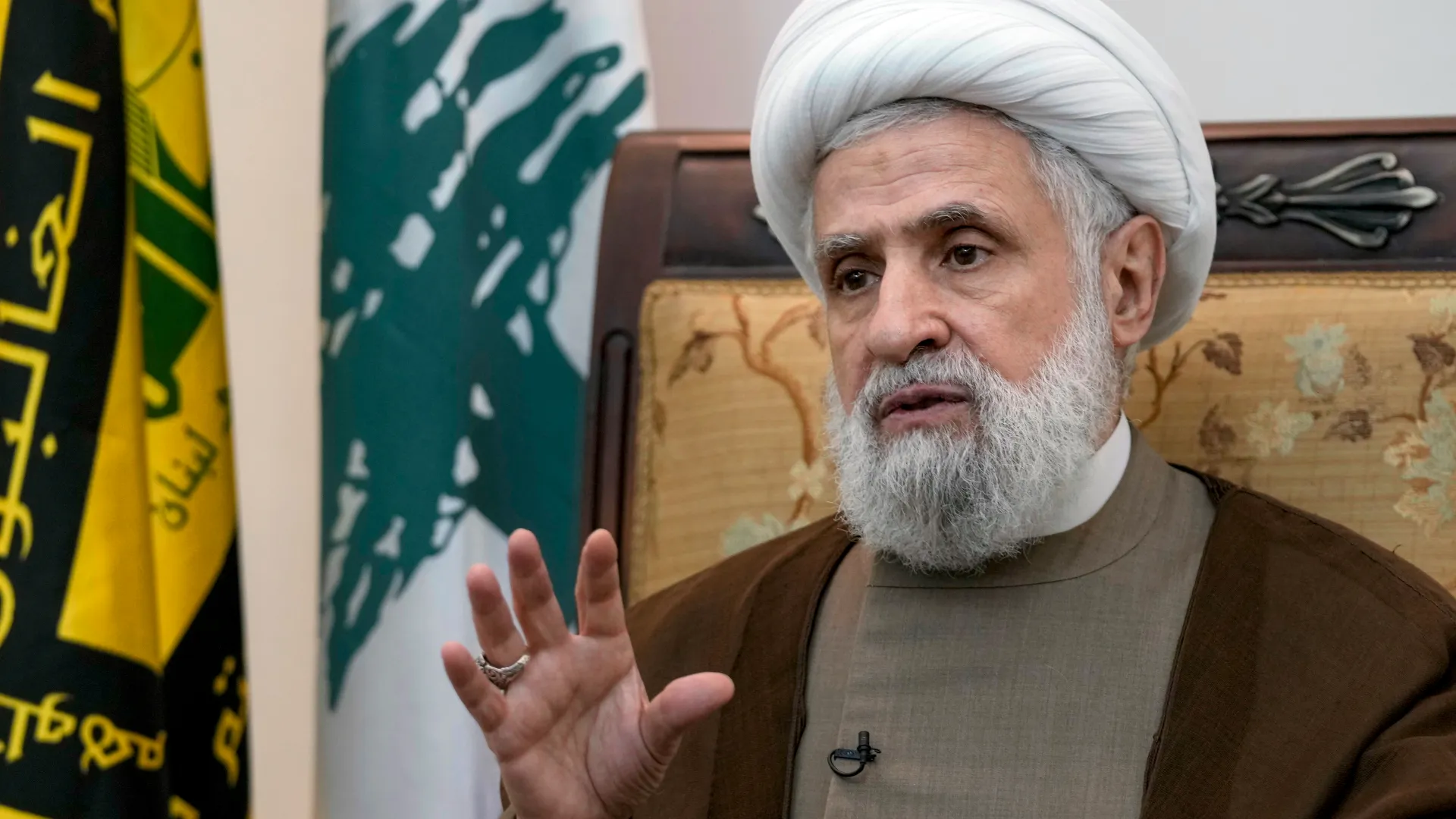
Hezbollah’s newly appointed leader, Naim Qassem, declared on Sunday that the Lebanese militant group would not disarm or bow to Israeli threats, just a day ahead of a planned visit to Beirut by US envoy Thomas Barrack.
The visit is expected to include formal discussions with Lebanese officials over an American proposal calling for Hezbollah’s disarmament by the end of the year, according to an anonymous Lebanese official.
Addressing thousands of Hezbollah supporters gathered in Beirut’s southern suburbs for Ashura, a major Shiite Muslim commemoration, Qassem delivered a defiant message. “This (Israeli) threat will not make us accept surrender,” he stated during the televised speech. The gathering took place in one of Hezbollah’s traditional strongholds, where the group’s yellow banners flew alongside the national flags of Lebanon, Palestine, and Iran.
Qassem’s statement reinforced Hezbollah’s firm stance against relinquishing its arms, even amid growing domestic and international pressure. Lebanese authorities, who came to power after the devastating conflict between Hezbollah and Israel last year, have continued to call for a state monopoly on weapons. Their appeals are backed by international actors, particularly the United States, who are pressing for Hezbollah’s military wing to be dismantled.
Qassem, who assumed leadership after the death of Hassan Nasrallah in an Israeli airstrike in September, underscored that Hezbollah would only consider talks on national defense strategy and potential disarmament after Israel upholds its commitments under the ceasefire agreement reached in November. “Withdraw from the occupied territories, stop its aggression… release the prisoners,” Qassem said, adding that only then would the group engage in discussions about national defense and disarmament.
Despite the ceasefire, Israeli airstrikes on Lebanon have persisted. Israel claims these attacks target Hezbollah’s operational infrastructure in response to ongoing threats. Meanwhile, Lebanese authorities assert that they have been working to dismantle Hezbollah’s military presence in the south, particularly near the border with Israel.
Under the November truce terms, Hezbollah was required to move its fighters north of the Litani River, a buffer zone approximately 30 kilometers from the Israeli border. Conversely, Israeli forces were expected to pull out from five strategic positions in Lebanon — a withdrawal that has yet to occur.
Within his Ashura address, Qassem also pushed back against talk of regional normalization with Israel. “We will not accept normalisation… with the Israeli enemy,” he said, dismissing recent remarks by Israeli Foreign Minister Gideon Saar, who had expressed interest in normalized relations with Lebanon and Syria. While Lebanon offered no response to Saar’s statement, Syria, where a Sunni-led movement ousted Iran-aligned Bashar al-Assad in December, described such discussions as “premature.”
Supporters attending the Ashura procession voiced similar sentiments to Qassem’s. Hussein Jaber, 28, a native of southern Lebanon, told AFP: “Those who think Hezbollah will turn in its arms are ignorant. Our weapons can’t be handed over, not now, not later.”
Ashura commemorations took place across the Shiite world on Sunday. In Iraq, large crowds filled the holy cities of Najaf and Karbala. In south Lebanon, commemorations in Nabatiyeh — a town heavily targeted by recent Israeli strikes — were more subdued. “There were fewer people than usual because of the situation in the south and the Israeli strikes that destroyed the market and several areas of the city,” said local resident Ali Mazraani.
In Syria, several hundred Shiites marked the day under tight security at the Sayyida Zeinab shrine near Damascus. Security was heightened this year, and unlike in the past, no international pilgrims from Iran, Iraq, or Lebanon were in attendance. “The Syrian state has bolstered its protection at this time,” said shrine official Jaafar al-Amine, noting the absence of foreign participants.
As US envoy Thomas Barrack prepares to meet Lebanese officials, the path forward for Hezbollah’s future — and the fragile ceasefire with Israel — remains deeply uncertain. Qassem’s unyielding position suggests that disarmament is unlikely to happen without significant geopolitical shifts and guarantees that Hezbollah considers acceptable.
What you should know
Hezbollah’s new leader, Naim Qassem, has rejected calls for the group to disarm, insisting that Israel must first comply with ceasefire terms and end its aggression.
The statement comes as the US prepares to push for Hezbollah’s demilitarization by year’s end, but support from Hezbollah loyalists and unresolved border tensions make a peaceful resolution challenging.