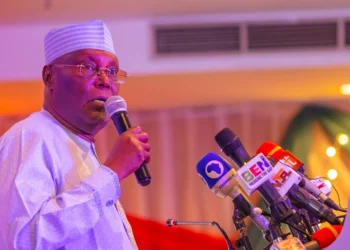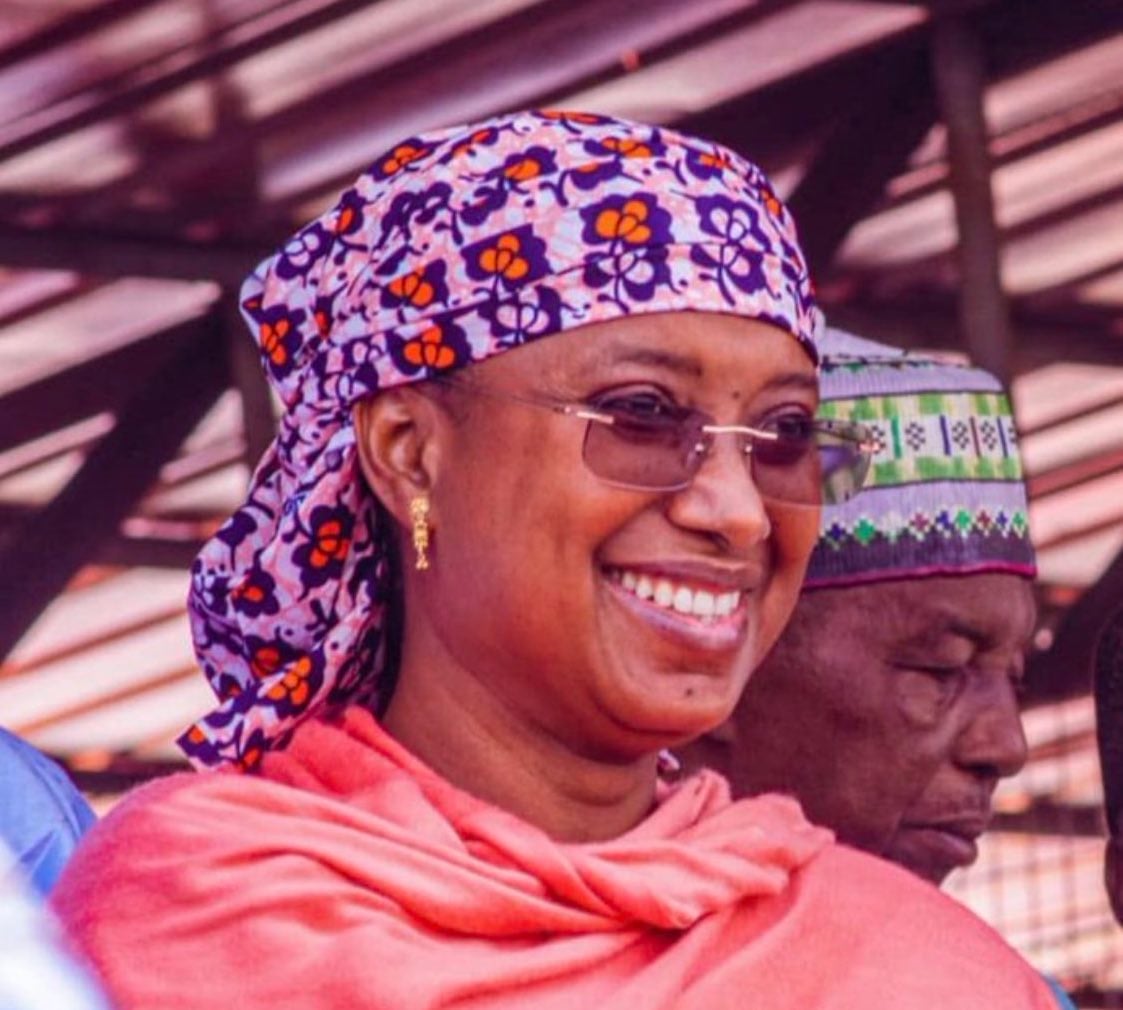
Former Adamawa governorship candidate Aishatu Ahmed Dahiru, widely known as Binani, has dumped the African Democratic Congress (ADC) for the National Democratic Congress (NDC) on Friday evening in a reception ceremony held in Abuja.
The former senator and two-time gubernatorial aspirant, whose political battles have made her one of the most recognizable female figures in Nigeria’s northeast political theater, made no secret of her motivations: her supporters had moved ahead of her, and she simply followed.
In what may be the most candid political statement of the evening, Binani told those gathered that the decision to defect was not entirely hers to make—it had already been made for her, by the grassroots.
“My supporters urged me to make that move, and for whatever reason, they decided that was no longer the place to be. They are the ones who brought me to the NDC,” she said, with a composure that betrayed neither bitterness nor regret.
It is a remarkable admission in Nigerian politics, where defections are more commonly dressed up in the language of ideology or personal conviction. Binani, by contrast, offered an unusually grounded explanation, one rooted not in grand principle but in the fundamental logic of political loyalty: you go where your people go.
She painted a picture of a political base that had grown restless under the ADC and had, without waiting for formal directives, begun migrating to the NDC in significant numbers. “Even before I joined, they had already gone far,” she noted, adding that Adamawa State had recorded one of the highest numbers of newly registered NDC members in the country.
Notably, Binani was careful not to burn bridges. In a political environment where defectors often deploy their farewell as an opportunity to launch broadsides at their former parties, she declined to take that route.
“I will never condemn where I left. But my first and overriding interest is the interest of my supporters,” she said.
The statement was at once diplomatic and pointed, a subtle but unmistakable rebuke wrapped in civility. It suggested that while she did not quarrel with the ADC as an institution, something about its direction had failed to serve her constituency’s aspirations. What that something was, she left carefully unsaid.
What she did say, however, was that the NDC offered something the ADC apparently did not: structure. Nigerians will be asking, “Why did I join the NDC?” The answer is simple—the party is focused on structured, policy-driven governance,” she declared.
For the NDC, Binani’s arrival is far more than symbolic. It is a recruitment coup that lends the party a measure of credibility and visibility in a region, like the northeast, where it has been working to establish roots.
Senator Seriake Dickson, the NDC’s National Leader and former governor of Bayelsa State, did not attempt to understate the significance of the moment. In characteristic form, he leaned into the occasion with the confidence of a man who believes his party is on the right side of history.
“In just three to four months, this party has become the most talked-about, most stable, and fastest-growing political party in Nigeria,” Dickson declared, a claim that will no doubt invite scrutiny from political observers but one that speaks to the NDC’s aggressive ambition.
He was equally pointed in his assessment of rival parties, drawing on a transportation metaphor that was hard to miss: “If you enter a vehicle and the engine starts knocking, won’t you come down and take a better one?”
Dickson also made a point of advertising the NDC’s legal cleanliness: no internal litigation, no court cases, and no appeals pending anywhere. In a country where inter-party disputes have gutted several promising political platforms, it is the kind of institutional stability that can, and does, attract serious political actors.
In perhaps the most consequential announcement of the evening, Dickson formally handed over the NDC’s leadership structure in Adamawa State to Binani, a gesture that confirms she is not arriving as a mere member but as a power broker with immediate authority on the ground.
The NDC’s National Women Leader, Dudu Manuga, used the occasion to frame Binani’s arrival in broader, generational terms as a statement about what is possible for Nigerian women in the political arena.
“This is a party for Nigerian women. This is the time for women to rise. This is the time to break ceilings,” Manuga said, her words carrying the weight of a rallying cry directed not just at those present but at women across the country watching from the margins of a political space that has historically sidelined them.
Manuga described Binani as a “rare political figure,” language that acknowledged the obstacles Binani has navigated, including a bruising governorship contest in Adamawa that tested her resilience and her legal fortitude in equal measure.
Binani herself has spoken openly about the role of community in her rise. “As an individual, you cannot drive anything alone. Your supporters build you, pave the way, and take you through every level,” she said Friday. “I am what I am today in politics because of the support of my people.”
Dickson echoed this sentiment in his own way, describing her as someone who “fought like a wounded lioness,” a tribute that drew knowing nods from those in the room who had watched her political battles unfold.
For Adamawa State, Binani’s defection is likely to redraw political calculations ahead of future electoral cycles. Her move consolidates a base of loyal supporters within a new party structure, and with the NDC reportedly already well-organized at the grassroots in the state, the combination could prove formidable.
At the national level, it raises questions about the trajectory of the ADC and whether Binani’s exit will trigger a broader exodus of figures who had affiliated with the party. Defections in Nigeria rarely happen in isolation; they tend to come in waves as political actors read momentum and adjust accordingly.
For the NDC, the challenge now is to prove that Dickson’s boasts are not merely rhetoric. A party that describes itself as “a baby” in the same breath as it claims to be Nigeria’s fastest-growing political platform must now demonstrate that it can translate noise into votes and ambition into governance.
Binani, for her part, closed the evening with a pledge and a prayer.
“Inshallah, we will do our best to build the NDC in Adamawa and at the national level,” she said, stressing that the party must be anchored on “equity, justice, transparency, and internal democracy.”
The crowd responded with applause.
WHAT YOU SHOULD KNOW
Aishatu Ahmed Dahiru, widely known as Binani, formally defected from the African Democratic Congress (ADC) to the National Democratic Congress (NDC) on Friday evening.