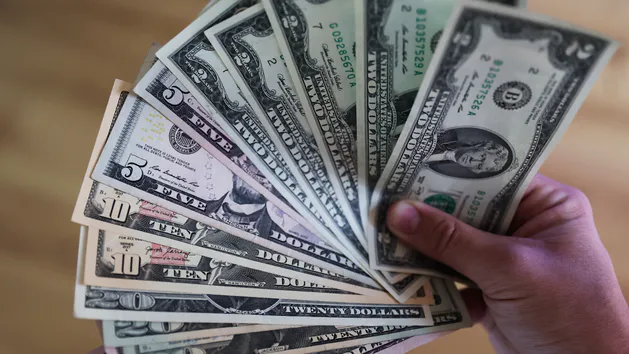
The U.S. dollar remained under sustained pressure on Thursday, trading near multi-year lows as investors grappled with mixed signals from Washington and growing unease about the independence of American monetary policy.
While emergency verbal interventions from Treasury Secretary Scott Bessent and cautionary remarks from European Central Bank officials helped stem what had been a dramatic currency rout earlier in the week, the greenback’s recovery proved anemic, suggesting deeper structural concerns about dollar dominance may be taking hold.
The Federal Reserve adopted a notably more relaxed stance on labor market conditions and inflation risks in its latest communications Wednesday evening, a shift market participants interpreted as signaling interest rates could remain on hold for an extended period. That dovish pivot comes at a precarious moment for the dollar, which has already shed 2% of its value this year.
The currency’s weakness stems from a toxic combination of factors: President Donald Trump‘s unpredictable policy direction, his renewed public criticism of Fed decision-making, and Friday’s bombshell suggestion that Washington might actively sell dollars to assist Japan in supporting the yen.
“Loss of independence is far and away the biggest risk to ongoing dollar hegemony,” said Ray Attrill, head of foreign exchange strategy at National Australia Bank. He noted that the currency’s trajectory now hinges critically on how questions surrounding Fed autonomy resolve, including a pending Supreme Court ruling on Trump’s controversial attempt to remove Fed Governor Lisa Cook.
The dollar had been in free fall Monday and Tuesday, touching a four-year nadir after President Trump appeared dismissive of the currency’s decline. Treasury Secretary Bessent intervened Wednesday with explicit reassurances that the United States maintains a “strong dollar” policy—comments widely viewed as coordinated damage control.
“It was a timely comment from Bessent that you’d assume was premeditated,” Attrill observed, suggesting the Treasury chief’s remarks were a deliberate effort to establish a floor under the beleaguered currency.
That floor held on Thursday, though barely. Against a basket of major currencies, the dollar index traded at 96.06, hovering uncomfortably close to Tuesday’s four-year low of 95.566.
The euro, which had breached the closely watched $1.20 level on the back of dollar weakness, pulled back slightly to $1.1988 in Asian trading after ECB policymakers voiced growing concern about the currency’s rapid appreciation.
The euro’s strength—it has gained roughly 7% against the dollar since early January—poses a significant threat to the eurozone’s export-dependent economy and could complicate the ECB’s inflation management efforts.
“You could argue that the euro/dollar move, which up until recently hasn’t been that great, is kind of masking broader euro strength,” Attrill said. “And that will feed into the ECB’s inflation forecasts.”
The coordinated verbal interventions from both sides of the Atlantic suggest central banks are increasingly anxious about disorderly currency moves, though neither has yet deployed actual market interventions.
Away from the dollar’s struggles, commodity-linked currencies posted impressive gains. The Australian dollar reached a three-year high, last trading up 0.72% at $0.7092, buoyed by market expectations of an imminent interest rate increase from the Reserve Bank of Australia as soon as next week.
The New Zealand dollar approached a seven-month high of $0.60925, while the Chinese yuan strengthened to a 32-month peak at 6.9471 per dollar, reflecting capital flows away from U.S. assets.
Sterling hovered near a 4.5-year high at $1.3844, and the Swiss franc—a traditional safe-haven currency—extended gains against the dollar, which fell 0.43% to 0.7654 francs, near an 11-year low.
The Japanese yen, which has been buffeted by speculation about coordinated intervention, rose 0.25% to 153.00 per dollar Thursday. The currency has traded in a tight 152-154 range for most of the week following last week’s “rate checks”—a technical term for when authorities survey market conditions, often as a prelude to actual currency intervention.
Japan’s Ministry of Finance has not intervened directly in foreign exchange markets, but the threat alone has been sufficient to stabilize the yen, which had weakened dramatically in recent months.
The current dollar turbulence represents the sharpest sell-off since Trump’s tariff announcements roiled markets last April. But unlike previous episodes of dollar weakness, which tended to be driven by cyclical economic factors, the current decline reflects something potentially more fundamental: questions about the institutional integrity of American economic policymaking.
If the dollar’s role as the world’s primary reserve currency comes into genuine question—a scenario that would require sustained policy chaos in Washington—the implications for global finance would be profound. Central banks hold an estimated $7 trillion in dollar-denominated reserves, and the vast majority of international trade is invoiced in dollars.
For now, markets are watching three key factors: the Supreme Court’s ruling on Fed governance, any further statements from President Trump regarding currency policy, and whether verbal interventions from officials prove sufficient to stabilize the dollar without requiring actual market operations.
As Asian markets closed Thursday, one thing remained clear: the dollar’s traditional safe-haven status is facing its most serious challenge in years, and how policymakers respond in the coming days could reshape global currency markets for years to come.
WHAT YOU SHOULD KNOW
The U.S. dollar is in crisis—not because of economic fundamentals, but because markets are losing confidence in America’s political leadership. President Trump’s attacks on the Federal Reserve, his dismissive attitude toward dollar weakness, and chaotic policy signals have triggered the sharpest currency sell-off since last April, pushing the dollar to four-year lows.
Investors now question whether the Fed can remain independent from political interference. If that independence erodes, the dollar’s 80-year reign as the world’s dominant reserve currency could be genuinely threatened.
Treasury Secretary Bessent’s “strong dollar” pledge on Wednesday temporarily stopped the bleeding, but the damage is done—global capital is already flowing into euros, commodity currencies, and other alternatives. Until Washington demonstrates coherent, stable economic leadership, the dollar will remain vulnerable.
This isn’t a normal currency fluctuation. It’s a warning sign that America’s institutional credibility—the real foundation of dollar dominance—is under serious strain.