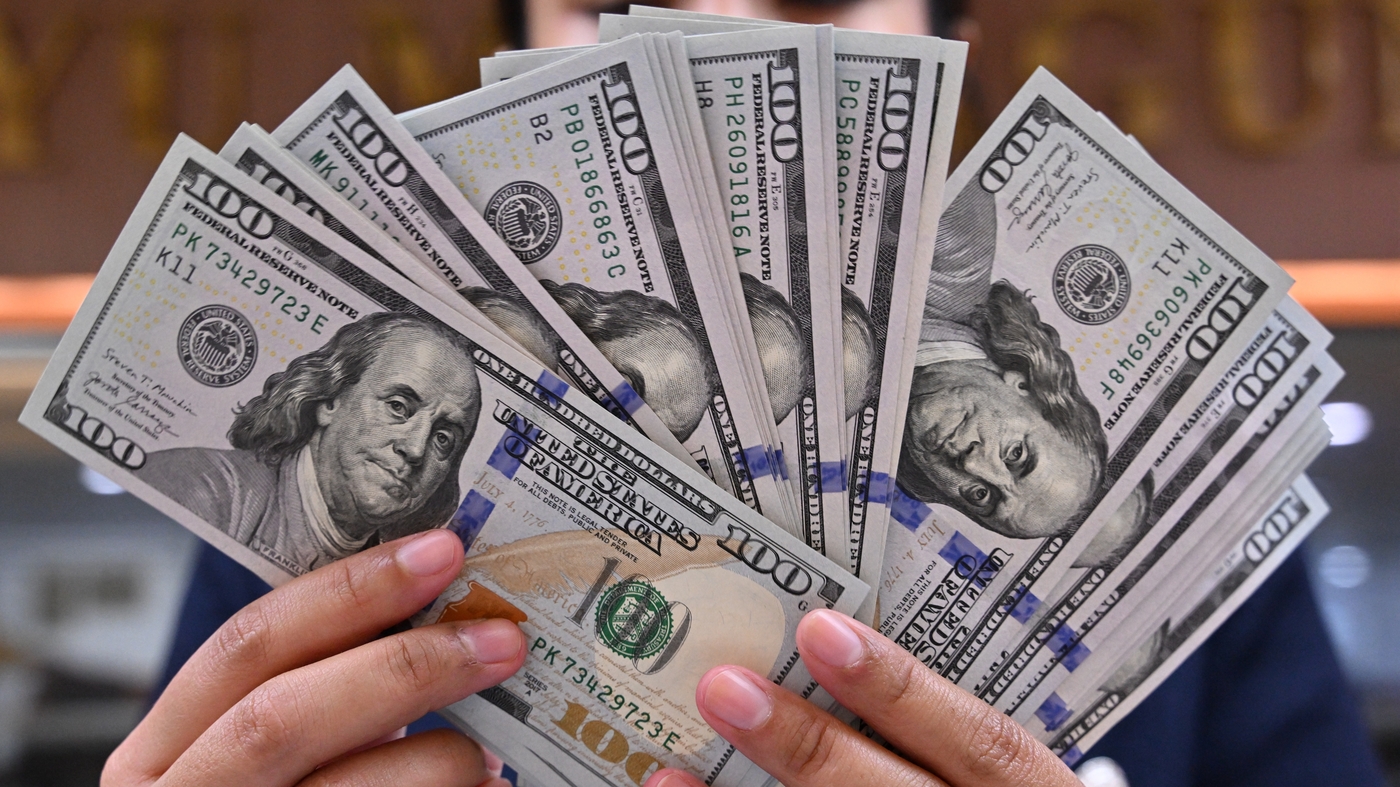
The U.S. dollar regained its footing Tuesday following a tumultuous morning that saw the greenback plummet after President Donald Trump took the extraordinary step of firing Federal Reserve Governor Lisa Cook, a move that has reignited fierce debate over the independence of America’s central banking system.
In an unprecedented escalation of his ongoing feud with the Federal Reserve, Trump announced Cook’s dismissal via social media, citing what he termed “alleged improprieties in obtaining mortgage loans.” The announcement sent immediate shockwaves through financial markets, with the dollar index initially sliding as much as 0.4% before recovering to close flat at 98.42.
Cook, however, has refused to go quietly. In a defiant response that underscores the constitutional crisis brewing between the White House and the Fed, she categorically rejected Trump’s authority to remove her from office. “Trump has no authority to fire her from the central bank, and she will not resign,” Cook stated, setting up what could become a protracted legal and political battle.
The currency markets’ initial panic gave way to cautious stability as traders digested the implications. Major currency pairs showed muted movement by day’s end, with the euro holding steady at $1.1617 and sterling unchanged at $1.3461. The Japanese yen and Swiss franc similarly showed little deviation from recent ranges.
“The story has been well-telegraphed,” noted Kenneth Broux, head of corporate FX and rates research at Societe Generale, referring to Trump’s sustained campaign for lower interest rates. The president has repeatedly criticized Fed Chair Jerome Powell for maintaining what Trump considers overly restrictive monetary policy, though he has refrained from threatening Powell’s dismissal as his term nears its end in nine months.
Market Dynamics Shift Amid Political Uncertainty
The attempted removal comes at a critical juncture for monetary policy, with money markets currently pricing in an 82% probability of a rate cut at the Fed’s September meeting. Trump’s action appears designed to pressure the central bank toward more aggressive easing, though the legal uncertainty surrounding Cook’s status could complicate the Fed’s decision-making process.
Currency strategists note that while Trump’s move might typically weaken the dollar, investors face limited alternatives amid ongoing economic turbulence in Europe. France’s political crisis deepened Tuesday as Prime Minister Francois Bayrou’s minority government appeared headed for collapse, with opposition parties signaling they would reject his confidence vote over proposed budget cuts.
French government bonds sold off sharply, with the 10-year yield climbing 4 basis points to 3.53% – its highest level since March. The selloff reflects growing investor anxiety about France’s fiscal trajectory and political stability.
“The broader question for the euro is whether recent French news destabilizes appetite for the euro more broadly, or whether this is an isolated French issue,” analysts at ING wrote in a research note, highlighting the contagion risks facing European markets.
Global Ripple Effects
The day’s events reverberated across global markets, though some regions showed resilience. China’s offshore yuan strengthened to 7.1635 per dollar, reaching near-monthly highs as domestic equity markets surged. The yuan’s gains suggest Chinese investors remain focused on local fundamentals despite the U.S. political drama.
Cryptocurrency markets remained volatile, with Bitcoin managing a modest 0.5% gain as it attempted to snap a three-day losing streak. Ethereum showed more strength, climbing 1.5% as digital assets continued their choppy trading pattern.
Constitutional Crisis Brewing
Trump’s attempt to dismiss Cook represents an unprecedented challenge to the Federal Reserve’s operational independence, a cornerstone of U.S. monetary policy since the central bank’s establishment. Legal experts suggest the president lacks clear authority to remove Fed governors except for cause, setting up a potential Supreme Court battle that could reshape the relationship between the executive branch and the central bank.
The standoff comes as the Fed faces mounting pressure to address slowing economic growth while managing persistent inflation concerns. Cook’s potential removal would eliminate a voice that has generally supported the Fed’s current cautious approach to rate cuts.
As markets closed Tuesday, the immediate currency volatility had subsided, but the underlying tensions between the White House and Federal Reserve suggest this story is far from over. Traders and policymakers alike will be watching closely to see whether Trump follows through on his threat and how the Fed responds to this unprecedented challenge to its authority.
The coming days will likely determine whether this marks a temporary escalation in Trump’s Fed feud or the opening salvo in a broader constitutional crisis that could reshape American monetary policy for years to come.
WHAT YOU SHOULD KNOW
President Trump’s unprecedented attempt to fire Federal Reserve Governor Lisa Cook has created a constitutional crisis that threatens the Fed’s independence. While Cook is refusing to step down and currency markets have stabilized after initial volatility, this marks a dangerous escalation in Trump’s pressure campaign against the central bank.
The standoff could fundamentally reshape the relationship between the presidency and monetary policy, with potential Supreme Court implications. Investors should watch closely as this power struggle unfolds, particularly given the Fed’s upcoming September rate decision, where an 82% probability of cuts is already priced in.