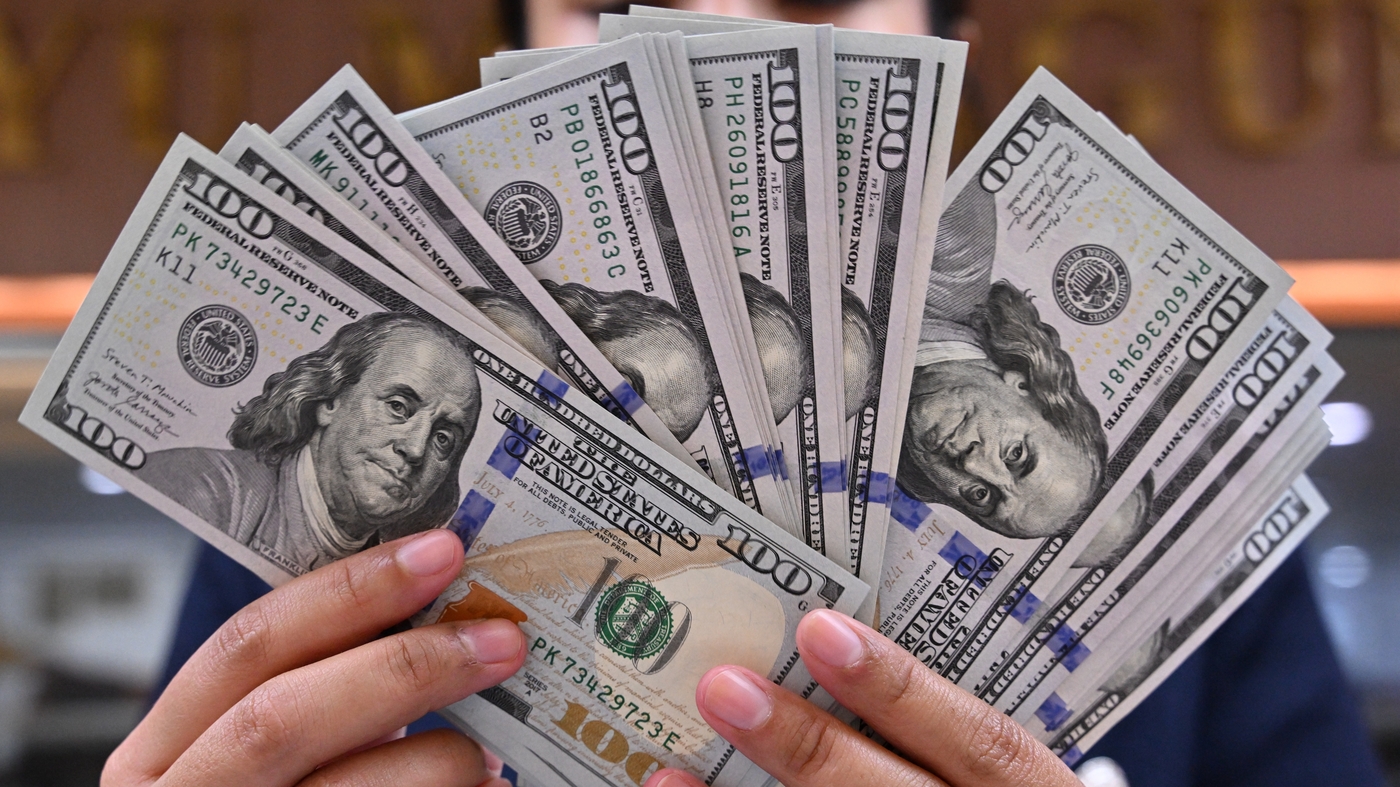
The US dollar continued its precipitous slide on Wednesday, hovering near its weakest levels since February 2022 as financial markets grappled with mounting concerns over President Donald Trump’s fiscal policies and the Federal Reserve’s monetary trajectory.
Trading floors across major financial centers remained in a state of cautious paralysis as investors weighed the potential ramifications of Trump’s massive spending package while bracing for looming deadlines for implementing tariffs. The uncertainty has created a perfect storm of factors that have battered America’s currency, delivering its worst first-half performance since the dawn of free-floating exchange rates in the early 1970s.
The dollar index, which tracks the greenback against six major trading partners, managed only a marginal recovery to 96.744 on Wednesday, still languishing near overnight lows not seen in over three years. Against this backdrop, the euro retreated 0.3% to $1.1774, though it remained tantalizingly close to Tuesday’s peak—its highest watermark since September 2021. Meanwhile, the British pound slipped 0.15% to $1.3722, pulling back from the previous session’s three-and-a-half-year summit.
Fiscal Fears Drive Currency Weakness
At the heart of the dollar’s malaise lies Trump’s controversial tax and spending legislation, a behemoth bill that threatens to balloon the national debt by $3.3 trillion. Having cleared the Senate, the measure now awaits final House approval, keeping traders on edge about its ultimate fiscal impact.
“The confirmation that this is an increase in issuance, an increase in government spending well beyond its means, is not necessarily good news for the Treasury market, and it’s arguably one of the reasons the dollar’s going down,” warned Rodrigo Catril, a strategist at National Australia Bank.
The currency’s woes extend beyond fiscal concerns. A confluence of factors has conspired against the dollar this year, including policy uncertainty that has spooked asset managers into increasing their currency hedges, an unwinding of previously stretched bullish dollar positions, and growing speculation about Federal Reserve rate cuts.
Fed Independence Under Scrutiny
Adding to the market’s unease has been Trump’s increasingly public pressure campaign against Federal Reserve Chair Jerome Powell. In an unprecedented move Monday, the president delivered a handwritten note to Powell containing global central bank rates, suggesting US rates should fall between Japan’s 0.5% and Denmark’s 1.75%, while chiding the Fed chief for being “as usual, ‘too late.'”
Such direct presidential intervention in monetary policy has raised alarm bells about Fed independence, a cornerstone of American economic credibility that markets have long taken for granted.
Powell, speaking at the European Central Bank’s annual conference in Sintra, Portugal, maintained the Fed’s measured stance Tuesday, reiterating a “patient approach” to further rate cuts while notably declining to rule out action at this month’s meeting. His comments that decisions would depend entirely on “incoming data” have amplified the importance of Thursday’s non-farm payrolls report, released a day early due to the July 4th holiday.
Labor Market Holds Key
The employment data has taken on outsized significance as traders search for clues about the Fed’s next move. Tuesday evening’s JOLTS job openings figures provided some respite for the dollar, showing continued labor market resilience that temporarily lifted the currency from session lows.
“Weaker economic data is still ultimately needed for U.S. rate cuts, and the JOLTs data throws up further doubts over the timing of a more pronounced labor market downturn that would encourage the Fed to restart monetary easing,” noted Derek Halpenny, head of research for global markets EMEA.
As markets brace for Thursday’s crucial employment report, the dollar’s fate hangs in the balance. With policy uncertainty reaching a fever pitch and traditional economic relationships under strain, currency traders find themselves navigating uncharted waters in what has already proven to be a historically challenging year for America’s once-dominant currency.
The coming days will likely prove pivotal in determining whether the dollar can mount a meaningful recovery or if its historic decline will continue to accelerate, reshaping global financial dynamics in the process.
WHAT YOU SHOULD KNOW
The US dollar has plummeted to its worst performance since the 1970s, driven primarily by President Trump’s $3.3 trillion spending bill that threatens to massively increase national debt.
Trump’s unprecedented pressure on Fed Chair Powell to cut interest rates has raised serious concerns about Federal Reserve independence, while markets remain frozen awaiting clarity on fiscal policy and Thursday’s crucial jobs report.
The combination of fiscal irresponsibility and political interference in monetary policy has fundamentally shaken confidence in America’s currency, with the dollar index hitting three-year lows against major trading partners.