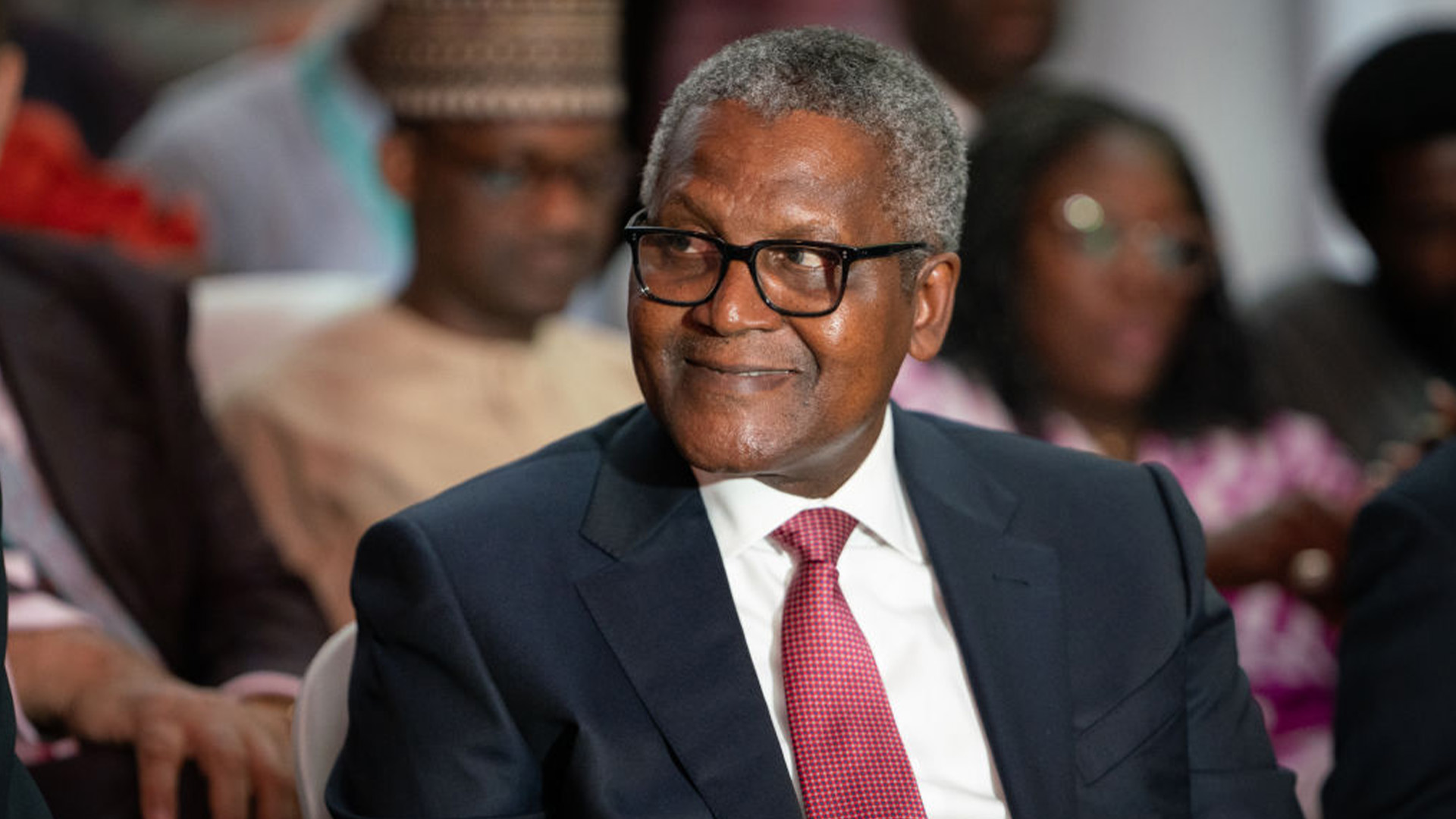
In a bold forecast that has injected fresh optimism into Nigeria’s economic landscape, Aliko Dangote, the billionaire chairman of the Dangote Group and Africa’s richest man, predicted that the naira could strengthen significantly to as low as N1,100 against the US dollar by the end of this year.
Speaking at the high-profile launch of the Nigeria Industrial Policy in Abuja on Tuesday, Dangote attributed the potential turnaround to recent government reforms aimed at curbing imports and bolstering local manufacturing.
The event, graced by Vice President Kashim Shettima and a cadre of top government officials, industrialists, and dignitaries, served as a platform for Dangote to highlight the early fruits of President Bola Tinubu’s administration’s economic policies.
With the naira currently hovering around N1,300 to the dollar in official markets—a figure that has seen fluctuations amid ongoing currency pressures—Dangote’s remarks come at a pivotal moment for Africa’s largest economy, which has grappled with foreign exchange shortages, inflation, and dependency on imports.
“I mean, today, if you look at it, Your Excellency, I believe with the policies that you have implemented in government, people now have started seeing the result, and manufacturers are very, very happy,” Dangote told the gathering, as reported by Channels Television.
He pointed to the naira’s recent trading levels, noting, “Today, the dollar is N1,340. Mr. Vice-President, I can assure you that, with what I know, by blocking all this importation, the currency this year will be as low as N1,100 if we are lucky.”
Dangote’s optimism is rooted in the government’s efforts to restrict unnecessary imports, which he argues will conserve foreign reserves and strengthen the local currency.
However, he acknowledged the double-edged nature of a stronger naira in an import-reliant economy. “The only thing is for, maybe, the government to stop the naira from getting stronger so that they will keep collecting more naira,” he quipped, adding, “But it’s a catch-22 situation where, now, if the naira gets stronger, it means that everything will go down. Everything will go down because we are an import-based country, which we shouldn’t be. What we should be doing is manufacturing all the things that we need.”
This call for self-sufficiency echoes broader themes in Nigeria’s industrial policy, which seeks to transform the nation from an import-dependent giant into a manufacturing powerhouse. Dangote urged policymakers to provide stronger protections for local investors, including incentives and improved infrastructure.
He singled out the chronic issue of power supply as a major hurdle, emphasizing that “while the policy is in order, it must be backed with full protection for industrialists to drive the nation’s goal for industrialization, job creation, and economic growth.”
Dangote’s prediction aligns with a wave of positive sentiment from other business magnates. Femi Otedola, the billionaire chairman of Geregu Power and a prominent investor, had earlier forecasted an even more aggressive strengthening, suggesting the naira could dip below N1,000 to the dollar before the year’s end.
Otedola tied his outlook to the ramp-up of the Dangote Petroleum Refinery, which has now achieved its full capacity of 650,000 barrels per day. “Its ability to supply up to 75 million liters of Premium Motor Spirit daily would shift the country’s energy narrative and conserve foreign exchange,” Otedola stated in a prior announcement. “I am optimistic that the naira will strengthen meaningfully, and trading below ₦1,000/$1 before year-end is increasingly within reach.”
These forecasts are bolstered by recent market trends. The naira has shown signs of stabilization, trading at approximately N1,354 to the dollar in the official foreign exchange market and between N1,430 and N1,440 in the parallel market—its strongest levels in over two years, according to traders and market analysts. This improvement follows a tumultuous period, including the naira’s sharp devaluation in 2024, which wiped out significant market value.
Adding to the upbeat narrative, Nigerian stocks have staged a remarkable comeback. According to a recent Bloomberg report, Nigerian equities have delivered the world’s second-best dollar returns so far in 2026, surging 31% and recouping about $21 billion in market capitalization lost during the 2024 currency crisis.
The total market cap on the Nigerian Exchange Limited (NGX) in Lagos now stands at roughly $84 billion, a 58% increase from pre-devaluation levels. This rally reflects growing investor confidence in the government’s reform agenda, including subsidy removals, forex market unification, and incentives for local production.
Yet, challenges remain. Nigeria’s economy, while showing green shoots, continues to face headwinds from global oil price volatility, insecurity in key agricultural regions, and infrastructural deficits.
Economists caution that sustaining the naira’s gains will require disciplined fiscal management, increased non-oil exports, and addressing structural bottlenecks like electricity shortages, which Dangote highlighted as critical for industrial growth.
As Vice President Shettima and other leaders at the policy launch nodded in agreement, Dangote’s words underscored a collective push toward economic resilience. If his predictions hold, 2026 could mark a turning point for Nigeria, shifting from recovery to robust growth.
For now, markets and manufacturers alike will watch closely as the government’s policies unfold, hoping the naira’s trajectory lives up to the hype.
WHAT YOU SHOULD KNOW
Aliko Dangote predicts the naira could strengthen to as low as ₦1,100 per US dollar by the end of 2026, driven primarily by aggressive government import restrictions and the push for local manufacturing—the single most important factor he believes will conserve foreign exchange and reverse Nigeria’s import dependency.