The Federal Government on Monday presented video evidence before the Federal High Court in Abuja as part of its efforts to establish an alleged failed coup plot targeted at overthrowing the administration of President Bola Ahmed Tinubu.
The video clips, tendered before the court during resumed proceedings, captured some of the defendants explaining to investigators their alleged roles in the aborted plot.
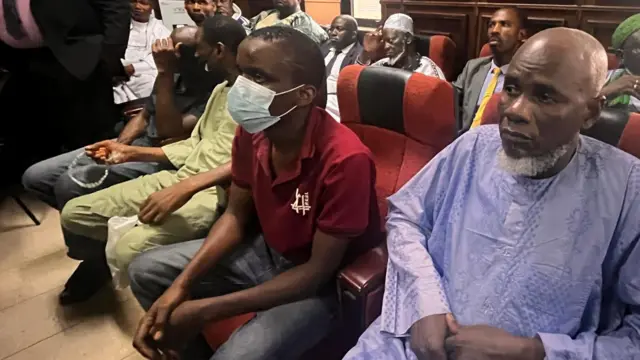
Those standing trial in the case marked FHC/ABJ/CR/206/2026 include retired Major General Mohammed Ibrahim Gana, retired Naval Captain Erasmus Ochegobia Victor, serving Police Inspector Ahmed Ibrahim, as well as Zekeri Umoru, Bukar Kashim Goni, and Abdulkadir Sani.
Also mentioned in the charge filed by the Office of the Attorney-General of the Federation is former Bayelsa State Governor and former Minister of State for Petroleum Resources under the late former President Muhammadu Buhari, Timipre Sylva.
Prosecutors alleged that Sylva fled the country before the coup plot was uncovered and remains at large.
The defendants are facing allegations bordering on treason, terrorism, failure to disclose security intelligence, and money laundering linked to terrorist activities.
During Monday’s hearing, the prosecution played a video showing retired Naval Captain Victor and Inspector Ahmed Ibrahim admitting they had prior knowledge of the alleged coup arrangement, while retired Major General Gana denied being aware of any such plot.
In his recorded statement, Gana told investigators that he retired from the Nigerian Army in 2010 as Chief of Defence Logistics and had since maintained a quiet life.
The retired officer insisted he had never been associated with indiscipline or criminal activity.
He acknowledged knowing the alleged coordinator of the operation, Colonel M. A. Ma’aji, but explained that he only knew the officer had grievances related to promotion issues.
According to him, he was unaware that Ma’aji was allegedly plotting to overthrow the government.
He maintained that if he had known, he would have immediately alerted the relevant authorities.
Gana explained that investigators linked him to the case after tracing a ₦2 million transfer to his account.
He admitted sharing via WhatsApp a speech previously delivered by Joshua Dongayaro during an earlier coup in Nigeria.
He also acknowledged forwarding anti-government messages through the same platform but insisted he neither created nor altered the materials.
When confronted with claims that a speech recovered from Colonel Ma’aji reflected the same tone and structure as materials he had circulated, Gana said he had no knowledge of any connection.
He further denied allegations that he conducted surveillance around the Presidential Villa or took part in sourcing funds for the alleged operation, including claims that billions were to be raised through a former governor.
Retired Captain Victor, however, admitted in the video that he knew of Ma’aji’s intentions.
He said the alleged mastermind had repeatedly complained about his stalled promotion and “out of anger, said he wanted to overthrow the system.”
Victor stated that he advised Ma’aji against such a move and suggested retirement as a more reasonable option.
He also admitted that he was approached to contribute financially, assist in securing accommodation, and help mobilise support for the operation, with assurances of a political appointment if the coup succeeded.
According to Victor, he declined all requests.
However, he admitted maintaining contact with Ma’aji through an encrypted messaging platform.
He confirmed that coded expressions were used during their conversations but maintained that he never played an operational role.
The retired naval officer expressed regret for not reporting the matter earlier.
He attributed his silence to his longstanding relationship with Ma’aji.
In the footage, Victor pleaded for leniency, describing his situation as “being in the wrong place at the wrong time.”
He said: “I feel so bad that I find myself in this situation. I am pleading for clemency.”
He argued that if the government could pardon terrorists and bandits, he should also be forgiven considering his years of service to the country.
Inspector Ahmed Ibrahim, who is attached to the State House, told investigators that his initial contact with Ma’aji centred on efforts to facilitate the officer’s promotion through connections in government.
He said the conversations later evolved into discussions about overthrowing the government.
The inspector admitted receiving between ₦1.4 million and ₦1.5 million.
He also admitted participating in reconnaissance around the Presidential Villa, including Aguda House.
According to his statement, he took photographs of parts of the Villa, including the President’s residence and surrounding areas, while discussions focused on possible access routes.
He disclosed that terms such as “fertiliser” and “farming” were used as coded references to funding and the planned operation.
Despite these admissions, Ibrahim insisted his involvement was the result of poor judgment and his relationship with the principal suspect.
He claimed he only played along because he believed it would be impossible for the alleged plotters to gain access to the State House.
Earlier in the proceedings, defence lawyers challenged the admissibility of the video evidence, arguing that their clients’ statements were not made voluntarily.
Their attempt to stop the footage from being played in open court was dismissed by trial judge, Justice Joyce Abdulmalik.
The court ruled that a trial-within-trial would be conducted to determine whether the statements were obtained voluntarily.
The matter was subsequently adjourned until Tuesday for further hearing.
The Federal Government alleged that the defendants conspired in September 2025 to levy war against the Nigerian state with the aim of intimidating President Tinubu, contrary to Section 37(2) of the Criminal Code.
Prosecutors also accused them of withholding intelligence about the alleged coup and failing to take reasonable steps to prevent it.
Additional charges were filed under the Terrorism (Prevention and Prohibition) Act, 2022.
The defendants pleaded not guilty to the 13-count charge during their arraignment on April 22 and remain in DSS custody pending the determination of the case.
What You Should Know
The alleged coup trial has become one of Nigeria’s most high-profile national security cases in recent years, involving retired senior military officers, a serving police inspector, and references to a former state governor.
Central to the case is the admissibility of video confessions presented by the prosecution. The court’s decision on whether those statements were voluntarily made could significantly shape the direction of the trial.
The allegations, which include reconnaissance around the Presidential Villa and coded operational discussions, have intensified public interest and raised broader concerns about internal security vulnerabilities within sensitive national institutions.