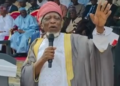
Nigeria’s long-running tension over religion in politics resurfaced this week when CAN’s Northern Chairman, Joseph Hayab, called for restraint in religious and political commentary in response to inflammatory remarks by an Islamic cleric that reopened old wounds over the country’s delicate religious balance.
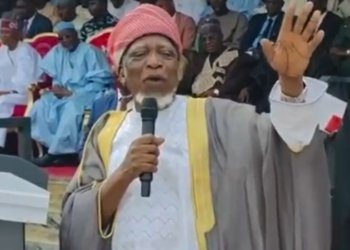
Speaking on Monday as a guest on Channels Television’s “The Morning Brief”, Hayab weighed in on comments made by Sheikh Yahya Jingir, who had appeared in a viral video urging Muslims to rally behind a Muslim-Muslim political ticket.
In the clip, Jingir was recorded telling his audience that anyone who does not want to accept a Muslim-Muslim ticket should leave Nigeria, insisting the country “belongs to us.”
The cleric made the remarks at a political event attended by some All Progressives Congress governors, including Kano’s Abba Yusuf and Jigawa’s Umar Namadi, as the video went viral over the weekend.
More damaging than the ticket comment itself, according to Hayab, was Jingir’s use of the word “infidel,” a term the cleric reportedly used when he urged the crowd to “show the infidels their limit,” dismissing claims that non-Muslims outnumber Muslims in Nigeria as false.
For Hayab, that single word changed the entire character of the cleric’s message. “Honestly speaking, if Jingir had said, ‘look, let’s vote for our Muslim brothers to show we are strong,’ it wouldn’t have been more offensive than adding the term ‘infidel,'” he said during the interview. “The moment he went out of just campaigning and insulting, then it turned the story different.”
The CAN chairman, however, was careful to frame his response not as an outburst of anger but as a call for perspective, one shaped by years of navigating similar controversies. “We have always been tolerant of this, and I want to take us back,” Hayab said. “We have had the worst of these statements. But we have to be moderate. We have to be careful when we come to public space.”
He went further, invoking a weary familiarity that many Christians in the North say has become part of their lived political experience: “We are saying this as Christians that we’ve had this for a long time, we’ve suffered this for a long time, we are familiar with this for a long time.”
Rather than escalate the confrontation, Hayab called for honest dialogue with open-minded individuals and clerics on both sides of the religious divide.
Jingir’s comments have not gone unanswered elsewhere. Former Aviation Minister Femi Fani-Kayode condemned the remarks as divisive and capable of worsening religious tensions in the country, saying he had received calls and messages from both Christians and Muslims expressing concern.
Fani-Kayode also pushed back on the underlying claim, insisting Nigeria is neither a Muslim nor a Christian country but a secular, multi-religious state with Christians and Muslims in roughly equal numbers, a balance he described as the country’s strength.
The episode underscores a recurring fault line in Nigerian politics: the extent to which religious identity should factor into electoral tickets, particularly at the presidential level, where the Muslim-Muslim pairing adopted in the 2023 election continues to generate debate ahead of the 2027 polls.
Hayab’s intervention, measured in tone but firm in substance, reflects an attempt by Christian leadership in the North to keep that debate from tipping into open religious hostility even as voices on both sides trade increasingly pointed accusations in the run-up to the next election cycle.
WHAT YOU SHOULD KNOW
At the heart of this controversy is not the call for Muslim political solidarity itself, but the language used to make it. Sheikh Jingir’s use of the term “infidel” transformed a routine campaign appeal into an inflammatory statement, turning political mobilization into a perceived insult.
CAN’s Joseph Hayab’s response makes clear that Nigeria’s religious communities, particularly Christians in the North, have long tolerated divisive rhetoric, but the line between political persuasion and religious provocation must be respected if the country’s fragile interfaith balance is to hold ahead of 2027.
Words matter as much as intent, and in a nation as religiously diverse as Nigeria, careless rhetoric from public and religious figures carries the real risk of deepening division rather than winning votes.