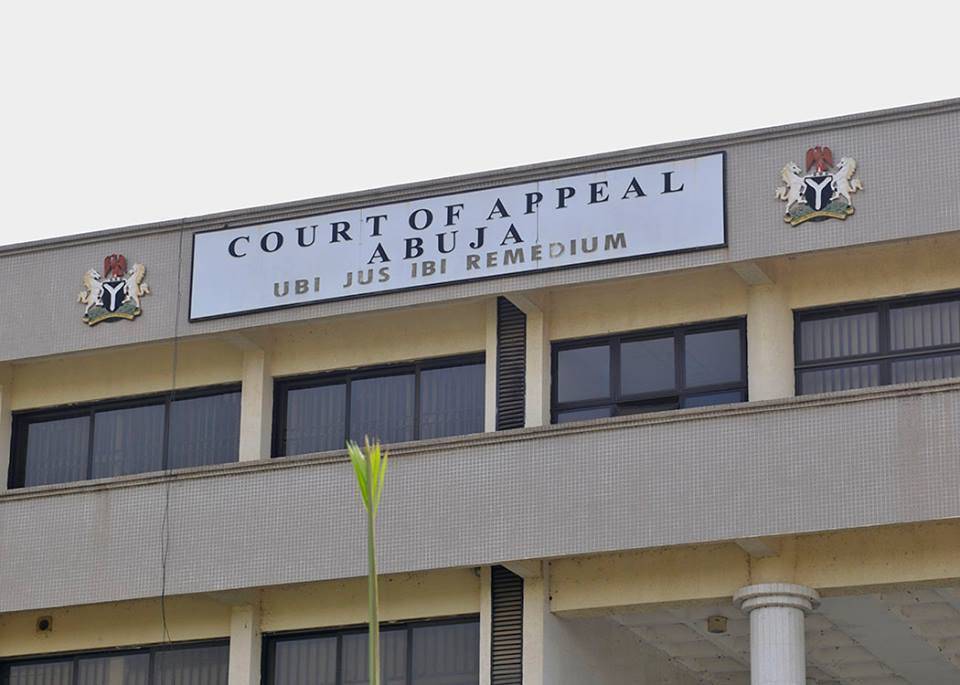
The Court of Appeal sitting in Abuja has rejected fresh attempts by the Central Bank of Nigeria (CBN) and Ahmadu Bello University (ABU) to halt the enforcement of a ₦2.5 billion judgment debt awarded in favour of 110 former ABU employees who were unlawfully dismissed in 1996.
In two separate but unanimous decisions delivered by a three-member panel, the appellate court directed the CBN to release the ₦2.5 billion to the affected workers without any further delay.

Delivering the lead judgments, Justice Okon Abang warned that the court would impose severe sanctions on the key officials of the CBN should the bank continue to withhold the funds, which have remained in its custody since 2018 after being deposited by ABU for payment to the workers.
Justice Abang dismissed the CBN’s argument that the 110 workers, who were sacked by ABU in 1996 but later ordered to be reinstated by the National Industrial Court in Abuja, could not initiate garnishee proceedings against the apex bank to recover the judgment sum.
The appellate court also rejected the claim that the workers were required to first obtain the consent of the Attorney General of the Federation and Minister of Justice (AGF) before the funds could be released.
Both the CBN and ABU had approached the Court of Appeal separately, challenging the enforcement of the Industrial Court’s judgment which ordered ABU to pay the entitlements of the 110 workers after ruling that their dismissal by the university’s Sole Administrator at the time, General Mamman Kontagora, was unlawful.
The two appellants further objected to the use of garnishee proceedings by the workers as a means of enforcing the judgment. However, the appellate court dismissed both appeals, describing them as lacking merit.
Justice Rakiya Haastrup of the National Industrial Court had, on January 27, 2022, issued a “garnishee order absolute,” instructing the CBN to release the judgment sum from ABU’s account to the affected workers.
Upholding that decision, Justice Abang ruled that the workers were fully entitled under the law to initiate garnishee proceedings against the CBN in order to enforce payment of their entitlements.
The Court of Appeal openly criticised the CBN for deploying public resources to engage legal counsel in a bid to obstruct the payment process, describing the bank’s conduct as reckless and deeply unfair to the workers, especially given that ABU had already lodged the funds with the bank specifically to settle the judgment debt.
“In this matter, it is not the duty of the CBN to play the role of the advocate but to implement the court judgment that awarded the money to the workers in the absence of any contrary court order.
“It is also unethical for the lawyer to the CBN to have supported the bank in frustrating the judgment of the Industrial Court. The unfortunate action of the CBN had prolonged the sufferings and hardships of the workers.
“The lawyer ought to have advised the CBN not to play the role of the advocate, no matter how juicy the CBN brief. The action of CBN is cowardice. It took the matter personal against the workers who have been suffering since 2013.
“There is no lawful reason for the CBN to have filed this appeal against the judgment of the Industrial Court since the workers made no claims against the bank.
“The lawyer owes a duty to the court, to the country, and to the 110 workers to see that they are not unjustly punished or denied the fruits of their court victory. He ought to have withdrawn his services if CBN goes against his advice. They ended up wasting the valuable judicial time of this Court.

“How can CBN be asking that the order of the court not made against it be vacated when it has been holding the workers’ money since 2018? The situation must not continue. There must be an end to it. The workers deserve the fruit of their labour,” he said.
In addition to reaffirming the ₦2.5 billion judgment debt, the Court of Appeal awarded ₦5 million against the CBN and another ₦5 million against ABU as costs of litigation, both sums to be paid to the affected workers.
What you should know
The ruling brings a decisive end to a long-running legal battle involving 110 former Ahmadu Bello University workers who were dismissed in 1996 and have pursued justice for decades.
The Court of Appeal not only upheld the ₦2.5 billion judgment in their favour but also criticised the Central Bank of Nigeria for obstructing payment despite holding the funds since 2018.
The decision reinforces the enforceability of garnishee proceedings and underscores that public institutions must comply promptly with court judgments.