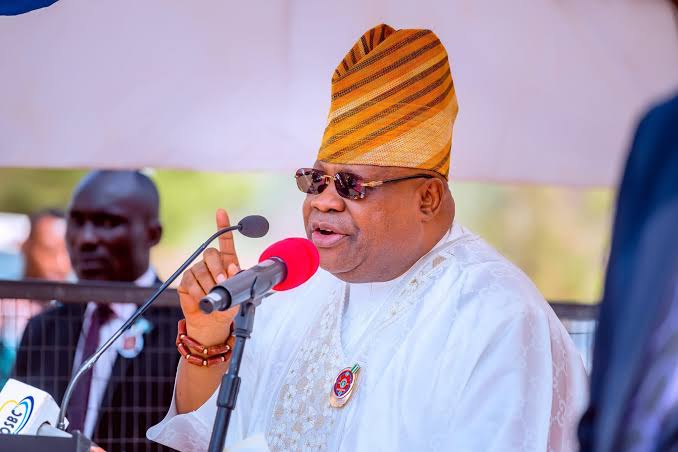
Governor Ademola Adeleke has been returned to office for a second term after the Independent National Electoral Commission (INEC) declared him winner of Saturday’s fiercely contested Osun State governorship election, closing out one of the South-West’s most closely watched political battles this year.
Collation concluded early Sunday morning at the INEC State Collation Centre in Osogbo, where the State Returning Officer, Professor Joshua Ogunwole, Vice-Chancellor of the Federal University, Oye-Ekiti, formally announced the result.
Adeleke polled 511,067 votes to emerge as the winner of the keenly contested exercise, comfortably ahead of his nearest rival, Bola Oyebamiji of the All Progressives Congress (APC), who came second with 444,815 votes. That gap translates to a winning margin of 66,252 votes.
Trailing well behind the two frontrunners was Najeem Salaam of the African Democratic Congress (ADC), who finished a distant third with 17,180 votes. Fifteen parties fielded candidates in the race, but the contest effectively narrowed to a two-horse race between the incumbent and the APC challenger.
According to figures released by INEC, Adeleke’s tally amounted to 50.8 percent of the 1,005,800 votes cast across the state’s 3,763 polling units, with Oyebamiji taking a 44.2 percent share and the remaining thirteen candidates splitting roughly five percent between them.
Turnout figures put into context the scale of the exercise: 1,010,684 voters were accredited for the poll, with 985,079 valid votes ultimately recorded. Around 20,721 ballots, or roughly 2.06 percent of the total, were rejected.
The victory was built on a wide but not overwhelming geographic spread. Adeleke carried 19 of the state’s 30 local government areas against Oyebamiji’s 11, but the margins in individual councils mattered as much as the count of councils won.
Adeleke recorded victories in Ede North, Ede South, Ejigbo, Iwo, Egbedore, Ife North, Ife East, Ife Central, Oriade, Ifelodun, Orolu, Ayedaade, Ayedire, Odo Otin, Boluwaduro, Ilesa West, Ifedayo, and Osogbo, among others, a footprint that included his political strongholds in the Ede axis.
Oyebamiji, for his part, won in Irewole, Isokan, Olorunda, Atakumosa East, Atakumosa West, Ilesa East, Boripe, Irepodun and Obokun. Yet even the APC’s wins in these councils weren’t enough to close the gap opened elsewhere.
Analysts pointed specifically to Adeleke’s home turf: results out of Ede alone accounted for a substantial share of his overall winning margin, meaning the APC’s council victories, strong as some of them were, could not offset the deficit built up in the governor’s base.
Sunday’s declaration carries particular political weight because Adeleke fought this election under a different party banner than the one that first brought him to power.
He contested and won his first term in 2022 on the platform of the Peoples Democratic Party (PDP) but defected to the Accord Party in December, a move he framed as a matter of political alignment rather than convenience.
Explaining the switch at the time, the governor said the party’s philosophy of welfarism matched his government’s focus on the welfare of workers and citizens, adding that the core purpose of government is the well-being of the people it serves.
That gamble has now paid off, with Adeleke becoming one of the most prominent governors to convert a party defection into a successful re-election bid, a result likely to be studied closely by other incumbents weighing similar moves ahead of future cycles.
Speaking after his victory was confirmed, Adeleke thanked President Bola Tinubu for the congratulatory phone call and described his re-election as a victory for democracy and the people of Osun.
He struck a conciliatory note toward his defeated rival, saying he expected Oyebamiji to reach out and framing the contest as one with no bitterness attached, “no victor, no vanquished,” as he put it, before wishing his opponent continued success.
The scale of the contest, and the scrutiny that came with it, was underscored by pointed calls for transparency from public figures monitoring the process, amid reported delays in the uploading of results to INEC’s IReV portal, a recurring flashpoint in recent Nigerian elections.
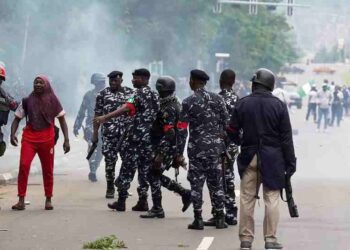
The road to Sunday’s declaration was not without friction. Reports from election observers flagged technical hitches at several polling units, including malfunctioning Bimodal Voter Accreditation System (BVAS) machines that slowed accreditation and voting in parts of the state.
Separately, at least one case surfaced of a party member found in possession of multiple Permanent Voter Cards (PVCs), the kind of irregularity that typically draws attention from election observers and opposition parties alike, even when it does not affect the overall outcome.
Ahead of the vote, INEC had recorded 2,339,233 registered voters in Osun, the highest number in the state’s governorship election history, of whom 81.5 percent had collected their PVCs and were therefore eligible to cast a ballot.
With the declaration now official, Adeleke’s second term formally extends his stewardship of the state by another four years. His victory speech signaled continuity rather than a shift in direction, with the governor reiterating welfare-focused priorities that have defined his first term.
Attention now turns to whether the APC will challenge the result through Nigeria’s election tribunal system, as has become customary in closely fought governorship contests, and to how Adeleke will use his renewed mandate to consolidate the political realignment that carried him under a new party banner back into office.
WHAT YOU SHOULD KNOW
Adeleke’s win wasn’t just about winning more councils; it was about winning the right ones. His 66,252-vote margin was built largely in his Ede stronghold, which alone outweighed the APC’s gains across the 11 areas Oyebamiji carried.
The bigger story, though, is that Adeleke pulled this off on a brand-new platform, having defected from the PDP to the Accord Party just months before the vote, turning a political gamble into a second term.