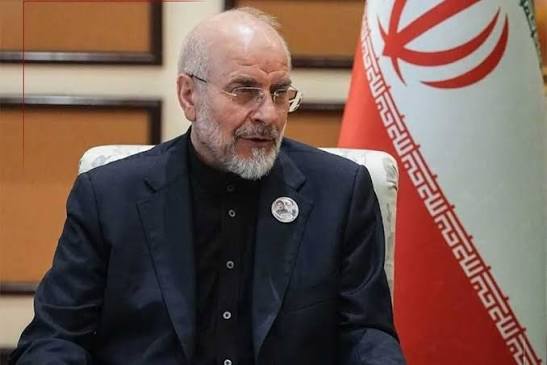
Iran’s parliament speaker and chief negotiator Mohammad Bagher Ghalibaf issued his toughest warning yet on Tuesday, saying the Strait of Hormuz, a carrier of roughly a fifth of the world’s oil, will stay closed until Washington meets Tehran’s outstanding demands.
Speaking in a televised address, Ghalibaf repeated Iran’s core conditions: an end to the U.S. naval blockade of Iranian ports and vessels, the lifting of sanctions on Iran’s oil and gas exports, and the release of Iranian financial assets frozen abroad.
He also demanded a halt to “military operations on all fronts.” These conditions, he said, were spelled out in a memorandum of understanding reached in June, one that, notably, expired on Monday, leaving the trajectory of the broader conflict and the fate of the strait mired in fresh uncertainty.
The timing lent Ghalibaf’s remarks added weight. Just hours before he spoke, an unidentified projectile struck a vessel transiting the Strait of Hormuz off the Omani coast, damaging its engine room and reportedly injuring a crew member, according to the UK Maritime Trade Operations agency.
The strike underscored how, even amid diplomatic maneuvering, the waterway remains a live flashpoint.
Deputy Foreign Minister Kazem Gharibabadi responded to the day’s developments with a pointed post on social media, asserting that the Strait of Hormuz “has been Iranian, is Iranian, and will remain Iranian,” and that it would only close or open on Tehran’s command rhetoric that leaves little room for near-term compromise.
The standoff traces back to February 28, when U.S. and Israeli strikes on Iranian territory ignited a war that has since rippled across the region.
An April 8 diplomatic push brought a temporary halt to the heaviest bombardment, with Washington declaring at the time that the strait would reopen under a ceasefire framework and that “commerce will flow” again, but that calm proved fragile.
Sporadic clashes have persisted ever since, concentrated largely around Hormuz itself, and shipping traffic has all but stalled as tankers and shipping firms weigh the risk of transiting a corridor that is barely 21 miles wide at its narrowest point.
Parallel to the standoff with Washington, Iran has been negotiating directly with Oman, the other coastal state along the strait, over a possible framework for resuming navigation.
Tehran says the two sides have agreed on geographic coordinates for a shipping route, and as of Monday, they described talks over the text of a joint statement as continuing “in a serious manner.”
Those talks, however, have been complicated by President Donald Trump, who has warned Oman against obstructing a U.S.-Iran deal on Hormuz and has separately called on Tehran to surrender outright a demand Iranian officials have flatly rejected, with figures like former IRGC commander Mohsen Rezaei insisting the war will only end once Washington pays reparations and guarantees a full U.S. withdrawal from the Persian Gulf.
For Trump, the conflict has increasingly become a domestic liability, with members of his own administration signaling frustration at the impasse; adviser Jared Kushner has said Iran shows little interest in any deal that “makes sense” for the American side.
For his part, Ghalibaf closed his address with defiant language, warning that Iran stood ready to “inflict an even more crushing defeat on the enemy, proportionate to its actions and advances.”
The comment, paired with the day’s attack on shipping and the lapsed memorandum, suggests the coming weeks are likely to bring more brinkmanship than breakthrough with the global economy, and roughly a fifth of its oil supply is hanging in the balance.
WHAT YOU SHOULD KNOW
The Strait of Hormuz remains closed with no resolution in sight. Iran’s expired June truce, a fresh attack on a transiting ship, and hardening rhetoric from both Tehran and Washington signal the conflict is deepening rather than de-escalating.
With roughly a fifth of global oil supply routed through this corridor, continued closure threatens serious disruption to world energy markets the longer this standoff drags on.