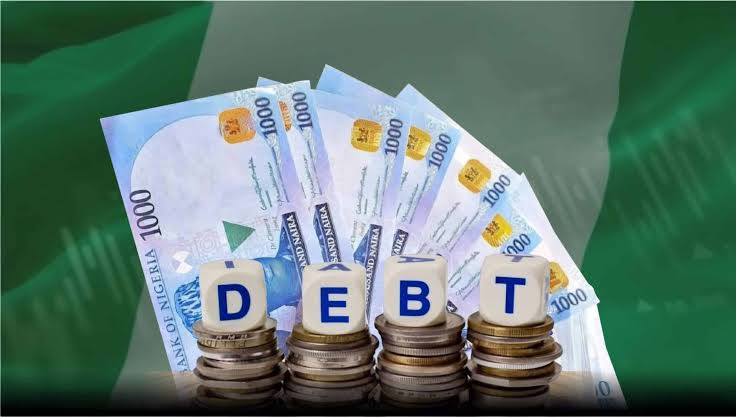
Nigeria’s total public debt crept higher in the first quarter of 2026, edging up to N159.35 trillion as of March 31, from N159.28 trillion at the close of December 2025, according to the latest figures released by the Debt Management Office (DMO).
The increase, though modest in percentage terms, amounted to roughly N71.6 billion in fresh obligations added to the country’s books over the three months, a signal that while the pace of borrowing has slowed compared to previous quarters, the upward trajectory of Nigeria’s debt profile remains unbroken.
Converted at the Central Bank of Nigeria’s official exchange rate of N1,386.2156 to the dollar as of the reporting date, the total debt stock translates to $114.95 billion.
Of that figure, domestic debt continues to carry the heavier weight, accounting for 54.85% of the portfolio at N87.40 trillion ($63.05 billion), while external obligations made up the remaining 45.15%, standing at N71.95 trillion ($51.90 billion).
That balance underscores a borrowing strategy that has, in recent years, leaned more heavily on local capital markets, a trend often linked to efforts by the federal government to reduce exposure to foreign exchange risk, even as it deepens reliance on domestic investors, pension funds, and banks to finance its deficits.
Within the domestic debt stock, the Federal Government remains by far the largest single borrower, responsible for N82.88 trillion, or 52.01%, of the entire national debt portfolio. States and the Federal Capital Territory, by contrast, account for a comparatively modest N4.52 trillion, or 2.84% of the total.
A closer look at the composition of the Federal Government’s domestic debt reveals a structure still anchored heavily in traditional instruments. FGN bonds remain the workhorse of domestic borrowing, making up N63.45 trillion, more than three-quarters (76.56%) of the FGN’s domestic debt stock.
Nigerian Treasury Bills form the next largest chunk, at N16.57 trillion, or nearly a fifth (19.99%) of the total.
Beyond these two dominant instruments, the debt mix includes smaller but notable components: FGN Sukuk bonds at N1.19 trillion, promissory notes totalling N1.39 trillion split between N300.41 billion in naira-denominated notes and N1.08 trillion in foreign currency-denominated notes, and FGN savings bonds, a relatively minor N116.21 billion.
Other instruments, including the UFTF FGN Security, contributed N100 billion to the mix. The lopsided concentration in bonds and treasury bills, analysts note, reflects the government’s continued preference for conventional debt instruments over more diversified or retail-targeted offerings like the savings bonds, which remain a marginal player in the overall structure.
On the external side, Nigeria’s $51.90 billion in foreign obligations is dominated by multilateral creditors, who together account for $23.86 billion, or 45.96% of the external debt stock, with the World Bank Group described as holding a significant share of that lending.
Institutions such as the World Bank have long been Nigeria’s preferred source of concessional, lower-cost financing, and their continued dominance suggests the government is still prioritizing cheaper, longer-tenor funding where available.
Commercial debt, largely composed of Eurobond issuances, represents the second-largest slice of external obligations, at $18.55 billion, or 35.73%. This category typically carries higher interest costs than multilateral lending, making it a more expensive, if flexible, source of foreign currency financing.
Bilateral loans account for $6.59 billion, or 12.69% of the external portfolio, while syndicated loans make up the remainder at $2.86 billion, or 5.51%.
Within the bilateral category, China’s outsized role as a creditor is once again on display. The Export-Import Bank of China alone is owed $4.95 billion, making it Nigeria’s largest single bilateral lender by a wide margin, while the China Development Bank holds a comparatively smaller $507.52 million.
Together, these figures reaffirm China’s position as Nigeria’s most significant bilateral creditor, a relationship that has drawn scrutiny in recent years over loan terms, project-linked lending conditions, and questions of debt transparency.
Taken as a whole, the DMO’s first-quarter 2026 figures paint a picture of a debt profile that is growing steadily rather than explosively, but one that continues to raise questions about sustainability, debt servicing costs, and the government’s capacity to balance domestic borrowing against the risks of currency depreciation on its external obligations.
With domestic debt now comfortably exceeding half of the total portfolio, and FGN Bonds and Treasury Bills continuing to dominate that space, Nigeria’s fiscal managers appear to be doubling down on local markets even as external creditors from the World Bank to Chinese state lenders remain deeply embedded in the country’s financing structure.
WHAT YOU SHOULD KNOW
Nigeria’s public debt rose only marginally in Q1 2026 to N159.35 trillion from N159.28 trillion, but the underlying story is structural, not just the small headline increase.
Domestic debt now makes up nearly 55% of the total, with the Federal Government’s borrowing still overwhelmingly concentrated in FGN Bonds and Treasury Bills. On the external side, China remains Nigeria’s dominant bilateral creditor, holding nearly $5 billion through its Exim Bank alone.
Growth in the debt stock has slowed, but Nigeria’s reliance on domestic bonds and Chinese bilateral financing continues to define its debt profile, a trend worth watching for its long-term implications on debt servicing and fiscal flexibility.