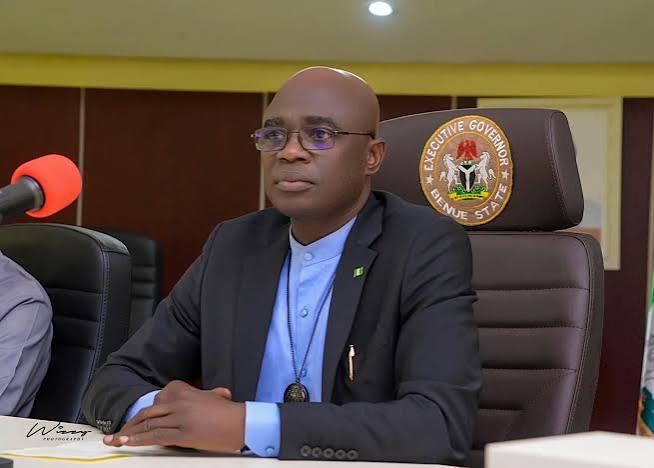
Governor Hyacinth Alia of Benue State has signaled that his administration will begin winding down some of the state’s Internally Displaced Persons (IDP) camps, pointing to a marked improvement in security that has allowed thousands of displaced residents to return to their farms and villages.
The governor disclosed a media engagement with the Renewed Hope Ambassadors Presidential Media Team, a delegation led by presidential media aide Bayo Onanuga that toured Benue to assess federal and state infrastructure projects spanning the state’s 23 local government areas.
For years, Benue has borne the brunt of violent herder-farmer clashes and attacks that forced tens of thousands from their homes, leading to the establishment of 15 IDP camps across the state at the height of the crisis.
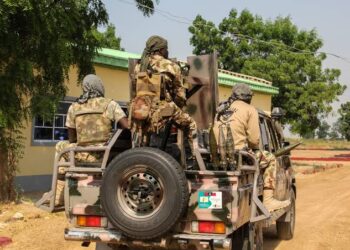
But Alia told the visiting journalists that the tide appears to be turning. With federal backing strengthening the security architecture bolstered by intelligence gathering from traditional rulers and community residents alongside conventional security deployments, displaced families have begun trickling back to their ancestral lands, many resuming farming and rebuilding homes they had long abandoned.
“We are already making some plans to close down some because the IDP occupants have voluntarily gone back to do their farming,” Alia said, framing the shrinking camp population as evidence of genuine, ground-level progress rather than a mere policy declaration.
Crucially, the governor was careful to frame the initiative as more than a resettlement exercise. He said his administration, working alongside international partners such as the United Nations and the International Organization for Migration, was focused on ensuring returnees do not simply cycle back into displacement should violence flare again an implicit acknowledgment of the fragile history of return efforts in the region.
Beyond the security and displacement question, Alia used the platform to tout a broader scorecard of achievements. He pointed to a declared state of emergency on road infrastructure that has yielded reconstructed arterial roads and urban renewal in major townships, along with the revival of long-dormant assets like the Tarakum Mill, Otobi Water Works, and the state brewery projects the Presidency’s Onanuga singled out as catalysts for local economic revival.
On education, the governor cited the rehabilitation of neglected primary schools and the recruitment of 9,700 teachers as central to rebuilding the state’s basic education system.
In healthcare, he highlighted the upgrading of primary healthcare centers and the transformation of the state teaching hospital, which he said now draws patients from neighboring states, aided by a new VIP wing and specialist services.
He added that medical equipment secured through a partnership with the U.S. government was expected to arrive soon for distribution to primary healthcare facilities statewide.
Alia closed his remarks by crediting the Federal Government’s support as pivotal to the pace of infrastructure delivery, insisting that campaign promises must translate into measurable outcomes for citizens to feel the tangible benefits of governance.
At a dinner hosted later by the state government, Onanuga commended Alia and his deputy, Samuel Ode, for their hospitality, saying the visit was designed to let senior media figures witness the transformation underway firsthand.
He also praised the administration for extending road development into previously insecure and remote areas and for clearing inherited arrears in teachers’ salaries and retirees’ benefits, a commitment he described as a marker of fiscal discipline and continuity in governance.
WHAT YOU SHOULD KNOW
Benue’s planned closure of IDP camps is being driven by genuine, on-the-ground security improvement, not just political messaging. Displaced residents are voluntarily returning to farm and rebuild, and the state is working with federal and international partners to ensure this return is sustainable rather than temporary.
This progress on displacement sits alongside broader gains in roads, education, and healthcare, reflecting a governor keen to show that promises are translating into measurable results for Benue’s citizens.