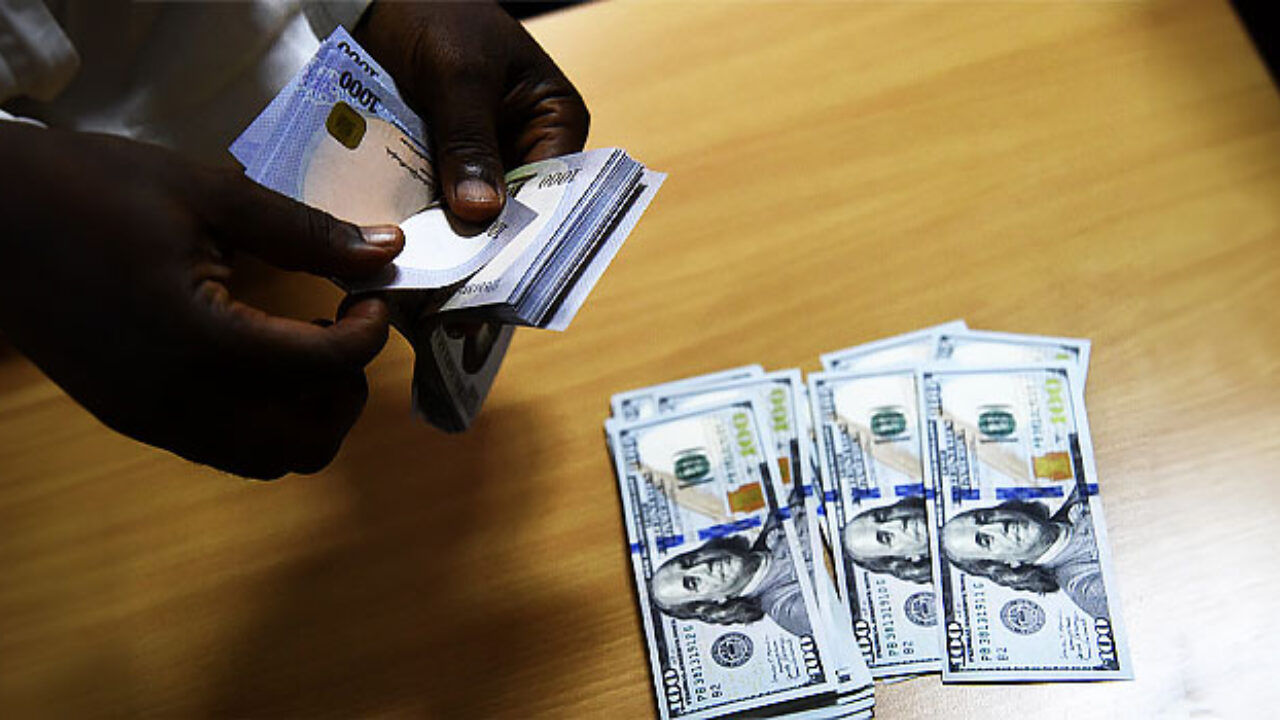
The Nigerian naira put in another calm session on Tuesday, trading around ₦1,368 to the United States dollar on the official Nigerian Foreign Exchange Market (NFEM), even as the parallel market continued to price the greenback well north of ₦1,400, underscoring a currency market that has settled, but not yet unified.
Figures released by the Central Bank of Nigeria (CBN) put the latest volume-weighted average rate at ₦1,368.22/$1, extending a run of tight, low-volatility trading that has kept the naira boxed between ₦1,362 and ₦1,369 in recent sessions.
For a market that spent much of 2024 and early 2025 lurching from one devaluation scare to the next, this kind of narrow banding is itself the headline.
Traders and analysts described Tuesday’s action as unremarkable in the best possible sense: no sharp intraday swings, no scramble for dollars at the official window, just currency trading in a groove.
Away from the CBN’s official plumbing, the story is a touch less tidy. In Lagos’s parallel or “black” market, Bureau de Change operators and street traders were buying dollars for roughly ₦1,410 on Tuesday morning, and selling anywhere from ₦1,415 to ₦1,425, with the exact price depending on location and the size of the transaction. Spot checks across the city on Tuesday found most quotes clustering tightly within that band.
That leaves a spread of somewhere between ₦45 and ₦57 per dollar separating the official and street rates a gap that, while far narrower than the chasms of previous years, still tells its own story: retail and informal demand for hard currency in Nigeria remains stubbornly ahead of what the official window is willing, or able, to supply at scale.
Financial analysts attribute the newfound stability to a trio of factors: improved foreign exchange liquidity feeding into the official market, tighter monetary policy from the CBN, and a string of reforms aimed at making the foreign exchange market more transparent reforms that have, by most accounts, chipped away at the kind of speculative distortions that plagued the naira through 2024 and into the first months of 2025.
The official rate’s recent confinement to the mid-₦1,360s is being read by market watchers as more than a lucky run of quiet days; it’s being framed as evidence that the CBN’s liquidity management is starting to hold under real market pressure, rather than simply papering over strain.
The arithmetic is straightforward, if sobering for anyone converting savings or remittances into naira. At Tuesday’s official rate, $100 fetched about ₦136,822.
Take that same $100 to a Lagos street trader, however, and you’d walk away with somewhere between ₦141,500 and ₦142,500 a gap of roughly ₦4,700 to ₦5,700 on a single $100 transaction, a vivid illustration of just how much the choice of market still matters to ordinary Nigerians moving money.
The CBN has been at pains to stress that the NFEM rate calculated as a volume-weighted average of actual completed transactions remains the country’s official benchmark for the naira’s value, a methodology designed to anchor the rate in real trading activity rather than quoted or indicative prices.
It’s this rate that continues to serve as the reference point for government accounting, official conversions, and policy discussions, even as millions of Nigerians conduct their day-to-day currency business several dozen naira away from it, in the parallel market down the street.
WHAT YOU SHOULD KNOW
The naira’s stability at ₦1,368/$1 officially versus ₦1,410–₦1,425 on the street isn’t a sign the currency has fully stabilized; it’s a sign of a market still split in two.
Where you exchange your dollars matters just as much as when, with a nearly ₦5,000 difference on every $100 depending on which market you use. Until that official-parallel gap closes further, “stability” at the CBN’s window doesn’t yet mean stability for the average Nigerian’s wallet.