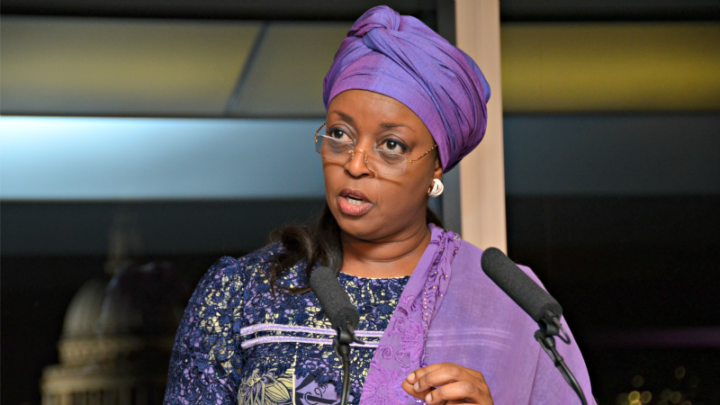
Diezani Alison-Madueke, Nigeria’s former minister of petroleum and one-time president of the Organisation of the Petroleum Exporting Countries (OPEC), was acquitted of six bribery charges in what has become one of the most closely watched corruption trials in recent British legal history.
Alongside her, oil industry executive Olatimbo Ayinde, and her brother Doye Agama were similarly cleared of all charges by the 12-member jury, a sweeping verdict that left prosecutors with nothing to show for an investigation that stretched back well over a decade.
The case against Alison-Madueke had been building since British authorities first began scrutinizing allegations of corruption linked to Nigeria’s oil sector, a sector notorious for opacity, patronage, and staggering financial leakage during Africa’s most populous nation’s oil boom years.
She served as petroleum minister from 2010 to 2015 under former President Goodluck Jonathan, presiding over a portfolio that placed billions of dollars in oil revenues and the contracts that directed them squarely within her orbit.
It was a position of immense power in a country where petroleum accounts for the overwhelming bulk of government revenue and where access to the right official at the right moment could mean the difference between a multimillion-dollar contract and nothing.
Prosecutors at Southwark Crown Court alleged that Alison-Madueke had leveraged precisely that power for personal gain. The Crown’s case painted a picture of a minister living lavishly on the generosity of oil and gas industry figures who, they argued, were purchasing influence in exchange for a shot at lucrative Nigerian contracts.
She faced five counts of accepting bribes and one count of conspiracy to commit bribery. The prosecution described her lifestyle in London as nothing short of “a life of luxury,” one allegedly financed not by her public servant’s salary but by those who stood to profit from her goodwill.
Alison-Madueke denied every charge with equal force. Her defence team mounted a vigorous counter-narrative, arguing that she had neither received bribes nor wielded the kind of direct, personal influence over contract awards that the prosecution alleged.
She was, her lawyers contended, a senior public official operating within a complex bureaucratic system, not a sole gatekeeper dispensing contracts to the highest bidder.
The argument evidently resonated with the jury. After deliberating for more than 46 hours, a duration that itself signaled the complexity and weight of the evidence placed before them, the panel returned unanimous not-guilty verdicts on all counts against all three defendants.
For Ayinde, the acquittals covered one count of bribery relating to Alison-Madueke and a separate count of bribery of a foreign public official, the latter a charge with serious implications under British anti-corruption law. For Agama, the charge of conspiracy to commit bribery had centered on alleged payments made to his church, a claim he firmly rejected.
The National Crime Agency (NCA) had invested considerable time and resources pursuing the case, with investigations reportedly commencing more than ten years ago. Such prosecutions are notoriously difficult; they require establishing not just that gifts or payments were made but that they were made with corrupt intent and that the recipient understood and accepted them as such.
Alison-Madueke’s case was further complicated by the jurisdictional and evidentiary challenges inherent in building a bribery case that straddles two continents. Witnesses, documents, and transactions spread across Nigeria, the United Kingdom, and beyond must be painstakingly assembled into a coherent legal argument, and in this instance, that argument was not enough.
British authorities regard the outcome as a reversal in their broader effort to prosecute high-level corruption linked to Nigeria’s oil industry.
The acquittal is likely to reverberate far beyond the walls of Southwark Crown Court. In Nigeria, where public trust in institutions has been eroded by decades of alleged elite impunity, the verdict will be received with a mixture of reactions: relief in some quarters and deep frustration in others.
Anti-corruption advocates who had watched the trial as a test of whether powerful political figures could be held accountable in foreign courts will be left to reassess what such prosecutions can realistically achieve.
For Alison-Madueke personally, Wednesday’s verdict is a legal vindication, even as questions about Nigeria’s oil industry governance during her tenure remain subjects of broader historical and political debate.
She has long been a lightning rod figure, celebrated by some as a formidable technocrat who broke barriers in a male-dominated sector and condemned by others as emblematic of an era of institutionalized graft.
She walked out of Southwark Crown Court on Wednesday a free woman, acquitted, not exonerated in the court of public opinion, perhaps, but cleared in the only court whose verdict carries the force of law.
WHAT YOU SHOULD KNOW
After more than a decade of investigation and a grueling trial that captivated observers across two continents, Nigeria’s former Petroleum Minister Diezani Alison-Madueke walked free from London’s Southwark Crown Court on Wednesday, acquitted of all six bribery charges alongside her two co-defendants.