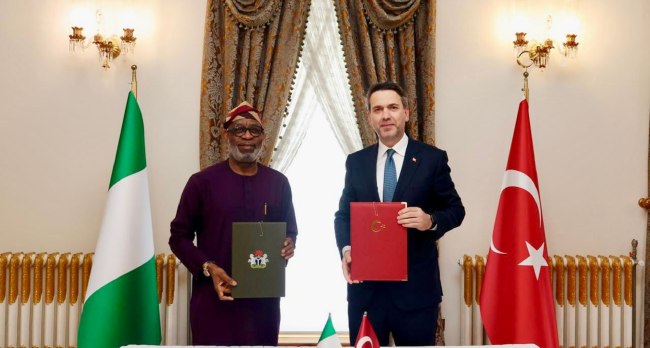
Nigeria and Türkiye have signed a Memorandum of Understanding to strengthen bilateral cooperation in the solid minerals sector, marking one of the more consequential mining diplomacy moves by Abuja in recent years.
The agreement was sealed on the sidelines of the Istanbul Natural Resources Summit (INRES) by Nigeria’s Minister of Solid Minerals Development, Dele Alake, and Türkiye’s Minister of Energy and Natural Resources, Alparslan Bayraktar.
At its core, the deal is about bridging a critical gap. Nigeria sits on commercially viable deposits of gold, lithium, iron ore, rare earth minerals, and dozens of other resources, yet has historically extracted little economic value from them.
The MoU positions Türkiye as a key partner in closing that gap, with Nigeria looking to leverage Turkish expertise in mining exploration, technology transfer, digitization, licensing systems, and capacity building.
Minister Alake arrived at the negotiating table with a reform story that is increasingly difficult to ignore. Under President Tinubu’s administration, the sector has attracted over $2.6 billion in foreign direct investment in under three years, driven by digitized licensing, stronger regulatory frameworks, improved ease of doing business, and a guarantee that investors can repatriate profits after due process.
Alake, who also chairs the Africa Minerals Strategy Group, described the reforms as having fundamentally transformed the sector’s operating environment.
Complementing those reforms has been a muscular crackdown on illegal mining. The specially created mining marshals have arrested over 300 illegal operators, including foreign nationals, with more than 150 prosecutions currently ongoing and over 100 illegal sites recovered and returned to licensed owners.
For Türkiye, the agreement is about more than mining. Bayraktar signaled that Turkish industrial companies are keen to expand into Nigeria’s energy and hydrocarbons sectors as well, describing the partnership as “strategic and timely” amid growing global competition for critical minerals.
He also used the occasion to express Türkiye’s desire to renew broader energy cooperation with Nigeria, a signal that Istanbul sees Abuja as a gateway to deeper engagement across the African continent.
Speaking at a panel session on the sidelines of INRES, Alake also stressed that sustainable energy security, the broader ambition underpinning deals like this one, cannot be achieved without global peace and conflict reduction. It was a sobering reminder that diplomacy and development, however promising, do not happen in a vacuum.
The MoU is non-binding at this stage but is widely expected to pave the way for concrete project-level agreements in the months ahead. For a sector long defined by unrealized potential, that may be precisely the point.
WHAT YOU SHOULD KNOW
Nigeria and Türkiye’s mining MoU is ultimately a story about strategic timing. Nigeria arrives at this partnership with rare credibility, with over $2.6 billion in FDI attracted, a crackdown on illegal mining underway, and a genuine reform record to show.
Türkiye, in turn, brings the technology, industrial expertise, and investment appetite that Nigeria needs to move beyond digging and exporting raw minerals toward building real industrial value at home.