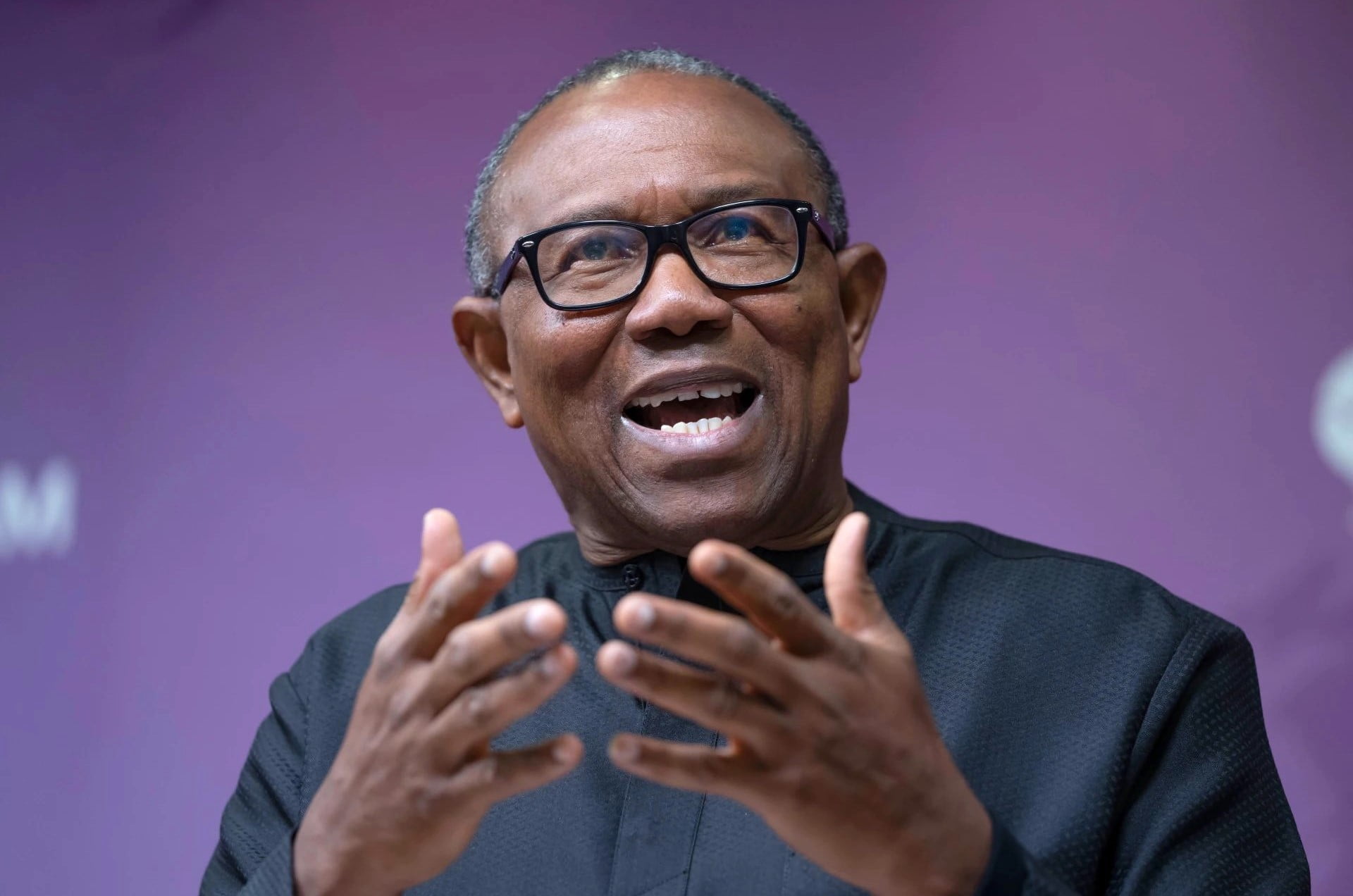
The door may have permanently closed on Peter Obi’s prospects of flying the Labour Party’s flag in the 2027 presidential election, the party’s interim national chairman, Senator Nenadi Usman, has declared, and this time, the barrier is not political but strictly legal.
Speaking in a wide-ranging interview on Arise TV on Wednesday, Usman invoked the provisions of the Electoral Act to make what amounts to the most definitive statement yet on Obi’s political future within the party he once electrified into national relevance.
“Well, it will be too late actually for him to come back,” Usman said, her tone measured but unambiguous. “Once we close the register 21 days before primaries and submit the e-register to INEC, you can’t come from behind the door for us to register you and for you to contest the elections. That would be impossible, legally impossible anyway.”
The Senator was referencing Section provisions of Nigeria’s Electoral Act, which mandate that political parties submit their membership registers to the Independent National Electoral Commission no fewer than 21 days before conducting their primaries.
Any aspirant not captured in that register at the point of submission would, under the law, be ineligible to participate in the party’s presidential primary, effectively rendering a last-minute return by Obi a non-starter, regardless of the political will of any faction within the party.
The declaration carries particular weight given how central Obi was to the Labour Party’s unprecedented surge in the 2023 general elections, when he garnered over six million votes and finished third in a race that many of his supporters still contest.
What makes Usman’s statement all the more striking is her candid acknowledgment of the very man she is now foreclosing. In a moment of rare political candor, the interim chairman admitted that she herself had been recruited into the Labour Party by Obi.
“Even me, he convinced me to come with him to the Labour Party,” she said. “Convinced me and not just me; many people that are in the Labour Party today were convinced by ‘Let’s join Peter; go to Labour Party because we believed in equity and fair play.'”
Usman, a former minister of finance under President Goodluck Jonathan and a long-standing fixture of northern Nigerian politics, said her decision to abandon the Peoples Democratic Party had been driven by the conviction that the PDP had unjustly denied the south its turn at the presidency.
“We believe that PDP should have zoned the seat to the south,” she said, acknowledging the irony of a northerner taking that position. “Though I’m a northerner, I felt it was not fair.”
That principled defection, alongside dozens of others swept along by what became popularly known as the “Obedient Movement,” helped propel the Labour Party from a fringe political outfit to a credible third force in Nigerian politics almost overnight.
Today, however, the man who made that transformation possible has no visible path back into the fold, at least not on any timeline that would make 2027 viable.
The backdrop to Usman’s pronouncements is a Labour Party that has barely emerged from what can only be described as an internal civil war, one that has left visible scars on the party’s structure, membership, and electoral prospects.
Since its strong 2023 outing, the party has become consumed by a ferocious leadership dispute between Usman’s caretaker committee and the camp of former national chairman Julius Abure, whose loyalists accused her faction of staging an illegitimate takeover of the party’s apparatus.
The legal battles that followed were protracted and bitterly contested. In April 2025, the Supreme Court ruled that Abure’s tenure had expired. A Federal High Court in Abuja subsequently sacked him entirely and directed INEC to recognize only Usman’s committee as the legitimate leadership pending a national convention.
When Usman’s team moved in to take over the party’s national secretariat in the Utako district of Abuja, the transition was far from orderly; allegations of vandalism and the theft of party documents were levelled squarely at Abure’s departing loyalists.
The Court of Appeal in Abuja has since dismissed Abure’s challenge, unanimously affirming Usman as interim chairman and directing INEC to deal exclusively with her faction.
Abure, however, has signaled his intention to escalate the matter to the Supreme Court, ensuring that a thread of legal uncertainty continues to hang over the party’s operations.
The price of this prolonged fratricidal conflict has been steep and, in some respects, irreversible. Mass defections have bled the party of key figures and grassroots structures built painstakingly around the 2023 campaign.
The Labour Party’s National Assembly caucus, once buoyed by the momentum of Obi’s presidential run, has shrunk considerably as members decamped to rival parties. Its presence in state assemblies and local government structures has similarly diminished.
And then there is Obi himself, who, citing precisely this internal turmoil, formally walked away from the party he had made famous. His exit, framed as a response to institutional dysfunction rather than ideological disagreement, was widely interpreted as a verdict on the failure of the party’s leadership to consolidate the extraordinary political capital of 2023.
Usman’s faction has wasted no time in signaling its direction for 2027. Membership revalidation exercises are underway, and in a move with clear strategic implications, the party has zoned its 2027 presidential ticket to the south, a decision that simultaneously honors the equity argument that brought many of its members over from the PDP and positions the party as a principled alternative ahead of the next general election cycle.
Whether that positioning will be enough to rebuild what was lost remains deeply uncertain. The Labour Party enters the 2027 cycle without its most recognizable face, without the grassroots energy of the Obidient movement, and with leadership still fighting rearguard legal battles.
For Peter Obi, the man who turned a minor party into a national phenomenon, the clock, as Senator Usman has made plain, has effectively run out.
The Electoral Act does not negotiate. And in Nigerian politics, where timing is everything, being caught on the wrong side of a registration deadline can be just as decisive as losing a vote.
WHAT YOU SHOULD KNOW
Peter Obi’s political future with the Labour Party is effectively over. The Electoral Act’s mandatory 21-day membership registration deadline before primaries makes his return legally impossible, not merely politically difficult.
While Obi was the singular force behind the Labour Party’s historic 2023 rise, convincing figures like Senator Usman herself to defect from the PDP, the party he built has since been gutted by a bitter leadership crisis, mass defections, and courtroom battles that cost it dearly in structure and relevance.
The party is now rebuilding without him, with a southern-zone 2027 presidential ticket and new leadership in place.