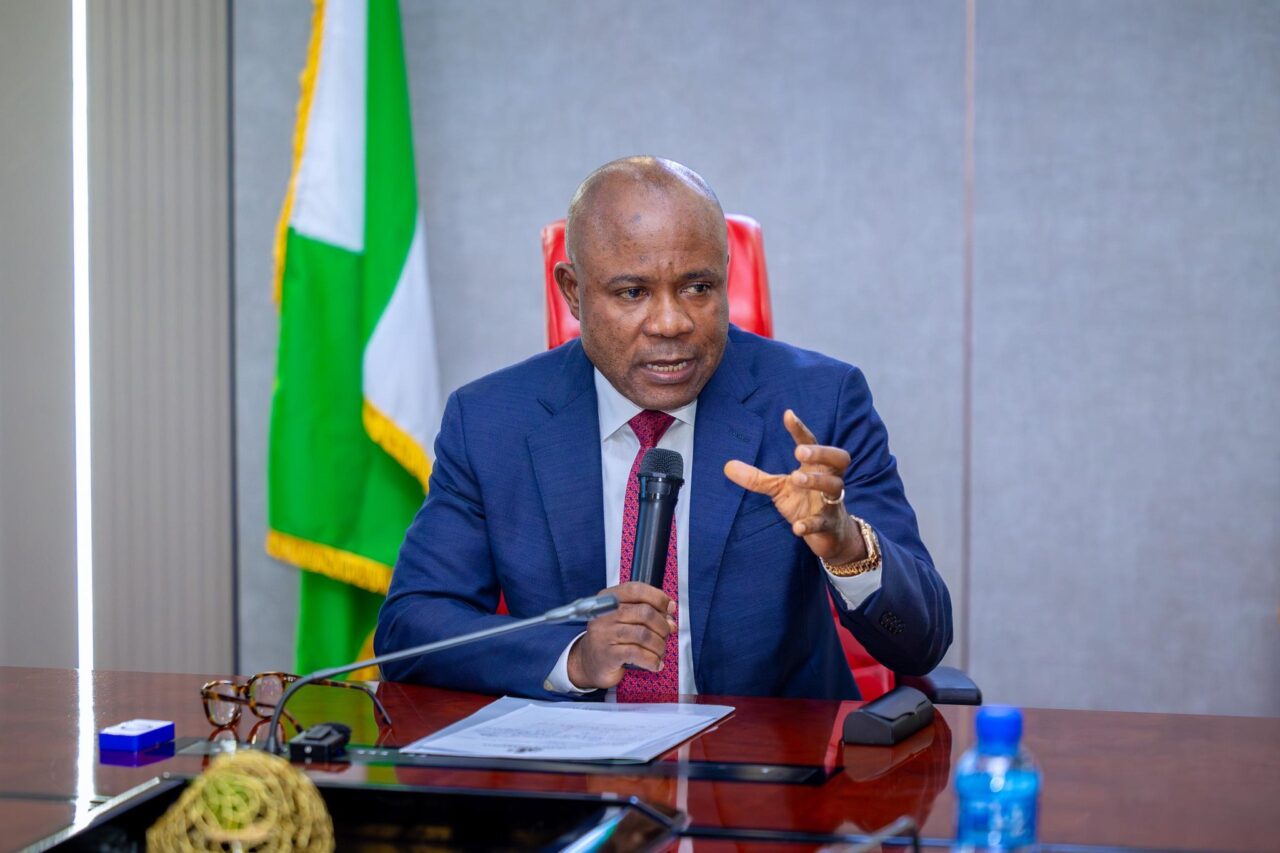
Governor Dr. Peter Mbah has dismissed widespread accusations of “high taxation” under his administration as nothing more than “a pathetic misconception” deliberately peddled by political opponents.
Speaking during a no-holds-barred interview aired by Afia Television this week, the governor insisted that far from burdening residents, his government has engineered a historic transformation of Enugu’s finances through transparency, innovation, and sheer efficiency, not by hiking taxes, but by plugging massive leakages that had bled the state dry for decades.
Mbah laid out the numbers that have stunned even his critics: the state’s Internally Generated Revenue (IGR) rocketed from a modest N26.8 billion in 2022 to N37.4 billion by the end of 2023, then surged to N180.5 billion in 2024 and exploded to a record N406.7 billion in 2025.
“That kind of exponential growth is beyond the imagination of those still trapped in the old narrative,” he said, his voice laced with unmistakable satisfaction. “They refuse to acknowledge that we have widened the tax net legitimately, blocked revenue leakages, and introduced game-changing reforms, such as the Consolidated Demand Notice, e-ticketing, aggressive recovery, optimization, and the monetization of dormant state assets.”
Crucially, Mbah delivered a masterclass in constitutional clarity, reminding citizens that the Enugu State Government literally lacks the legal power to raise or slash core taxes. Under the 1999 Constitution, he explained, taxation remains the exclusive preserve of the National Assembly in Abuja.
“Whether it is your personal income tax, company income tax, value-added tax, or withholding tax, those can only be legislated on by the National Assembly,” he stated firmly. “As a state, we are not able to legislate on taxation. It is in the exclusive legislative list.”
To drive the point home, the governor revealed a striking breakdown for 2025: of the N406.7 billion IGR, only N51.5 billion, just 12.6 percent, came from actual tax revenue. The remaining N355.2 billion, or a whopping 87.4 percent, was generated from non-tax sources through the very reforms his administration has championed.
In the limited areas where states do have competence rates, levies, and fees, Mbah disclosed that his team had gone further than any predecessor to ease the burden on citizens. A high-powered committee that included market leaders, organized labor, and the Chamber of Commerce and Industry toured the entire Southeast, only to discover that Enugu already charged the lowest rates in the region.
“Even so, we crashed those rates further by 70 percent, especially in the land sector,” he revealed, underscoring a deliberate pro-people policy.
Yet the governor was candid about persistent challenges. He acknowledged that illegal revenue collectors and extortionists still roam the streets, setting up unauthorized roadblocks and harassing hapless citizens, a hangover from years of impunity.
That era, he promised, is about to end.
The recently passed Enugu State Harmonised Taxes and Levies (Approved List for Collection) Law, 2026, has consolidated all legitimate payments into a single transaction. “You only make one payment, and you are done with all the services the government provides,” Mbah said.
To enforce the new regime, a standing task force has been constituted, public enlightenment campaigns are being intensified, and multiple toll-free lines have been activated so that residents can call without airtime to report extortionists directly.
“Some people still go about extorting money because this is a practice that has gone on over the years,” he conceded. “But we will track them and bring them to book, and we want citizens to report them.”
Governor Mbah’s robust defence comes at a time when Enugu residents are still adjusting to the new revenue regime, even as many acknowledge visible improvements in infrastructure, security, and service delivery. Whether the governor’s detailed explanations will finally silence the critics or merely shift the battleground to implementation remains to be seen.
What is no longer in doubt, however, is this: under Peter Mbah, Enugu’s IGR story has moved from stagnation to a trajectory few other states can match, and the governor is betting that facts, not fiction, will ultimately carry the day.
WHAT YOU SHOULD KNOW
Governor Peter Mbah has firmly rejected claims of high taxation in Enugu State, clarifying that states lack the constitutional power to increase or reduce major taxes, a right reserved exclusively for the federal government.
The dramatic rise in Internally Generated Revenue (from N26.8bn in 2022 to N406.7bn in 2025) stems not from higher taxes but from blocking leakages, optimizing dormant assets, and capturing non-tax revenue (which made up 87.4% of 2025 IGR).