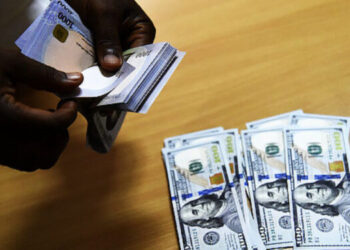
The Central Bank of Nigeria (CBN) absorbed more than N3.57 trillion from the banking system in just three trading days, as deposit money banks flooded the apex bank’s Standing Deposit Facility with surplus cash in one of the most aggressive liquidity mop-ups Nigeria’s money markets have seen in recent times.
The scale of the operation, spanning Tuesday, February 17, through Thursday, February 19, underscores a financial system that is not short of cash—far from it. Nigeria’s banks are, by most measures, swimming in it.
To understand the gravity of what transpired last week, one must first grasp the sheer volume of naira sloshing through the banking system. Analysts at Coronation Research had already flagged the brewing situation in their Nigeria Weekly Update published on Friday, February 13, noting that banking system liquidity had surged past N4 trillion.
By Friday of the following week, that figure had climbed further, closing at N4.32 trillion, a level that even seasoned market watchers described as remarkable.
Banks, finding themselves with more cash than they could prudently deploy in the short term, responded in the most logical way available to them: they turned to the CBN’s Standing Deposit Facility, a window that allows financial institutions to warehouse excess reserves overnight in exchange for an interest rate of approximately 22.8%, according to data from FMDQ.
The appeal is straightforward—in a high-interest-rate environment, parking surplus funds at the CBN offers a risk-free, guaranteed return that many banks find difficult to pass up.
SDF placements told the story most vividly. At the start of the week, banks deposited N2.52 trillion into the facility. By the end of the period under review, that figure had surged to N4.26 trillion — a dramatic rise that confirmed liquidity was not merely elevated but actively expanding despite the CBN’s aggressive countermeasures.
The apex bank was not a passive observer. Armed with its monetary policy toolkit, the CBN deployed a combination of open market operations and primary market issuances to drain the excess. The results were substantial on paper, even if the liquidity tide proved stubborn.
On February 17 alone, the CBN executed OMO sales worth N2.30 trillion. Yet the impact was partially blunted by N1.87 trillion in maturing instruments returning to the system, leaving a net absorption of approximately N435 billion for the day—significant, but modest against the backdrop of a N4 trillion-plus liquidity pool.
By February 19, the CBN shifted emphasis toward the primary market, booking treasury bill and bond sales totaling N1.91 trillion against N765.89 billion in repayments, generating a net withdrawal of roughly N1.14 trillion. Combined, direct market instruments accounted for approximately N1.57 trillion in net sterilization across the three-day window. Yet through it all, banks barely flinched. On February 17, they placed N3.35 trillion at the SDF.
Two days later, they placed approximately N2.97 trillion—barely a naira less in practical terms, suggesting that the mop-up operations, while firm, were not sufficient to alter the underlying liquidity posture of the system materially.
The picture that emerges from last week’s data is not one of a banking sector scrambling to cover funding gaps. Analysts are careful to make this distinction. Standing Lending Facility usage—the window banks tap when they need emergency funds—remained minimal throughout the period, and opening balances were modest relative to the volume of policy absorptions. This is not a system under stress. It is a system that is, if anything, too comfortable.
The deeper question is why liquidity has built to such levels in the first place, and the answers point to forces that will not be resolved by a few days of OMO sales.
Olubunmi Ayokunle, Head of Financial Institutions Ratings at Augusto & Co., identified three structural drivers. First, historically high allocations from the Federation Account Allocation Committee—the mechanism through which oil revenues and other federally collected funds are shared among the three tiers of government—have consistently pushed fresh naira into circulation.
Second, the lingering overhang of Ways and Means financing from the previous administration, a controversial practice through which the government borrowed directly from the CBN, has left residual monetary effects that continue to ripple through the system. Third, gradual economic recovery has meant that money disbursed for projects and public expenditure finds its way back into bank accounts, further recycling liquidity within the financial sector.
“If the government pursues expansionary spending—infrastructure, economic stimulus—you will inevitably see high liquidity,” Ayokunle said. “The key issue is management.”
It is a point that carries weight. High liquidity is not inherently a problem. Capital markets function, credit can flow, and economic activity can be financed. The danger, central bankers know well, lies in unmanaged excess liquidity that feeds inflation, weakens the naira, or inflates asset prices beyond what economic fundamentals justify.
For the CBN, last week’s operations reflect a policy stance that remains firmly hawkish. Governor Olayemi Cardoso’s administration has made taming inflation a central pillar of its monetary strategy, and the aggressive use of OMO and primary market instruments to drain excess reserves is consistent with that posture.
The 22.8% overnight SDF rate itself is a product of the elevated Monetary Policy Rate, which the CBN has held at historically high levels in its bid to squeeze inflation out of the economy.
But the arithmetic of last week’s operations raises legitimate questions about the sustainability of the current approach. The CBN absorbed N1.57 trillion through direct instruments and watched banks deposit N3.57 trillion through the SDF anyway.
The gap between what policy tools can drain and what the system generates suggests that, without complementary fiscal discipline—restraint in government spending, more efficient FAAC distribution mechanisms, and a reduction in deficit financing—the CBN may find itself running a perpetual and increasingly expensive mopping exercise.
Each naira absorbed through OMO comes at a cost. Interest payments on sterilization instruments are a quasi-fiscal burden that, if sustained at current volumes, could compound the very pressures the CBN is working to contain.
For now, Nigeria’s banks remain well-funded, the overnight market is orderly, and the CBN is demonstrating that it has both the tools and the appetite to manage the excess. Whether that management proves sufficient—or merely postpones a more difficult reckoning—may depend less on what happens at 33 Tafawa Balewa Crescent in Abuja and more on the spending decisions made across the street in the halls of executive power.
WHAT YOU SHOULD KNOW
Nigeria’s banking system is drowning in excess cash, with over N3.57 trillion parked at the CBN in just three days—and the CBN’s aggressive mop-up operations are barely making a dent.
The root cause is not a thriving economy generating organic wealth but rather structural fiscal pressures: bloated FAAC allocations, the toxic legacy of Ways and Means financing, and unchecked government spending that keeps recycling naira back into the system.
Until fiscal policy aligns with monetary policy, the CBN is essentially fighting a flood with a bucket—absorbing liquidity at high cost while the taps remain wide open.