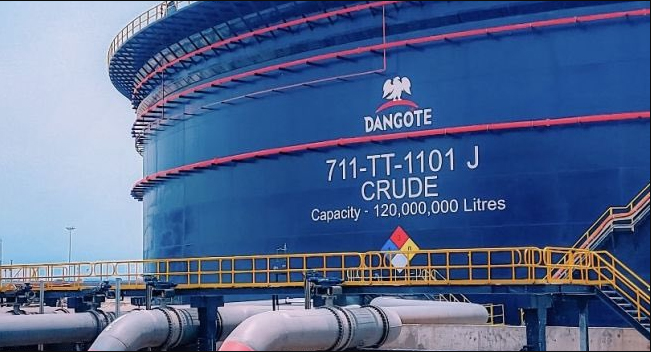
The Dangote refinery now supplies over 61 percent of Nigeria’s petrol, marking the first time in over a year that domestic production has surpassed imports, according to the Nigerian Midstream and Downstream Petroleum Regulatory Authority (NMDPRA).
The regulatory body’s January 2026 ‘State of the Midstream and Downstream Fact Sheet’ reveals that Africa’s largest refinery delivered an average of 40.1 million liters of petrol daily during the month, while imports accounted for just 24.8 million liters per day, representing 38.22 percent of total supply.
This represents a dramatic reversal from January 2025, when Nigeria relied heavily on imported petroleum products to meet domestic demand, a situation that has plagued Africa’s largest oil producer for decades despite its vast crude reserves.
Despite the groundbreaking achievement, the Dangote refinery fell short of its ambitious production target. The $20 billion facility had planned to supply 50 million liters daily but delivered 9.9 million liters less than projected, raising questions about operational challenges at the massive complex.
Nevertheless, the NMDPRA noted significant improvement in the refinery’s output, with production climbing from 32 million liters per day to 40.1 million liters per day during the review period. This increase in domestic refining capacity helped push the total average daily petrol supply to 64.9 million liters in January.
Nigerian consumers utilized an average of 60.2 million liters of petrol daily in January, according to data based on volumes trucked into the domestic market. The figures also show Nigerians consumed 19.2 million liters of diesel and 3.5 million liters of aviation fuel per day during the same period.
The regulator defines domestic supplies as “volumes received into coastal depots plus volumes trucked out from local refineries,” providing a comprehensive picture of the country’s fuel distribution network.
While Dangote dominates petrol production, other domestic refineries are making smaller contributions to Nigeria’s diesel supply. The Waltersmith refinery delivered an average of 124,000 liters of diesel daily, while the Edo refinery and Aradel supplied 55,000 liters and 118,000 liters per day, respectively.
In a curious development, the Port Harcourt refinery—officially reported as shut down—somehow supplied 376,000 liters per day of diesel, a discrepancy that may warrant further clarification from authorities. Meanwhile, the Kaduna and Warri refineries remain closed, continuing a pattern of underperformance that has characterized Nigeria’s state-owned refining infrastructure for years.
The NMDPRA emphasized the broader significance of these developments, stating that the data “underscores Nigeria’s strategic transformation in the energy sector, emphasizing reduced imports, strengthened domestic production, job creation, safety improvements, and economic stability.”
This shift toward domestic refining could have far-reaching implications for Nigeria’s economy, potentially reducing foreign exchange pressure, creating employment opportunities, and enhancing energy security for Africa’s most populous nation. However, the Dangote refinery’s failure to meet its full production capacity suggests challenges remain in achieving complete self-sufficiency in petroleum products.
As Nigeria continues to grapple with economic challenges and energy sector reforms, the performance of domestic refineries in the coming months will be closely watched by industry stakeholders, policymakers, and consumers alike.
WHAT YOU SHOULD KNOW
Nigeria has achieved a historic energy milestone: for the first time in over a year, domestic refining now exceeds fuel imports. The Dangote refinery supplied 61.78% of the country’s petrol in January 2026—delivering 40.1 million liters daily compared to 24.8 million liters from imports.
While this marks a dramatic shift toward energy self-sufficiency for Africa’s largest oil producer, the refinery fell short of its 50-million-liter daily target by nearly 10 million liters, indicating that challenges remain in achieving complete independence from imported petroleum products.
This transformation could significantly reduce foreign exchange pressure and strengthen Nigeria’s economy, but sustained performance will be critical.