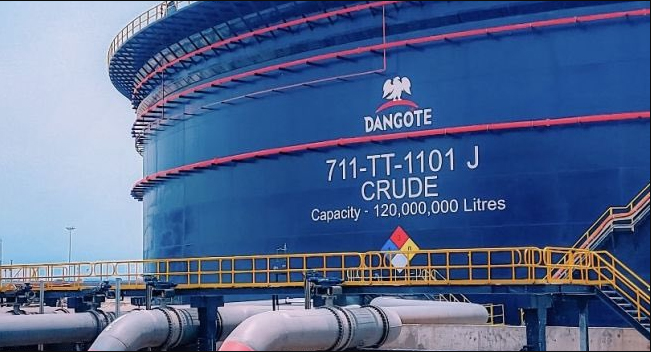
The Dangote Petroleum Refinery announced on Wednesday that it has reached its full designed capacity of 650,000 barrels per day, becoming the first refinery worldwide to achieve such output in a single-train configuration of this magnitude.
The milestone, achieved through optimization of the facility’s Crude Distillation Unit and Motor Spirit production block, comes as Nigeria grapples with decades-long fuel import dependency that has drained foreign reserves and left consumers vulnerable to price volatility and chronic shortages.
The $19 billion complex, located in Lagos’s Lekki Free Zone, has commenced a rigorous 72-hour performance testing protocol in partnership with technology licensor UOP to validate operational efficiency against international benchmarks. The testing phase represents a critical step in confirming the refinery’s ability to sustain peak production under real-world conditions.
“Our teams have demonstrated exceptional precision and expertise in stabilizing both the CDU and MS Block, and we are pleased to see them functioning at optimal efficiency,” said David Bird, Chief Executive Officer of Dangote Refinery. “This performance testing phase enables us to validate the entire plant under real operating conditions.”
Bird emphasized that the naphtha hydrotreater, isomerization unit, and reformer unit are now operating steadily at the facility’s full nameplate capacity, with additional processing units scheduled for Phase 2 performance testing beginning next week.
The refinery’s expanded capacity translates to significant near-term supply increases for Nigeria’s domestic market. According to company disclosures, the facility supplied between 45 and 50 million liters of Premium Motor Spirit daily during the recent festive period. With the CDU and MS Block now fully operational, the refinery projects it can deliver up to 75 million liters of PMS daily—a substantial boost to domestic fuel availability.
Energy analysts project the refinery’s full operation could fundamentally reshape Nigeria’s economic profile. The facility is expected to eliminate the need to import over 80% of refined petroleum products, a dependency that has cost Africa’s largest economy billions in foreign exchange annually.
Conservative estimates suggest the refinery could save Nigeria up to $10 billion per year in forex expenditures while generating thousands of direct and indirect employment opportunities. The reduced import burden is also anticipated to strengthen the naira and enhance regional energy security across West Africa.
“This is more than just a refinery coming online; it’s a strategic asset that repositions Nigeria from a net importer to a potential net exporter of refined products,” said one Lagos-based energy economist who requested anonymity. “The downstream effects on currency stability, employment, and industrial development could be transformative.”
Beyond fuel production, the Dangote complex is designed to catalyze downstream industrial growth, particularly in petrochemicals and fertilizer manufacturing. The integrated facility’s operations are expected to provide raw materials for plastics, pharmaceuticals, and agricultural inputs, with multiplier effects throughout Nigeria’s economy.
The refinery’s success also carries symbolic weight for African industrialization efforts. Built entirely with private capital by Nigerian billionaire Aliko Dangote, the facility challenges longstanding narratives about the continent’s capacity to develop world-class industrial infrastructure.
Despite the milestone, significant challenges remain. Nigeria’s complex fuel subsidy regime, distribution logistics, and regulatory framework will all play critical roles in determining whether the refinery’s capacity translates into stable, affordable fuel for consumers.
Questions also persist about crude oil supply arrangements, given Nigeria’s ongoing production challenges and OPEC quota constraints. The refinery’s ability to source sufficient feedstock at competitive prices will be essential to sustained operations.
Nevertheless, Wednesday’s announcement marks a tangible step toward energy self-sufficiency for a nation that has long endured the paradox of being Africa’s largest oil producer while importing the majority of its refined petroleum products.
“This milestone underscores the strength, reliability, and engineering quality that define our operations,” Bird stated. “We remain committed to producing high-quality refined products that will transform Nigeria’s energy landscape, eliminate import dependence, and position the nation as a net exporter of petroleum products.”
As the 72-hour performance tests continue, industry stakeholders across West Africa will be watching closely to see whether the Dangote Refinery can deliver on its promise to end Nigeria’s fuel import era and potentially reshape the region’s energy dynamics for decades to come.
WHAT YOU SHOULD KNOW
The Dangote Refinery has achieved a full capacity of 650,000 barrels per day, making it the world’s largest single-train refinery and potentially ending Nigeria’s decades-long dependence on imported fuel.
This milestone could save Nigeria up to $10 billion annually in foreign exchange, stabilize fuel prices, eliminate chronic shortages, and transform Africa’s biggest oil producer from a net importer to a potential exporter of refined petroleum products.
The refinery can now supply up to 75 million liters of petrol daily to the domestic market, marking a turning point for Nigerian energy independence and economic stability.